CTRIP provides a variety of student housing options
Jim Fall
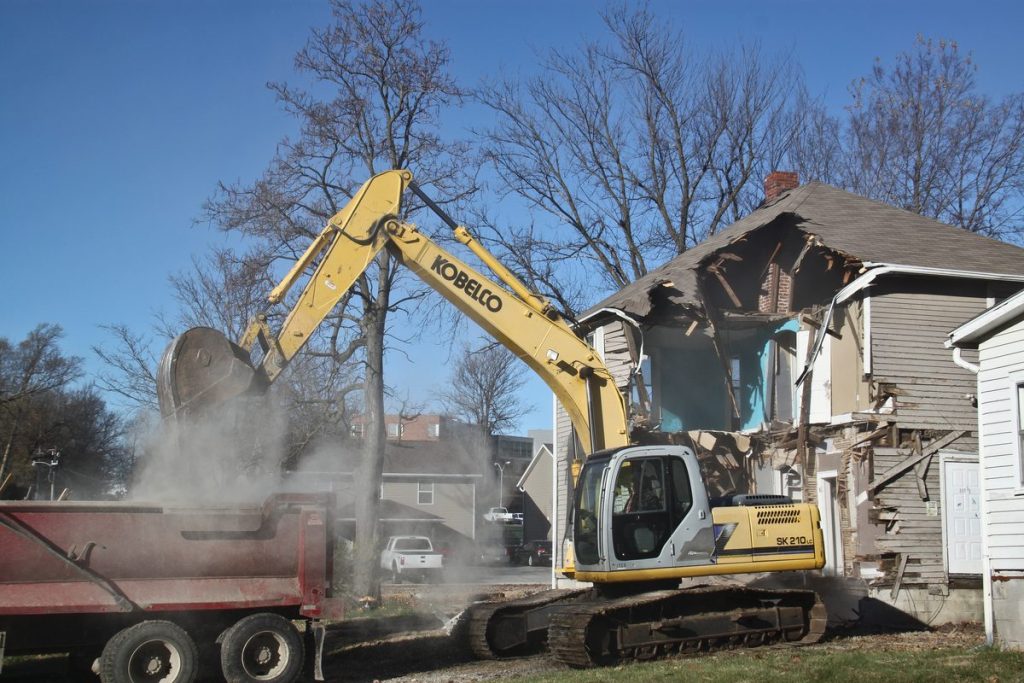
Demolition crews razed a former student rental property adjacent to Peach Creek on West Fifth Street the week before Thanksgiving as part of the Campus Town Redevelopment Program. The CTRIP has resulted in the removal of approximately 30 houses since the program’s inception in 2013, resulting in a significant increase in local property tax revenues.
By JENNIFER DITLEVSON
HAGLUND
Staff Writer
Since the Campus Town Redevelopment Program began in 2013, Maryville has continued seeing economic growth and increased tax revenues.
The program has also provided Northwest Missouri State University students more variety in housing options.
CTRIP started as a means of removing dangerous structures from the city and also to encourage development in what the Maryville City Council defined as the campus overlay area. This area is located primarily east of the Northwest campus, west of Main Street and it currently houses hundreds of Northwest students.
Julie Tobin, co-owner of Shirley’s Realty, said she has seen quite a change in the last couple years.
“A lot of rentals are geared toward students, and unfortunately in the past a lot of landlords did capitalize on renting them without doing the improvements a landlord should do regularly,” Tobin said. “I have seen a tremendous improvement in upkeep by landlords in recent years.”
According to City Manager Greg McDanel, Maryville has had a problem with absentee landlords.
“We just have to continue to deal with it,” he said. “There’s not a silver bullet for the issue.”
CTRIP, however, is supposed to help resolve the problem.
Property owners of substandard or dilapidated structures can apply for CTRIP assistance that eliminates tipping fees up to $20,000 for demolition debris from within the geographic boundaries of Campus Town.
In addition, landowners may be granted a waiver for redevelopment permit fees.
“The $8,000 to $15,000 isn’t monumental, but it’s an incentive they’ve never had before,” McDanel said.
Julie Tobin and her husband, Kurt, took advantage of the incentive to build rental properties on the 800 block of North Walnut. She said she was surprised at how quickly they filled the units merely based on the floor plan. The Tobins said they have watched how in recent years students and their parents are willing to pay more for updated living spaces.
“I really do feel that student housing is improving because they’re trying to get rid of the unsafe properties that probably aren’t suitable for college students,” Julie Tobin said. “If they’re not safe for a family, they’re not safe for a college student.”
Julie said that in years past, students would rent in big groups outside the generally designated student housing zones because they wanted something nicer than what was available closer to campus.
“Location is key,” said Northwest senior Kaeleigh Hernandez.
Hernandez lives in a new unit that the Tobins finished building in May.
“It was nice when I saw all the people scraping their windows this morning and I knew I didn’t have to get up any earlier,” said Northwest senior Alexandria Park, who lives with Hernandez.
Park and Hernandez said they were looking for new units because they wanted to be sure everything worked and would be clean. Both of them had previously lived on campus.
Updated housing also increases the possibility for more economical bills with more efficient heating and cooling.
“I think all my friends have a gas bill, and we don’t,” Park said.
In 2012, CTRIP was approved for a two-year trial basis as a part of the city’s comprehensive plan. It was renewed in February because council members wanted to allow more time for further development under the incentives.
McDanel said CTRIP has made a significant impact on the community’s tax base. Properties previously assessed to generate $2,500 per year are now returning $25,000 in annual tax revenues to city coffers.
Approximately 75 percent of real property tax revenue goes to the school district, and the rest is divided between the city and county, McDanel said.
McDanel said it might get to a point where the city council would not want to incentivize the construction of rental homes. When McDanel started with the program, there were 30 homes on the demolition list. Since then, he said, almost all of them have been removed.
“We’re going to get to a point in the community sooner rather than later when we’ve removed all those (structures) that are really considered unsafe and dangerous and we’re going to have to target a secondary group of houses that maybe, instead of demolition, there’s some incentivized program for repair,” McDanel said.
Moving forward, McDanel said he expects there will be conversations in early 2016 focusing on the rehabilitation of properties.
Another potential avenue for an expansion of the program would include a focus on the downtown area, having ground-floor retail and second-floor living spaces.
Jim Fall
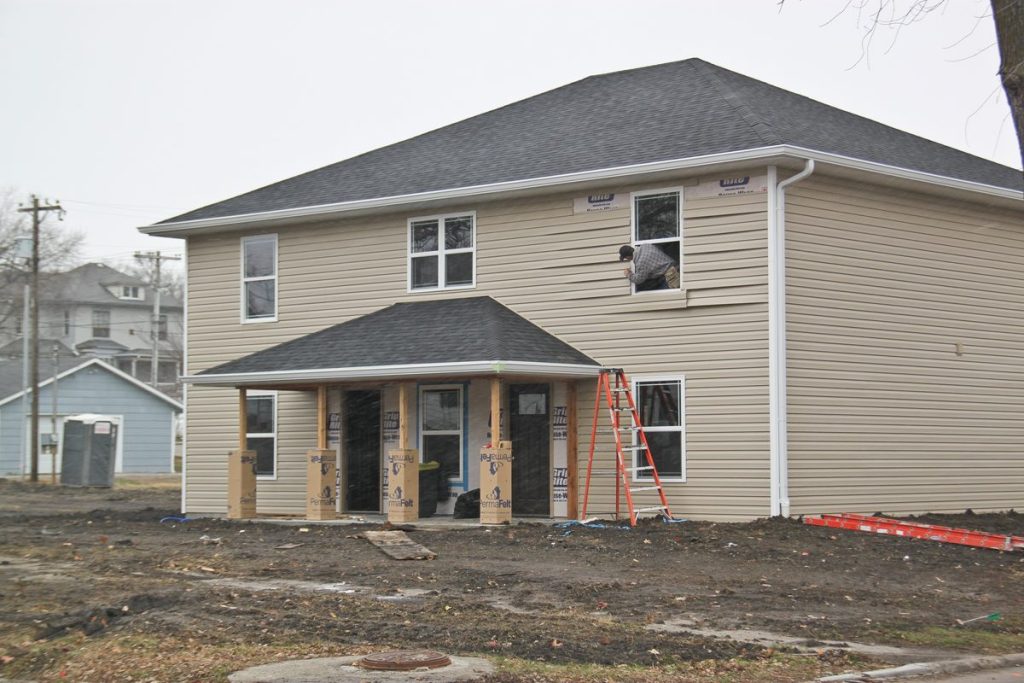
Workmen Tuesday were installing windows in new multi-unit housing under construction near the intersection of Fifth and Walnut streets in Maryville’s Campus Town zoning district. The city’s Campus Town Redevelopment Program has resulted in the removal of some 30 “unsafe and dangerous structures” since its inception in 2013. Most of the resulting redevelopment is focused on providing improved student housing.