Sales tax plans proposed to finance conference center
TONY BROWN/DAILY FORUM
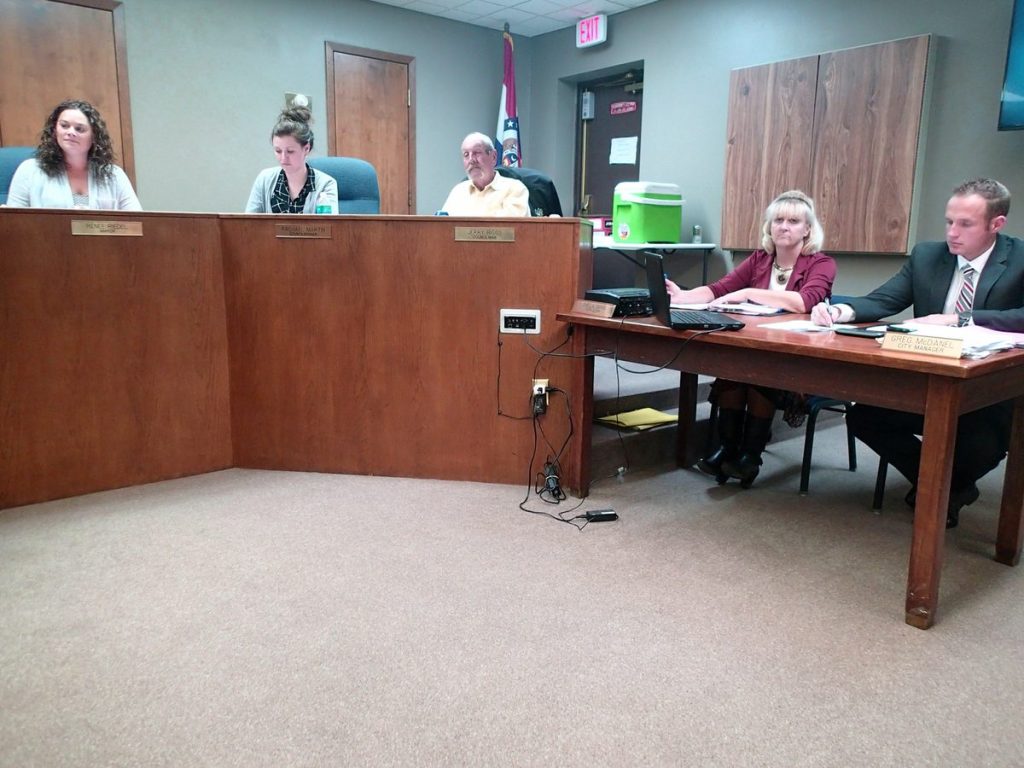
Members of the Maryville City Council met this week to consider sales tax proposals related to financing a proposed conference center at Mozingo Lake Recreation Park. Pictured from left are Mayor Renee Riedel, Council Member Rachael Martin, Council Member Jerry Riggs, City Clerk Sheila Smail and City Manager Greg McDanel.
The Maryville City Council reviewed options for financing a proposed $4 million conference center at Mozingo Lake Recreation Park this week during an hour-long special session prior to its regular Monday meeting.
City Manager Greg McDanel gave essentially the same presentation he offered Nov. 2 to the Mozingo Lake Advisory Board, which declined to voice support for a particular strategy. On Monday, the council also took several options under advisement without providing additional direction to staff.
The issue will go back before the Advisory Board at its next meeting on Nov. 16 and then return to the council for a final decision.
At stake is which of several sales tax options will be presented to voters for approval, probably on the April 2016 municipal election ballot.
The council has declared building the conference center to be one of its top priorities, but McDanel said rejection at the polls of either a new quarter-cent or eighth-of-a-cent sales tax could spell the end of efforts to construct the facility.
Exactly how those taxes will be used to finance the center, and how long they will be collected, are questions the city must answer before formulating the language that will appear on the ballot.
Another issue proposed for the April election is a proposed 20-year extension of the existing half-cent Mozingo sales tax, set to expire in 2017, that accounts for roughly half of the park’s $1.9 million annual budget.
Inclusion on the ballot of two Mozingo-related tax measures makes what the city wants voters to consider next spring seem a little complicated, and McDanel said it is important for citizens to understand that distinct issues are at stake: keeping services and facilities at Mozingo operating at existing levels and building the conference center.
Regardless of what the voters decide, however, McDanel said a privately financed plan to build a 40-unit hotel at the 3,000-acre park will almost certainly move forward.
Though envisioned as adjoining facilities whose functions compliment each other, McDanel said market research indicates that “the hotel can survive without the conference center, but the conference center does not survive without the hotel.”
If built, the center is envisioned as containing dining and banquet facilities, meeting rooms, and a clubhouse serving both the Sechrest 18 and Watson 9 golf courses.
As things stand now, the city plans to place one of three sales tax measures before voters in addition to the existing half-cent levy renewal. A fourth option, which McDanel said is probably not viable without increases in park user fees and cuts to Mozingo operations and development, would be financing the center through a combination of existing revenues, grants, naming rights, and fundraising.
Whether or not the existing tax is used to construct a conference center, McDanel said, its renewal is essential to Mozingo continuing to provide current levels of service to both local patrons and tourists.
That means voters will also be asked, in all likelihood, to choose, or reject, one of the following options for financing the new center:
First, a quarter-cent sales tax collected over 20 years that would raise the combined sales tax levy for Maryville shoppers from 8.475 cents on the dollar to 8.725 cents. This amount would drop to 8.6 cents when a tax levy currently collected to service debt acquired to pay for construction of the Maryville Community Center disappears in 2021.
The new tax would service the debt on a $3 million bond issue, which would be used to build the center in conjunction with a zero-interest $1 million Rural Economic Development Loan through the U.S. Department of Agriculture.
A second option calls for an eighth-of-a-cent sales tax to be collected over 30 years, which means the total Maryville sales tax levy would revert from 8.6 cents to its existing level of 8.474 cents when the Community Center levy comes off the books.
Thirdly, McDanel asked the council to consider and eighth-of-a-cent tax for 20 years, a shorter term that he believes might be more acceptable to voters.
The drawback for this option, McDanel said, is that tax revenues would cover only 77 percent of the debt service on funds borrowed to build the center.
While that kind of shortfall is normally the kind of thing that makes city councils uncomfortable, McDanel pointed out that debt acquired to build cart paths at the Sechrest 18 golf course will be paid off in June 2017. Those funds, he said, which come from existing revenue sources, would be sufficient to make up the difference, assuming the existing half-cent Mozingo sales tax is renewed.
In framing the argument for why the conference center is justified, McDanel drew comparisons to a similar publicly owned facility in Denison, Iowa, built near a golf course hotel operated by Boulders Inn & Suites, the same company that wants to operate a lodge at Mozingo.
Located in a similar off-the-interstate rural community, McDanel said the facility has a “break even” annual budget of between $220,00 and $250,000 and hosts an average of 250 events a year.
McDanel said he believes similar volume could be achieved at Mozingo, which receives requests for wedding receptions, meetings, and other gatherings on “almost a daily basis.”
Assistant City Manager Ryan Heiland added that he was “excited” about the “synergy” that could be achieved by the existence of a hotel, conference center, golf courses, Mozingo youth camp, and the nearby Mozingo Outdoor Education Recreation Area operated by Northwest Missouri State University.
While council members appeared supportive of staff efforts to justify the center, Councilman Jerry Riggs urged his fellow governing board members to make sure they are “comfortable” with any plan in which revenues were projected to fall short of fiscal obligations.
Mayor Renee Riedel warned her colleagues that they were on the cusp of a big decision, and wondered aloud if a vote on a conference center tax might hurt the chances for renewal of the existing half-cent Mozingo operating levy.
“We need to be very confident about the decision that we make because we are going to be a part of the sales team,” Riedel said.