Landlord seeks to revive barbershop culture
Jennifer Ditlevson Haglund
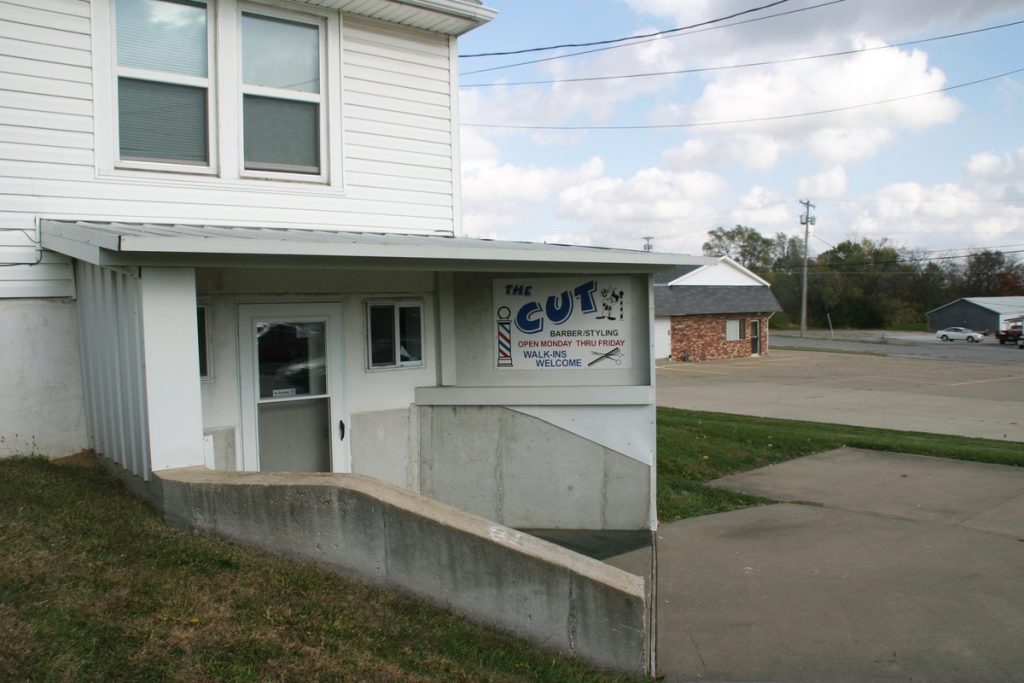
At the corner of N. Main and W. 16th Streets, The Cut currently stands vacant, as Capt. Tamir Middleton of Maryville searches for a resident barber. Middleton said he would like to rent this property to someone who shares his vision of carrying on the barbershop tradition in the next generation.
Capt. Tamir Middleton of Maryville remembers going to the barbershop with his dad when he was young, and he said they didn’t go just for haircuts. For them, it was father–son bonding time and a place they could be with other men.
When he moved to Maryville and started in the rental business, Middleton got an idea. He owns the building at 117 West 16th Street. Instead of renting the whole house, he started a new venture.
“All of a sudden with 117, I had an epiphany. We could have a barbershop here,” Middleton said.
In the summer of 2014, Middleton and some of his friends transformed the downstairs of the property into a barbershop.
Middleton is trying to keep the barbershop tradition going, but it hasn’t been easy.
For two months, Middleton rented the shop to an individual, but he paused the enterprise due to conflicts of interest with the person. Now that they are no longer partners, Middleton is looking for another licensed barber.
Middleton wants to find someone who can cut all types of hair, someone who is personable, and self-motivated. He wants to keep it simple, not selling anything but haircuts and atmosphere.
“You go in there and get a haircut. While you’re there, you’re going to watch a ball game and talk about the news,” Middleton said.
If Middleton doesn’t find a good fit within the next few months, he will sell the barber equipment and turn the downstairs into another room to rent. Someone who shares his vision of bringing the barbershop experience to the younger generation would be ideal.
“But I’m not holding my breath,” Middleton said.
Attracting and keeping customers in a barbershop, however, hasn’t been easy for a long time.
Fred Robertson, who works at Downing’s Barbershop on Market Street, has been cutting men’s hair for 48 years. He practiced right through the shaggy-haired days of Beatlemania and the long hippie hair.
In those days, he said, it was hard to stay in business and many barbers left their craft to find income by driving trucks and working in factories.
Since then, the industry has changed because several schools offer a dual license, blending cosmetology and barbering. Although this makes stylists more flexible, Robertson said this has done a disservice to the barbershop culture because it spreads people too thin.
“I still feel, and always will, that the barbershop is a place for people to come and feel welcome and to get their hair cut and catch up with their neighbor that’s in the farm or business right next to him,” Robertson said.
According to Robertson, it’s not just the industry that has changed. Robertson said he sees people more interested in their phones than having a conversation.
Gary Greeley, who owns Gary’s Barbershop and has been cutting hair in Maryville for 43 years, said he’s seen some of the same changes.
“Everybody’s living such a fast-paced life,” Greeley said. “I think that’s probably the biggest reason. They just want to get in and get out. People need to start smelling the roses a little bit more.”
Also, Greeley said when he started his apprenticeship in 1972 in Elmo, barbers would give a dozen straight-edge shaves before they gave a haircut. In the past 25 years, Greeley hasn’t given a single shave because people quit requesting them.
Every once in awhile, Greeley will get a call for the service, but he’s gotten rid of all the equipment for it.
Despite the difficulties of the industry, both Greeley and Robertson have repeat customers for years. Greeley said he cuts hair for a family through four generations. Tuesday, he cut the great-grandfather’s hair. The man is in his late nineties.
As Northwest Missouri State University continues to draw a more racially diverse student body, the barbers in town admitted to facing a welcome learning curve.
“There is a difference in cutting hair. It lays different. It grows different,” Greeley said.
Middleton said he struggled knowing where to go for a haircut when he came to town. He informally surveyed other men in the area, asking workers at Wal-Mart and Casey’s General Store where they went. Of the two examples he gave, both men traveled outside town. One even went as far as Kansas City.
Robertson recalled several years ago speaking with a young man who was skeptical about Robertson’s ability to cut his hair because he is white. After 20 minutes, Robertson told the man he couldn’t cut his hair over the phone and invited him to visit his shop. Five years later, the man was still coming back for haircuts.
Still, some requests from clients are becoming more complicated. Greeley has had customers requesting straightening and dye jobs that he wasn’t trained to do in barber school.
Robertson said that the requests push him to broaden his services and build relationships with customers.
“If they hang with me, I’ll try to learn any and all of it,” Robertson said.
Learning how to meet the needs of a growing diverse population, Middleton said, could help to preserve the barbershop tradition.
“It doesn’t mean you’re black, you’re white, you’re Indian, you’re white, you’re Egyptian, you’re blue, you’re green. It doesn’t matter,” Middleton said. “You want someone who can cut your hair regardless.”
Reviving the barbershop culture, Greeley said, is possible.
“But it isn’t going to come back fast,” he said.
Part of it, Greeley said, is due to trust. New barbers have to earn the confidence of their clients. When Greeley started in Maryville, he said there hadn’t been a new barber in the area for eight years. He and Robertson said they had to build that over time.