Body art trend blossoms for teens
JENNIFER DITLEVSON HAGLUND/DAILY FORUM
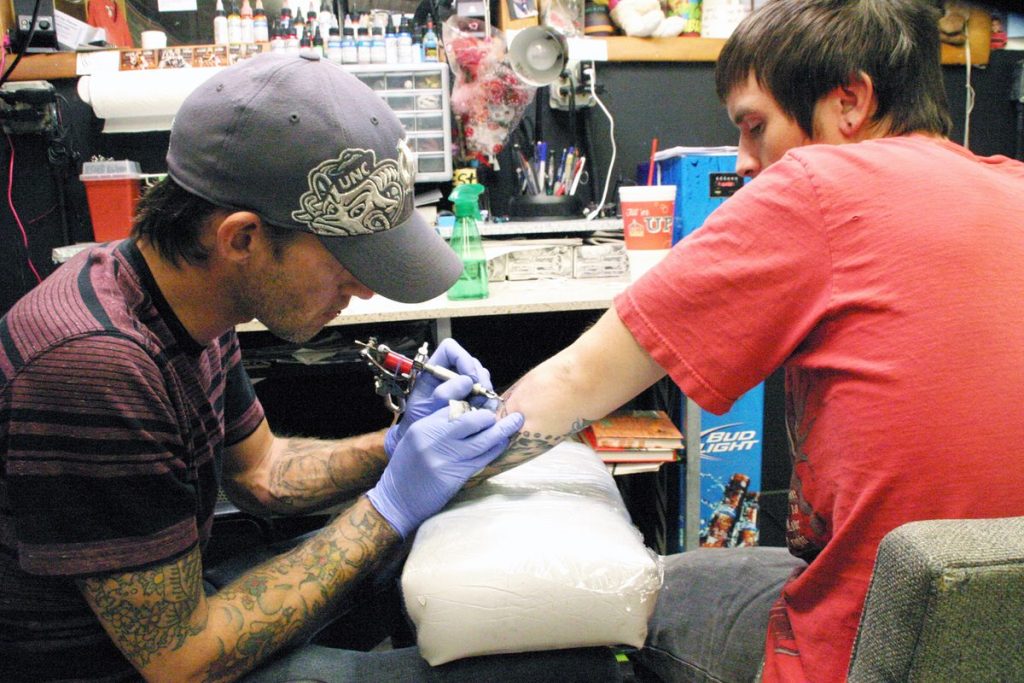
Tattoo artist and owner of WestSide Tattoo & Body Piercing Greg Brumley inks a skull design for Jimmy Heimen, 22, of Maryville. Heimen and his sister have a running competition, and he’s winning with 19 tattoos after Saturday’s addition.
Sitting on a couch, Jossye Herrada, 16, scrolled through designs of flowers on her phone to find the right one for her first tattoo. It was her birthday present, and she’d been thinking about it for two years.
Even though she thought through her decision, she said she was a little nervous about the pain.
Herrada’s mother, Inez Lleras, took her to WestSide Tattoo & Body Piercing on Fifth Street for the ink. Lleras has 18 tattoos that she got when she was 18 and living in Florida hanging out at her friends’ tattoo parlor. Since then, she has only touched up a few of them. The mother and daughter came to Maryville from St. Joseph because they had heard about the establishment from Llera’s niece.
Owner of West Side Tattoo & Body Piercing Greg Brumley said he’s giving more tattoos to minors these days.
“We do every minor around now because no other shop is doing them,” Brumley said.
Brumley said his shop attracts so much business from minors because many other tattoo artists in town operate from their homes, which isn’t as safe as going to someone with a license.
“You might be getting a good tattoo, but you might be getting something else along with it,” said Kirk Poppa, who works in the shop with Brumley.
With the consent of a legal guardian, Brumley and Poppa could tattoo a first grader, but they won’t. Brumley said he’ll tattoo at 16 and pierce at 15, even though he didn’t allow his son to get a tattoo until he was 18.
Working with parents, Brumley said, is part of the process. Sometimes the child will want something the parents don’t, and from there it’s trying to find something suitable.
“If it’s something dumb, I’ll let them know,” Brumley said.
Brumley pointed to the media as one reason for the influx of minors and young adults coming in for body art. He also suggested the trend may be due, in part, to the decreasing stigma attached to tattoos because of television shows like “Bad Ink,” “Ink Master,” “Black Ink Crew,” and “Inked.”
“It’s actually brought in people’s ideas of what they get,” Poppa said “You’re almost in the minority if you don’t have one.”
According to a Harris poll from 2012, one in five adults in the United States has a tattoo. The Pew Research Center reported two years before that close to 40 percent of adults between the 18 and 29 had at least one tattoo.
“And it’s not going away,” Brumley said.
Increasing numbers of people with tattoos naturally means more business, especially when, according to the Pew Research survey, half the people with tattoos come back for more. In 2010, 18 percent of those with tattoos had at least six.
Neither Brumley nor Poppa can count how many tattoos they have. They said it’s hard to keep track when you use your body for practice.
For the millennial generation, those born between 1980 and 2000, tattoos don’t necessarily have to have meaning. Sometimes they just need to look good. Harrada said she chose her flowers because they added beauty to her body.
“We’re to the point now where people just like tattoos,” Poppa said. “If you like it, you get it.”
In the last year, clients have brought in requests that Brumley said are a little behind the trends on the east and west coasts. Popular designs include living dead girls inspired by the Day of the Dead festival and watercolor tattoos. Some traditional tattoo art, Poppa said, is also making a comeback.
When tattoos carry meaning, Brumley and Poppa said they appreciate having the ability to help people make a statement.
Both tattoo artists said they have worked on people who struggled with self injury and wanted a way to cover their scars.
“For something that was such a dark time for them, they’ve got something beautiful to cover it up,” Poppa said.
When Northwest Missouri State University hosted events for the #IWillListen campaign, which seeks to raise awareness about mental health issues, two weeks ago, WestSide Tattoo offered semicolon tattoos at a discount.
The semicolon symbolizes a turning point when people could have chosen to end their lives but didn’t. It comes from a common grammatical practice. When writers choose to use a semicolon instead of a period, they don’t end the sentence; they add a clause.
“It shows, ‘This is a chapter of my life, but my life will continue,’” Poppa said.
In two days, the two artists served 43 people who wanted the tattoo. They estimated that they donated about $300 for a fundraiser for suicide prevention.
Giving memorial tattoos also deepens the experience for the artists because they inevitably share stories while using their skills to draw portraits.
“I love doing pieces for people who want to remember somebody,” Brumley said.
Brumley recently lost a good friend, and said he will be tattooing the man’s portrait on the daughters now grieving the loss of their father.
JENNIFER DITLEVSON HAGLUND/DAILY FORUM
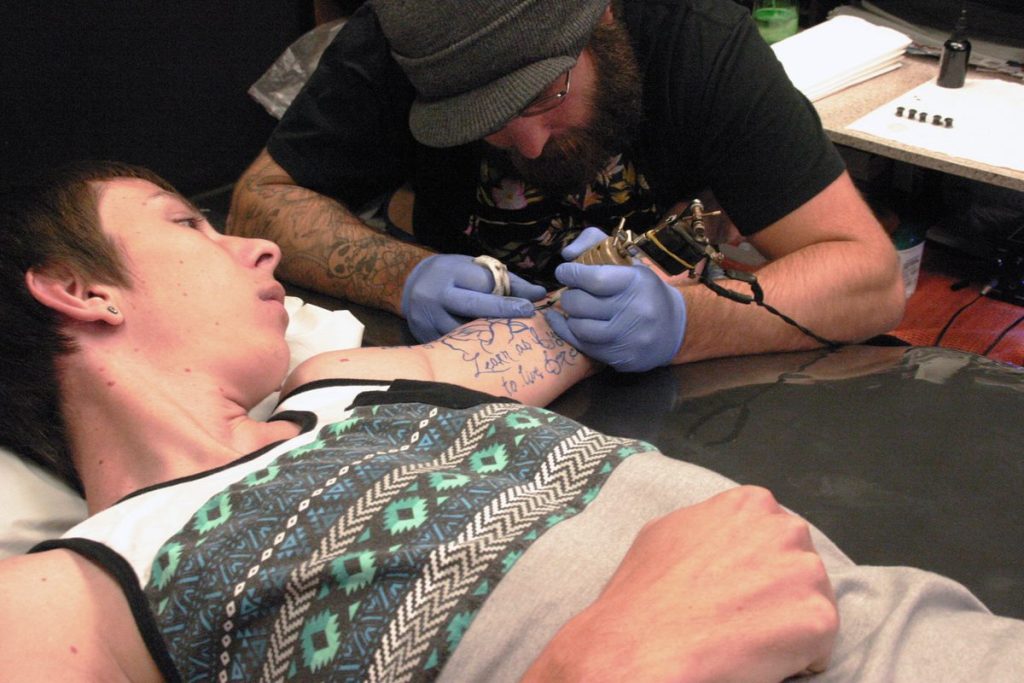
Tyler Harper, 21, of Maryville couldn’t remember which number of tattoo this was for him as artist Kirk Poppa worked on this design. After taking inventory, Harper discovered he was on number seven.