Program provides support, education
Jennifer Ditlevson Haglund
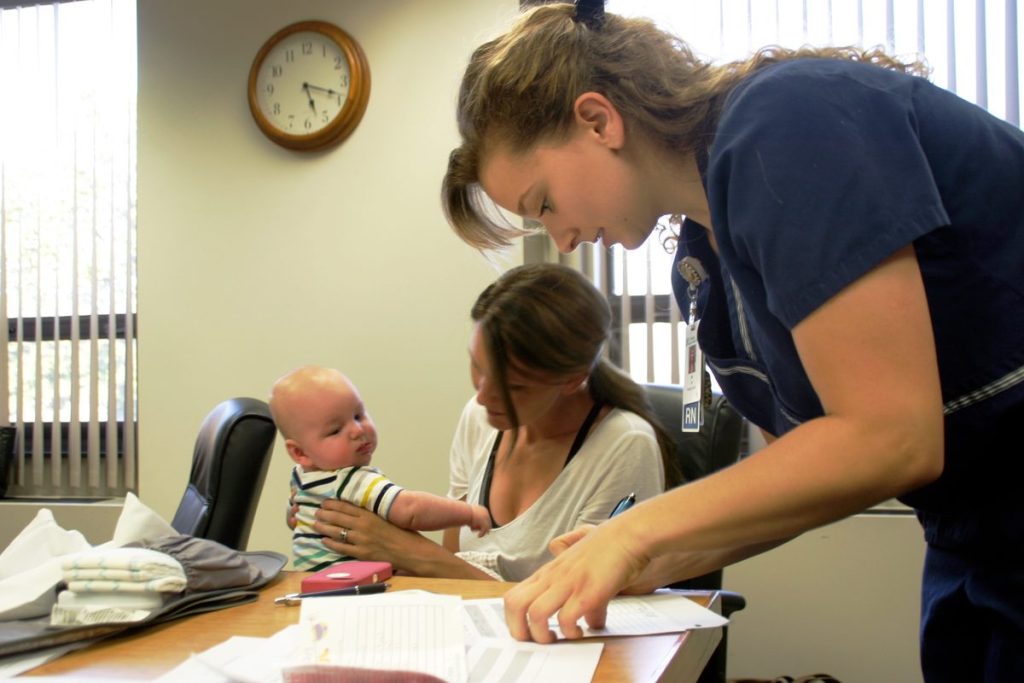
Obstetrics nurse Ali Ackman records the progress of Valor Nashleanas, age four months. Valor’s mother, Tierney Nashleanas, said the infant h as been steadily gaining a half-pound each.
At SSM Health St. Francis Hospital, visitors can hear the action in the boardroom all the way down the hall on Monday evenings — and on Mothering Mondays, it’s not just business as usual.
Around the big table, nearly a dozen mothers hold their infants or try to bar them from escaping out the door.
“I guess you could technically consider it a support group, but it’s more of a mommy mixer,” Katie Skaggs said.
Skaggs, a certified lactation consultant and obstetrics nurse at St. Francis, started Mothering Mondays with a small group of interested mothers less than two years ago.
Before the hospital hosted Mothering Mondays, there had been a La Leche League International group in town. But when it quit meeting, with the nearest similar organization gathering in St. Joseph, Skaggs saw the need for a mother’s group in Maryville.
“We go through enough judgment,” Skaggs said. “It’s nice to have people around you who are going through the same thing.”
One of the group’s founding mothers, Deanna Manderick, participated on Monday. Manderick started attending the sessions when it was only herself, Samantha Wray, and Skaggs.
Now, several new mothers cite Manderick and Wray as mentors.
Amy Gessert said Wray helped her through her son’s colic with helpful suggestions.
According to the Centers for Disease Control and Prevention, more mothers choose to breastfeed their infants now than they did 15 years ago. Last year, 49.4 percent of mothers were still breastfeeding at six months, which is up from 35 percent in 2000.
Skaggs said she is seeing a greater percentage of mothers choosing to breastfeed because they are better educated about the health benefits. But education doesn’t always translate to practical knowledge, and that is where Skaggs comes in.
“Breastfeeding wasn’t the norm when our parents and moms were raising us, and we didn’t get the education,” she said.
Mothers who breastfeed often wonder if their children are getting enough food because they can’t see how much milk the infants consume.
At the meetings, women can weigh their infants before and after feedings so they don’t have to wait for scheduled doctor visits.
“It is reassuring,” Manderick said. “You know they’re getting nourishment.”
Amber Hanna brought her 9-month-old daughter Brynlee on Monday so she could record the child’s length and weight.
“And just to get to visit,” Hanna said.
As the number of breastfeeding moms continues to increase, more women are seeking out lactation support groups and Internet-based mommy blogs where they can get their questions answered.
Manderick said many of the women in the Maryville group use online discussion boards and secret groups on Facebook to find like-minded moms. They say it’s a safe place to say all the things they might be afraid to ask in an open forum.
There’s even an online group called The Night Hooters dedicated to women who stay up late to feed their infants.
“There’s not such a thing as TMI (web-speak for ‘too much information’),” Manderick said. “What did moms do before Facebook?”
Brittany Mitchell said that although these online groups help, she finds Mothering Mondays useful.
“Here, you’re not talking behind a screen,” Mitchell said.
“Other than the Internet, this was my only resource,” said Gessert.
Mothering Mondays isn’t just about information. Gessert said she began coming to the group because her husband is an only child, and she didn’t have any sisters living nearby to help her.
“I needed the moms. I needed mom friends,” Gessert said.
Women who attend the group breastfeed their children, but Skaggs said she wants people to know this isn’t strictly a breastfeeding group.
“I have said this to moms before,” she said. “Breastfeeding, ideally, it would be for everybody and every baby, but it’s not. There’s no one-size-fits-all. It’s very personal, and I’m here to say [these women] deserve support.”
The group doesn’t have set discussion topics. Although much of the conversation focuses on breastfeeding issues, the group gives mothers the opportunity to talk about anything with each other.
According to Skaggs, women sometimes ask questions about such parenting issues as cloth diapering and babywearing, the practice of wearing or carrying babies in a sling or carrier.
Heather Schieber’s son Jackson Campbell is only 2 months old, but she said he’s a “textbook baby so far.”
For Schieber, the value of the group lies in building a network for future parenting issues. While everything is fine for now, she anticipates problems with teething and other areas that childcare classes at the hospital didn’t cover.
Mothering Mondays meets in the boardroom at SSM Health St. Francis Hospital from 4:30 to 6:30 p.m.