Agronomist reaches out to Ethiopian farmers
GEORGE KEGODE PHOTO
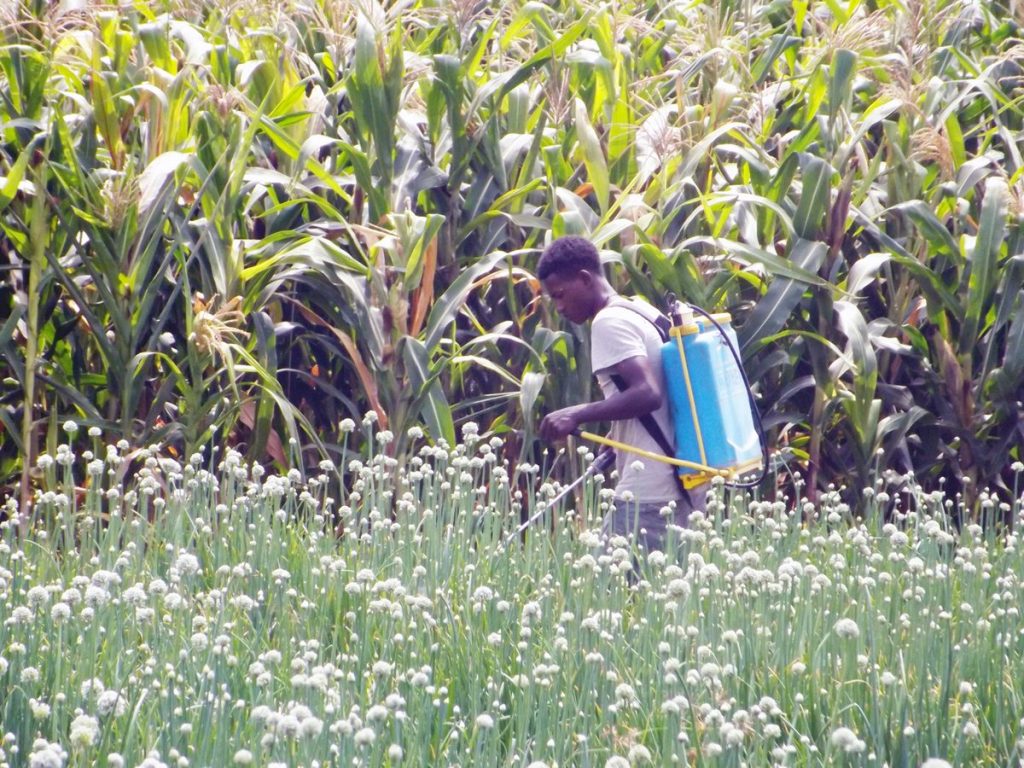
A farmer sprays fungicide on crops in a field near Addis Ababa, Ethiopia, in an attempt to prevent the onset of powdery mildew. Most rural farmers in the eastern African nation apply agriculture chemicals using backpack sprayers.
George Kegode, an agriculture and food security consultant from Maryville, recently returned home from Ethiopia where he spent three weeks evaluating pesticide safety for the Farmer to Farmer program funded through the U.S. Agency for International Development.
Kegode, who served on the Northwest Missouri State University agriculture faculty from 2006-2014, undertook the assignment at the invitation of Catholic Relief Services, which partnered with Farmer to Farmer in an effort to promotes economic growth, food security, and agricultural development in eastern Africa.
Back in 2011, Kegode accepted a similar assignment in Malawi in southeastern Africa, where he did horticultural work focusing on vegetable crop rotation and sequencing designed to maintain supply while limiting excess production leading to spoilage.
He characterized his most recent trip as a fact-finding mission to discover how poor, rural farmers use pesticides in hopes that strategies can be devised that will allow those farmers to employ agriculture chemicals safely and efficiently.
“One of the takeaways was that a lot of pesticide is coming in (to Ethiopia) and is being used,” Kegode said. “But the farmers know little or nothing about these chemicals except that they may be able to solve their problem.”
Kegode added that many farmers are using pesticides without the equipment or knowledge needed to properly calibrate application levels. In addition, growers commonly lack basic safety gear such as goggles and gloves.
“As the world is faced with the need to continually increase food production, pesticide use has become widespread,” he said. “It is now common to find peasant farmers in rural Africa using pesticides without fully understanding the risks to their health or the environment.
“The opportunity to use my expertise to help improve the safe use of pesticides is deeply fulfilling and rewarding, especially when it elicits a behavior change among farmers.”
In Ethiopia, Kegode worked with eight host organizations in conducting an assessment of pesticide safety during the “Ethiopian pesticide lifecycle,” which includes policy implementation, purchase, transport, use, and disposal.
The assignment was one of nearly 500 such Farmer to Farmer missions focusing on agriculture, food security, and nutrition in Ethiopia, Tanzania, Kenya, and Uganda. This is the first time Catholic Relief Services has been involved with the 28-year-old federal Farmer-to-Farmer program.
Other institutions suporting the effort include the National Catholic Rural Life Conference, Foods Resource Bank, National Association of Agricultural Educators, American Agri-Women, and the University of Illinois’ College of Agricultural, Consumer, and Environmental Sciences.
Missions undertaken by scientists and researchers like Kegode, whose expenses are covered by USAID, last from one to six weeks.
“One thing we are certain of is that this program will be beneficial not just to the farmers in East Africa, but also to the volunteers from America,” said Catholic Relief Services’ Bruce White, who directs the program. “It’s going to make the world a little bit smaller for everyone involved.”

George Kegode