Young scientists draw cookie conclusions
TONY BROWN/DAILY FORUM
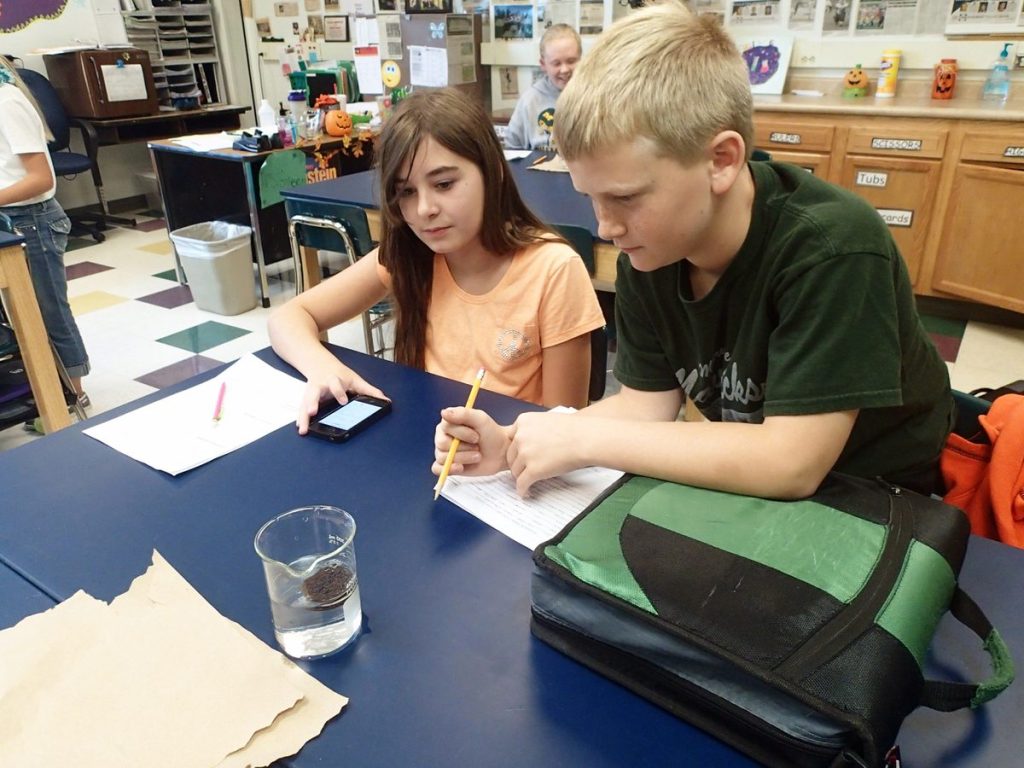
Kelsey Bailey, left, and Clay Pritzel, members of Chelli Green’s sixth-grade science class this semester at Maryville Middle School, wait for an original-recipe Oreo Cookie to sink to the bottom of a beaker filled with water. The children were carrying out an “inquiry lab” assignment that led them through the process of asking a “testable question,” forming a hypothesis, conducting an experiment to determine the buoyancy of different varieties of Oreos, and recording their findings.
So what’s the best way to learn about the scientific method? Conduct an experiment, of course.
And if the experiment happens to taste good? Well, so much the better.
Students in Chelli Green’s 6th-grade science class on Tuesday honed their laboratory skills by testing the buoyancy characteristics of one of America’s favorite sweet treats — Oreo cookies.
That’s right.
The idea wasn’t to determine how the cookie crumbles, but rather how it floats.
Actually there was no particular reason to conduct an experiment using Oreos, other than that Nabisco produces them in a number of varieties likely to display variable properties when the cream-filled sandwich wafers are placed in a glass of water.
Well, that, and a general consensus that Oreos taste good.
In fact one of the steps in the students’ lengthy list of lab protocols was “eat a cookie if desired.”
But the light-hearted — some might say sugarcoated — experiment had a serious purpose: teaching children how scientists ask questions about the natural world and then organize processes that enable them to go about finding the answers.
Green said the Oreo experiment took the form of a “testable question” explored within the context of an “inquiry lab.”
The question in this case, Green said, was, “Does the type of Oreo affect the time it takes to sink?”
When scientists pose questions like that, she said, they often seek solutions by comparing an “independent variable,” in this case four different kinds of Oreo cookies, with a “dependent variable,” say the time it takes each variety of cookie to sink to the bottom of a beaker of water.
Green admitted that results from the experiment might have been more satisfying, at least from a taste standpoint, had the class been able to use milk instead of water. “But milk,” she pointed out, “costs money.”
And so several dozen perfectly delicious cookies were sacrificed in the name of science, though enough were left over for a nice snack.
After coming up with their variables, the students formed a number of hypotheses, several of which posited something like, “Double-stuffed Oreos will sink faster because they are the heaviest.”
Then, using an original-style Oreo as the “control,” the youngsters put their assumptions to the test, timing each cookie’s float time with a stopwatch ap on their smartphones. Other cookie varieties used included reduced fat and mint.
And the results? Well, the fast-sinking double-stuffed cookie hypothesis went the way of the geocentric universe theory.
In the course of the experiment, heavy-cookie proponents discovered that fat floats, and that the more filling a cookie had, the longer it bobbed on the surface of the water.
Also, because they contain less fat, the lower-calorie Oreos “sank like a rock,” Green said.
But there are no wrong answers in science, the children learned, since good researchers simply throw out their disproved hypotheses and go where the evidence leads them.
So, after carefully recording their findings, Green’s students graphed their data and wrote brief reports summarizing their conclusions.