Townships join county in quest for disaster funding
TONY BROWN/DAILY FORUM
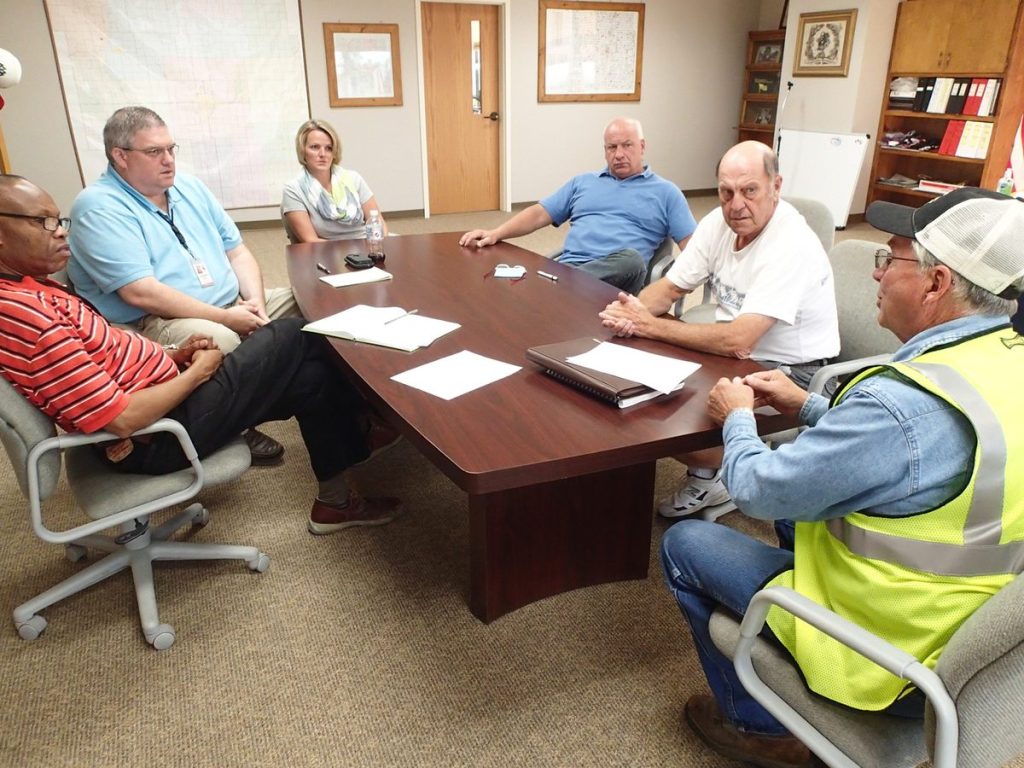
State and federal emergency management officials met with members of the Nodaway County Commission last week to go over the application process for federal disaster funding that, if approved, will be used to repair bridges, tube crossing and gravel roads damaged by this summer’s flooding and heavy rainfall. (From left) FEMA’s Paully Onyirimba, SEMA Regional Coordinator Corey Sloan, County Emergency Management Coordinator Christy Forney, Presiding County Commissioner Bill Walker, North District Commissioner Robert Westfall, and County Road and Bridge Supervisor Larry Dougan.
Nodaway County and township officials met with Federal Emergency Management Agency representative Paully Onyirimba last week as efforts continue to secure federal disaster funding for the repair of roads, drainage tubes and bridges damaged in a series of severe rainstorms stretching through the second half of July.
Two members of the Nodaway County Commission, Bill Walker and Robert Westfall, along with Road and Bridge Supervisor Larry Dougan and County Emergency Management Coordinator Christy Forney, sat down with Onyirimba and State Emergency Management Agency Regional Coordinator Corey Sloan at the county’s Administration Center Thursday to review the framework for receiving disaster funds.
Officials spent much of the rest of the day touring 10 of the more than 70 sites the commission now believes are eligible for federal assistance. County staff also spent several hours copying scores of documents detailing damage at the sites and estimating the amount of time, manpower and material that will be required for repairs.
Information from those documents will be used to create preliminary damage reports, or PDAs, which are processed at the state level by SEMA before being submitted to FEMA evaluators who determine the amount of federal money, if any, to which the county is entitled.
Mike O’Connell, communications director for the Missouri Department of Public Safety, of which SEMA is a part, said counties are usually reimbursed by Washington after going ahead with approved infrastructure repairs on their own. However, in the case of “small” projects costing less than $80,000, O’Connell said the government can simply cut a check, eliminating the need for stop-gap local funding.
Dougan said Friday he estimates the combined cost of restoring county-owned bridges and tube crossings to their pre-flood condition at approximately $700,000, about the same amount Nodaway sought after similar rain events last summer.
Funding for the 2014 damage was approved but has been slow in coming, and a number of projects from last year have yet to be completed.
Dougan said there is little doubt Nodaway County will qualify for a new round of disaster assistance because the estimated damage total easily exceeds FEMA’s minimum $83,000 threshold, which the government figures by multiplying $3.56 times the county’s total population of slightly more than 23,000.
The $700,000 estimate does not include washed-out gravel roads and drainage tubes less than 30 inches in diameter. That infrastructure is the responsibility of Nodaway County’s 15 townships.
Commissioners said Friday that at least 11, and as many as 13, townships will seek FEMA assistance totaling more than $500,000.
Of the 15 political subdivisions, each of which has its own revenue stream, two have yet to respond to FEMA’s request for estimates, and two others, White Cloud and Grant, do not plan to apply.
The remaining 11 entities submitted estimates Thursday ranging from $8,000 in Hughes Township to $300,000 in Nodaway Township.
Should disaster funding be approved, O’Connell said FEMA would pay 75 percent of the repair costs for damaged bridges, crossings and gravel roads. He said SEMA’s share is 10 percent, which leaves a 15 percent local match.
In a sense, Nodaway is playing catch-up with 68 other Missouri counties approved Aug. 7 for federal disaster aid related to this summer’s record rainfall.
Forney said Nodaway and seven other counties were left off the initial list because they sustained relatively little new damage to bridges, tube crossings and other transportation infrastructure in late June and early July and opted not to respond to SEMA’s initial request for estimates.
But in mid-July, Nodaway County was hit by a series of storms that dumped more than 10 inches of rain on the area within a week.
According to road and bridge department records, 45 tube crossings and eight bridges were on the county’s original request list for FEMA dollars, with nine of those projects described as being already completed.
Funding was also requested in connection with seven additional locations where logs and brush have washed onto tube crossing or bridges, with one site complete. In addition, about 10 roads in various parts of the county remain closed due to tube or bridge washouts.
Dougan said Friday about 20 locations have been added to the list for a damage site total comprising 72 locations, most of which are washed-out tubes and eroded bridge approaches.
Counting Nodaway County and other recent additions, O’Connell said the current list of 76 aid-eligible counties is the longest for any natural disaster in Missouri since the “Great Flood” of 1993.
According to state estimates, the prolonged period of flooding and severe storms caused more than $39 million in damage to roads, bridges and other public infrastructure and resulted in at least 10 deaths.
Gov. Jay Nixon first declared a state of emergency in Missouri on June 18, an action that activated the State Emergency Operations Center and mobilized SEMA in an effort to assist local authorities. Nixon has now extended the state of emergency through Aug. 14.