Conservationists confirm spread of ash borer threat
UNIVERSITY OF KENTUCKY FORESTRY EXTENSION
The Missouri Department of Conservation is warning landowners in northwest Missouri to treat or harvest ash trees due to the spread of the emerald ash borer. Treatment is most effective in the spring and early summer and can cost anywhere from $25 for a small tree to several hundred dollars for large trees requiring the services of a professional arborist. Conservationists confirm spread of ash borer threat Ash borers found in Buchanan County MDC confirms spread ash tree pest
ST. JOSEPH, Mo. — Missouri Department of Conservation foresters say landowners in northwest Missouri may want to make plans now to protect or replace their ash trees.
According to an MDC release, the Missouri Department of Agriculture recently reported that the emerald ash borer, an insect that kills ash trees, has been found for the first time in Buchanan County.
Adult emerald ash borers were collected at three locations: near Faucett, at MDC’s Pigeon Hill Conservation Area, and on the eastern edge of St. Joseph.
The collections were not unexpected, said MDC forest entomologist Rob Lawrence, since ash borer populations have been building rapidly to the south in Platte County.
Ash borers have also been found in the Kansas City and St. Louis areas and their presence confirmed in a total of 13 Missouri counties.
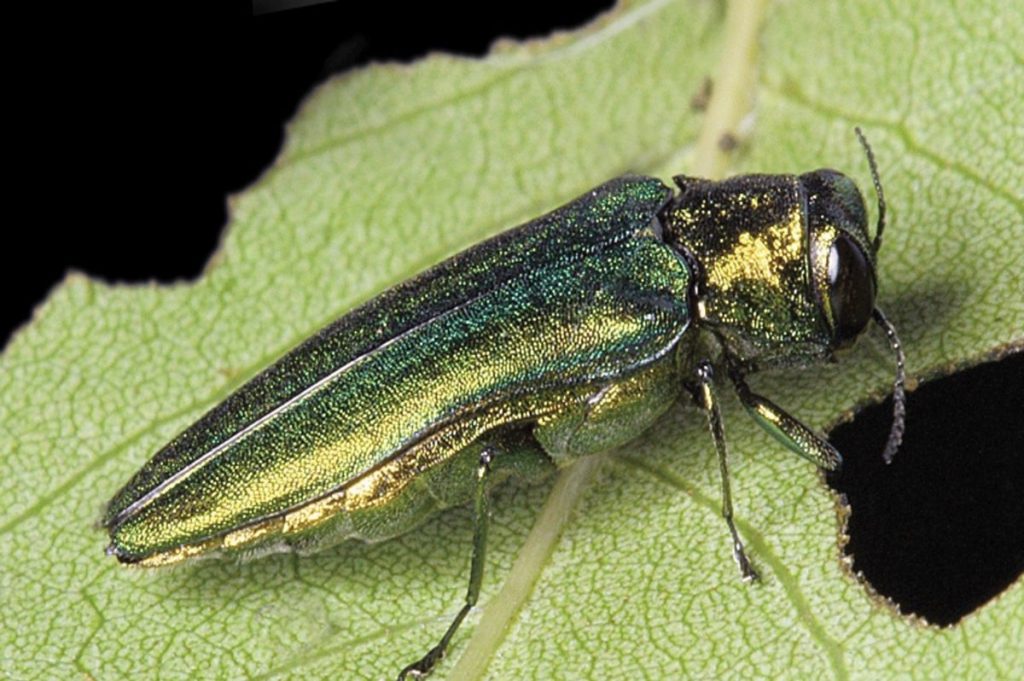
The emerald ash borer is an Asian beetle that tunnels under the bark of ash trees, disrupting the flow of water and nutrients and eventually killing the tree. The metallic, dark-green beetles are about one-inch long when fully developed.
Larvae leave S-shaped tunnels under bark. Adults leave D-shaped exit holes when they emerge.
Resource forester Lonnie Messbarger, who works out of St. Joseph, said MDC is urging northwest Missouri landowners to decide between trying to save ash trees by beginning treatments next spring or removing trees and planting different species.
Treatment costs vary according to the size of tree and type of treatment used, Lawrence said. They can range from $25 for do-it-yourself treatment of a small tree to several hundred dollars for a large tree requiring the services of a professional arborist.
Insecticides effective against ash borers are best applied in the spring and early summer when adults are active and larvae are beginning to develop.
Movement of emerald ash borers into different parts of the United States is most often caused by people transporting firewood, and MDC is urging people not to move wood from one locality to another. In addition, campers are encouraged to buy wood that has been locally harvested.
All Missouri counties are currently under a federal and state quarantine that prohibits the transport of nursery stock, ash trees parts, and firewood from hardwood trees outside the state.
For more information about the emerald ash borer threat, go to mdc.mo.gov/your-property/your-trees-and-woods/tree-and-forest-health/invasive-tree-pests.