Mom’s milk is winning formula for infant health
TONY BROWN/DAILY FORUM
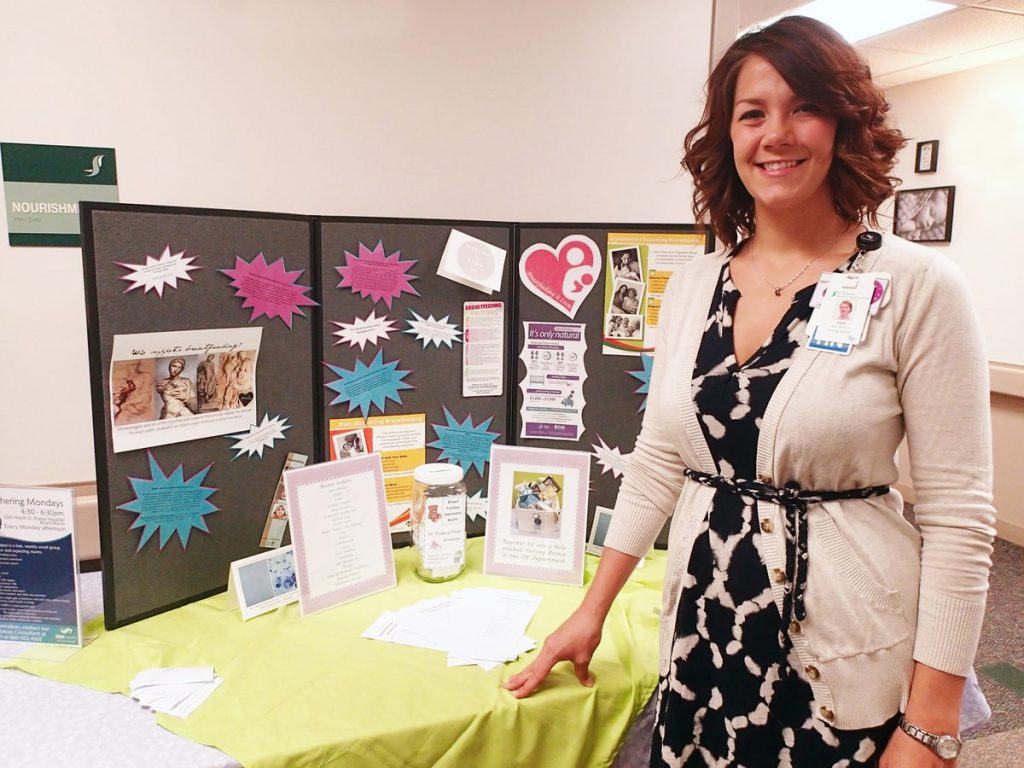
Katie Skaggs, a registered nurse and lactation consultant at SSM Health St. Francis Hospital in Maryville, stands beside a table display designed to provide new mothers with information about the benefits of breastfeeding. “For a generation, we were told formula was better than breastfeeding,” Skaggs said, “but research shows that’s simply not the case.
MARYVILLE, Mo — Becoming a parent is one of life’s greatest joys. And new mothers and fathers naturally want to do everything they can to provide what’s best for their child.
But what physicians and other health care professionals believe is best for babies has changed over the years. And one of the most significant of those changes has been the move back to breastfeeding.
“For a generation, we were told formula was better than breastfeeding,” says Katie Skaggs, a registered nurse who serves as SSM Health St. Francis Hospital’s lactation consultant. “But research shows that’s simply not the case. We need to get back to making breastfeeding a normal part of life, and that starts by providing education and support to families.”
Breastfeeding, Skaggs said, helps protect babies from a host of ills, including Type I diabetes, childhood leukemia, obesity and high blood pressure. It has also been shown to boost cognitive development and lower the risk for developing allergies, and even cancer, later in life.
Nursing mothers benefit as well through weight loss, reduced stress, and decreased risk for a multitude of diseases including breast cancer, osteoporosis, and diabetes.
Skaggs said one of the most important things to remember about human milk is that it’s made for human babies. What’s more, a specific mother’s milk is biologically tailored for her baby alone.
“The first milk, called colostrum, contains antibodies passed on from mom to baby to help protect the newborn from any type of bug that mom or baby may be exposed to,” Skaggs said. “Another role colostrum plays is coating the lining of the baby’s stomach to protect baby from any bacteria it might ingest.
“Formula just doesn’t do that. In fact, it can have the opposite effect and cause stomach upset or more severe gastrointestinal illness in sick or preemie infants.”
What’s more, Skaggs said, breast milk’s nutrients change over time to meet the infant’s changing needs. For example, as older babies learns to crawl their mothers’ milk becomes richer with energy-producing fat.
Breastfeeding also helps keep babies from overeating, which can be a problem with formula.
Skaggs said overeating is easier for infants fed from a bottle due to rapid flow from the bottle’s nipple, which babies find difficult to control. And once the child’s stomach is used to too much food, it is difficult to reverse the craving for more, just as with adults trying to stick to a diet.
Of course, not every mother can breastfeed, but issues such as the inability to make enough milk or nipple pain are not problematic for the majority of women.
“Most moms will have no problem producing enough milk for their baby,” she said. “However, there are times when a mother may not be able to provide enough milk to exclusively breastfeed her baby. This is usually related to an underlying medical reason, but is fairly uncommon.”
As for pain, Skaggs said some women experience tenderness after starting to breastfeed, but that the discomfort is usually temporary.
“If pain is severe or constant,” she said, “it is usually related to how the baby is latched and can, therefore, be corrected with the help of a lactation consultant.”
Overall, Skaggs said, the most important thing is to give breastfeeding a chance because mother’s milk provides the right nutrients at the right time in the right amount. In addition, the benefits of skin-to-skin contact between mother and child carries numerous developmental benefits.
If a new baby is not immediately ready to breastfeed, Skaggs said, mothers may want to choose the “rooming-in” option while at the hospital. Rooming-in means the baby spends most of its time in the mother’s room instead of the nursery.
Rooming-in gives mothers the opportunity to learn their newborn’s behaviors and responses until the child is ready to nurse, and lets new moms grow confident in caring for their baby while increasing the amount of physical contact.
“Babies that room-in cry less frequently,” said Kathy Brand, St. Francis obstetrical unit nurse manager. “Rooming with the baby also gives new moms the opportunity to ask questions and learn about newborn care while still around OB nurses.”
For more information about best infant-care practices for new parents, call the SSM Health St. Francis Hospital’s obstetrics department at 660-562-7924.