Council takes up Cooper crossing; continues transfer station dialogue
TONY BROWN/DAILY FORUM
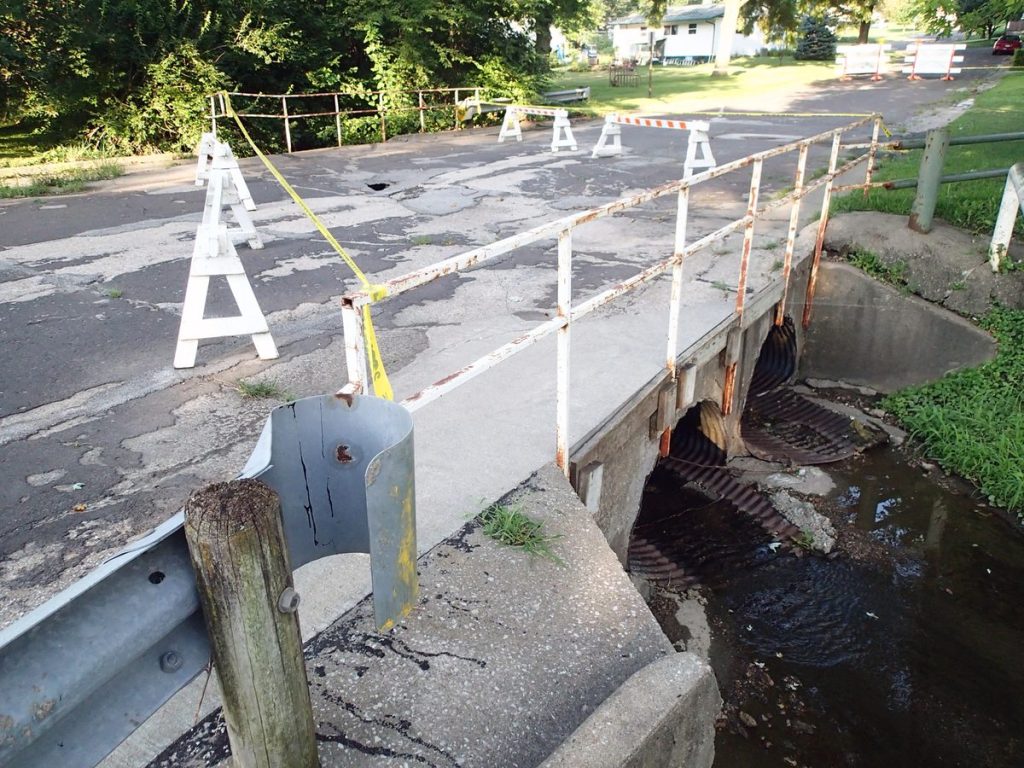
The often-flooded Peach Creek traffic crossing on West Cooper Street at the south end of Judah Park has been closed by the city following a pavement failure blamed on this month’s heavy rainfall. Emergency repairs are to be undertaken during the current budget year by White Cloud Engineering & Construction, of Maryville.
Heavy rainfall in July has transformed a festering problem for the city’s storm water drainage system into an emergency demanding an immediate fix, City Manager Greg McDanel told the Maryville City Council this week.
Long prone to flooding, the West Cooper Street tube crossing at the south end of Judah Park between South Frederick Avenue and South Dunn Street finally gave way during a recent storm, resulting in a platter-sized hole in the pavement opening directly into the corroded drainage tube below.
The small bridge, which spans Peach Creek, has been closed to traffic and is scheduled for permanent repairs to be carried out by White Cloud Engineering & Construction as soon as possible.
Because municipal staff classed the deteriorated crossing as an emergency the normal requirement for competitive bids was waived. The council unanimously approved the White Cloud contract on Monday during its final regular session of July. Cost is estimated at around $45,000.
The city’s current budget contains $40,000 in General Fund money for the project, but $17,000 from that line item was diverted to widening and dredging Peach Creek further to the south.
This was done, McDanel said, because the city was hoping to receive a grant for the Judah Park crossing from the Federal Emergency Management Agency, and believed the aging bridge would hold together one more year.
“Unfortunately,” McDanel said, the grant request has languished, and “the volume of storm water since April has expedited the need for this project.”
He added that additional funding for Cooper Street would come from General Fund reserves, and that construction materials will be charged to the appropriate line item in the Street Maintenance Division budget.
While locally based White Cloud is responsible for engineering, removal of rubble and old pipe, installing new culverts and providing fill between the creek and the bottom of the street, city crews will pour new curbs and pavement, an in-house project with an estimated cost between $3,000 and $4,000.
Plans call for White Cloud to replace two existing 48-inch culverts with 54-inch polymer-coated steel tubes, an upgrade McDanel said will increase water flow capacity at the crossing by 25 percent.
In addition, a clay tile sewer running beneath the roadway is to be replaced, and Empire Gas Co. has expressed an interest in relocating an aboveground line straddling the creek.
The completed crossing will also include an 8-foot strip of grass adjoining the curb that McDanel said would allow for future construction of a sidewalk or trail by Maryville Parks & Recreation.
Also on Monday, the council heard a brief report from McDanel updating the governing board on the fate of the city’s fiscally troubled solid waste transfer station, which has been losing about $100,000 a year since Porter Trash Service opened a competing station east of town in 2012.
McDanel said the city has basically three options with regard to the station, where garbage is compacted and loaded onto trucks for transport to landfills.
These include closing the station altogether in conjunction with a five-year fee deal proposed by Porter Trash owner Dennis Porter, who has pledged to keep charges reasonable for both the city, which must dispose of tons of street sweepings each year, and private haulers; leasing the facility out to a private concern, such as a recycling company; and “municipalization,” under which the city would likely contract with a single hauler while excluding other haulers from operating inside the city limits.
The contract hauler would be required to use the city’s transfer station and pay “tipping fees” sufficient to cover operations there.
City Council Member Tim Shipley said during Monday’s meeting he was disappointed in the lack of engagement demonstrated by Maryville’s half-dozen private haulers with regard to a possible fourth option, forming a cooperative or consortium and taking over the transfer station themselves.
“I think my mind is made up as to what I think needs to happen,” Shipley said. “I think the transfer station needs to close.”
With Porter as a nearby option, Shipley added that he didn’t “see anybody going out of business” if the city gets out of garbage handling altogether.
Council Member Jerry Riggs asked if other transfer station services — mostly tree limb disposal following storms — would disappear if the facility were closed. McDanel responded that municipal staff would look into the issue and come back with an answer later.
Mayor Renee Riedel asked that McDanel also direct staff to conduct an inventory of current transfer station assets and prepare a closure contract for the council’s consideration.
In other business this week, the council passed an ordinance acknowledging a petition to annex property adjoining the north city limits near where North College Drive turns into Polk Township’s Ideal Road.
The 1.12-acre property, located on the east side of the street, belongs to Dennis L. Nelson and Jennifer M. Nelson, doing business as DLN Properties LLC, who have built three apartment buildings on the parcel and are completing a fourth.
In the past, City Hall allowed such developments to connect to municipal water and sewer service, but McDanel said the policy has been changed in accordance with guidelines set forth in the city’s comprehensive plan.
“This (former) practice reduces tax liability for the property and causes issues with unification of services and fragmentation of city boundaries,” he told the council.
After being informed of the policy shift, McDanel said the Nelsons submitted a request for voluntary annexation of the property.
Should the request ultimately gain approval, the apartment complex will generate additional city tax revenue of about $390 a year. In addition, the property owners will realize “minimal savings” by paying lower “in-city” water and sewer rates.