
City meets state DNR sewer plant deadline
TONY BROWN/DAILY FORUM
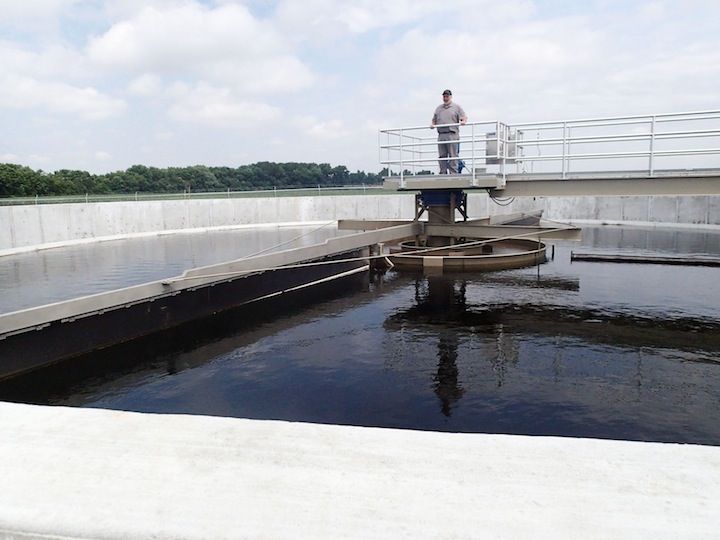
PeopleService Lead Operator Jerry Riley stands on a catwalk overlooking one of the clarifying basins at the new Maryville wastewater treatment facility. Built under a state Department of Natural Resources mandate at a cost of $13.7 million, the new plant is now fully operational, meaning the city has met DNR’s July 1 deadline for getting the installation online. PeopleService operates both the sewer plant and Maryville’s water treatment facility as a contract service provider.
City Manager Greg McDanel has announced that Maryville’s new $13.7 million wastewater treatment plant is operational and compliant with all requisite regulatory agencies.
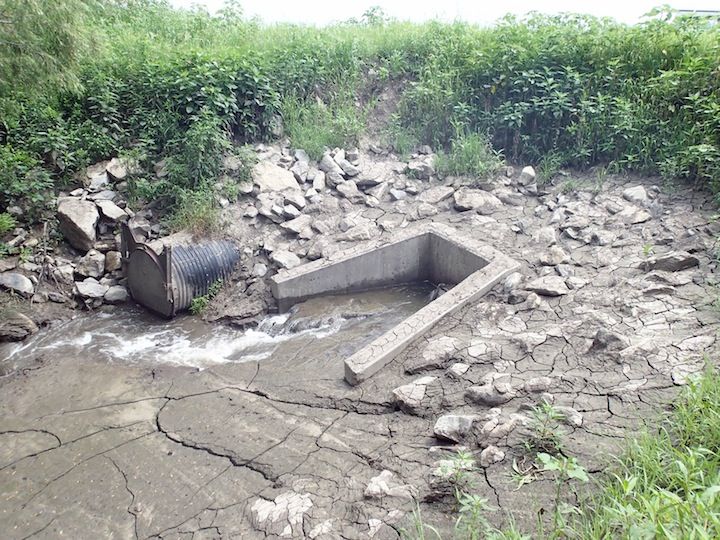
In a prepared statement, McDanel said the effluent gate is open, and the mechanical facility is successfully discharging cleansed water into the One Hundred and Two River under a new permit issued by the Missouri Department of Natural Resources.
Official notice that the plant had passed regulatory muster came at 10:17 a.m. on Wednesday, July 1, the final day of a grace period allowed by MoDNR before the city faced the possibility of punitive fines.
A newly issued MoDNR permit means Maryville now meets key provisions specified by both the Missouri Clean Water Law and the Federal Water Pollution Control Act.
The history of the new plant, which replaces a decades-old system of settling lagoons, goes back to 2009, when the state declared its intention to enforce new limits on ammonia imposed by both MoDNR and the U.S. Environmental Protection Agency.
After an initial preliminary plant design, which would have partially preserved the lagoon system, proved unworkable, the city, in 2012, hired HDR Engineering to provide regulatory support, facility design and construction services related to the creation of a fully mechanical plant.
“The services provided by HDR Engineering have been crucial to the success of the project since day one,” said Public Works Director C.E. Goodall. “The plant has also been designed with a look toward the future.”
McDanel said the facility is designed to process 2 million gallons of sewage a day, and that the city currently generates about 1.7 million gallons. The extra capacity, he said, means the plant will be able to handle additional volume created by population growth or industrial development.
In April 2012, Maryville voters approved a $13.7 million bond issue to pay for the plant, and the city hired David E. Ross Construction of Raytown to serve as general contractor.
Actual construction cost to date totals $11.4 million, McDanel said, with the remaining funds spent for engineering, site preparation and land acquisition.
“Substantial completion of the plant marks a significant achievement for our community,” he said. “Faced with strict deadlines and unfavorable weather conditions, the plant is now operational.”
The city manager issued a “special thank-you to the citizens of Maryville” as well as city staff, water/wastewater operations vendor PeopleService, HDR Engineering and David E. Ross Construction.
“The contractor and their crews should be recognized for their tenacity in ensuring compliance by the deadline,” McDanel said.
Like the old lagoons, the plant relies on a “biomass” of bacteria that feeds off human waste and transforms ammonia into nitrogen.
However, that process now takes place in a massive concrete aeration basin designed to force oxygen through contaminated liquid, speeding the biological and chemical reactions that transform effluent back into clean water.
The facility also has two large clarifier tanks equipped with metal arms that churn through sewage in order to remove particulates and suspended solids.
In a final step, ultraviolet light is used in place of chlorine to kill undesirable microorganisms before the effluent is discharged back into the river.
TONY BROWN/DAILY FORUM
Effluent from Maryville’s new wastewater treatment plant east of town flows from a conduit into a small creek leading to the One Hundred and Two River.




