Fair ceremony to honor Purple Heart recipients
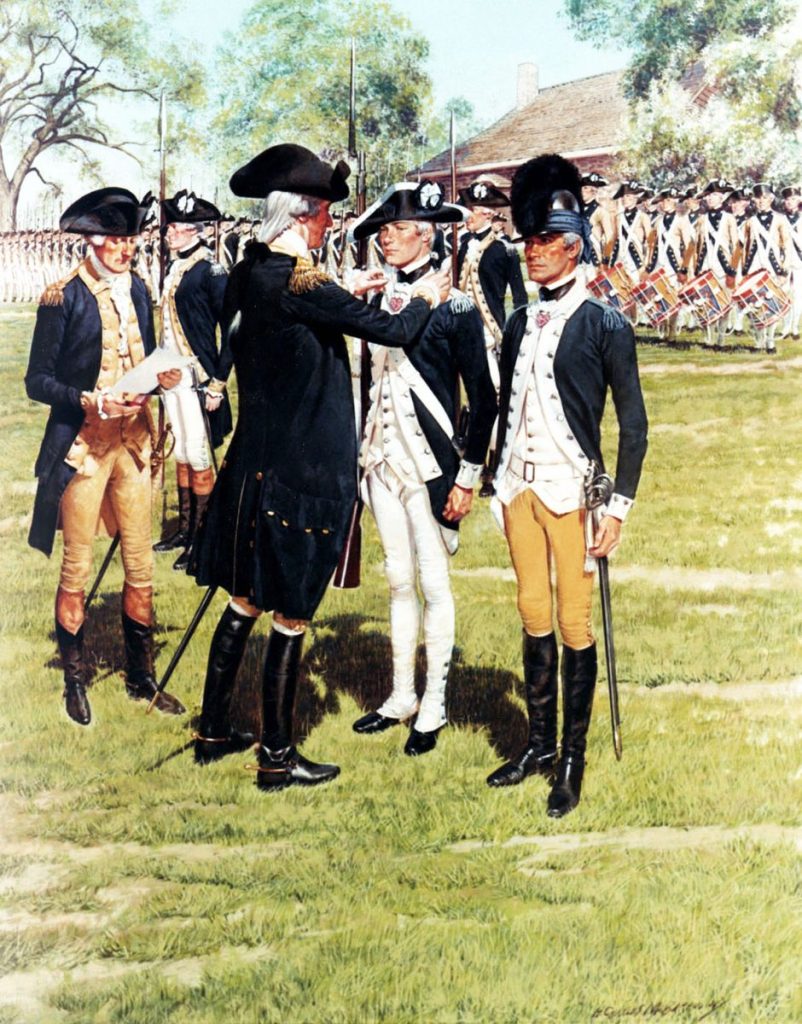
U.S. ARMY CENTER OF MILITARY HISTORY
Shown is an artist’s conception of Gen. George Washington awarding the Badge of Military Merit during the American Revolutionary War. Though the commendation fell out of favor for 150 years, it was revived in the early 1930s as the Purple Heart Medal for Military Merit, now generally known simply as the “Purple Heart” and bestowed on military personnel wounded in battle. During the upcoming Nodaway County Fair, both Maryville and Nodaway County are to be recognized as Purple Heart communities by the Military Order of the Purple Heart, which was chartered by Congress in 1958.
The Nodaway County Commission and the city of Maryville are making plans to honor U.S. military veterans and active-duty personnel wounded in action during a ceremony set for 6:45 p.m. Thursday, July 16, on the courthouse square — opening night of the Nodaway County Fair.
North District Commissioner Robert Westfall said Monday the commission has been notified by the Missouri Department of the Military Order of the Purple Heart that Nodaway is to be designated an official Purple Heart County, and that Maryville will become a Purple Heart City.
Westfall said the application for the distinction was made by the commission in response to a request from the Purple Heart society’s John Dismer, who is expected to accept a resolution from local officials on the fair’s mainstage.
Chartered by Congress in 1958, the Military Order of the Purple Heart is composed of military men and women who received the medal after suffering wounds in combat. The group currently claims to have slightly more than 45,000 members.
Regular membership is restricted to living veterans. However, the order also offers participation through its Ladies Auxiliary and associate memberships available to parents or lineal descendants of either a living or deceased Purple Heart recipient.
Nodaway will become the 25th Missouri county and Maryville the 81st Missouri city to be named Purple Heart communities. The distinction means both governments will be eligible to display signs and plaques proclaiming the MOPH distinction.
Reserved seating will be provided for Purple Heart recipients and their families attending the ceremony.
The Purple Heart is a United States military decoration awarded in the name of the president to those wounded or killed while serving on or after April 5, 1917.
However, the iconic heart-shaped medal — cast in gold and purple and blazoned with the profile of Revolutionary War commander George Washington on one side and the words “For Military Merit” on the other — has a history dating to the nation’s original struggle for independence from England.
Washington, later the nation’s first president, established the honor that became the Purple Heart in 1782. What was then called the Badge of Military Merit consisted of a simple heart-shaped patch fashioned from purple fabric and bearing the word “Merit.”
According to general orders issued by Washington on August 7 of that year, and retained by the Library of Congress, the honor was intended for soldiers who exhibited, “not only instances of unusual gallantry in battle, but also extraordinary fidelity and essential service in any way.”
Though never abolished, the honor fell into disuse and was not officially revived until the early 1930s, when the first “Purple Heart Medal for Military Merit” was bestowed on Gen. Douglas MacArthur, then Army chief of staff.
The general had been exposed to mustard gas 14 years earlier during World War I.
Though MacArthur was one of the most storied commanders in U.S. history, Washington’s original badge is believed to have been perhaps the first in modern times presented to common soldiers.
According to the late Donald N. Moran, a member of the Sons of the American Revolution and author of several articles about the war for independence, the practice in European armies was to restrict the giving of such decorations to officers.
But, as Washington wrote in his general order, “The road to glory in a patriot army and a free country is thus open to all.”
The estimated number of soldiers, sailors and airmen receiving the modern Purple Heart is given here: World War I, 320,518; World War II, 1,076,245; Korean War, 118,650; Vietnam War, 351,794; Persian Gulf War, 607; Afghanistan War, 7,027 (as of June 5, 2010); Iraq War, 35,321 (as of June 5, 2010).