Local law agencies abreast of camera trend
TONY BROWN/DAILY FORUM
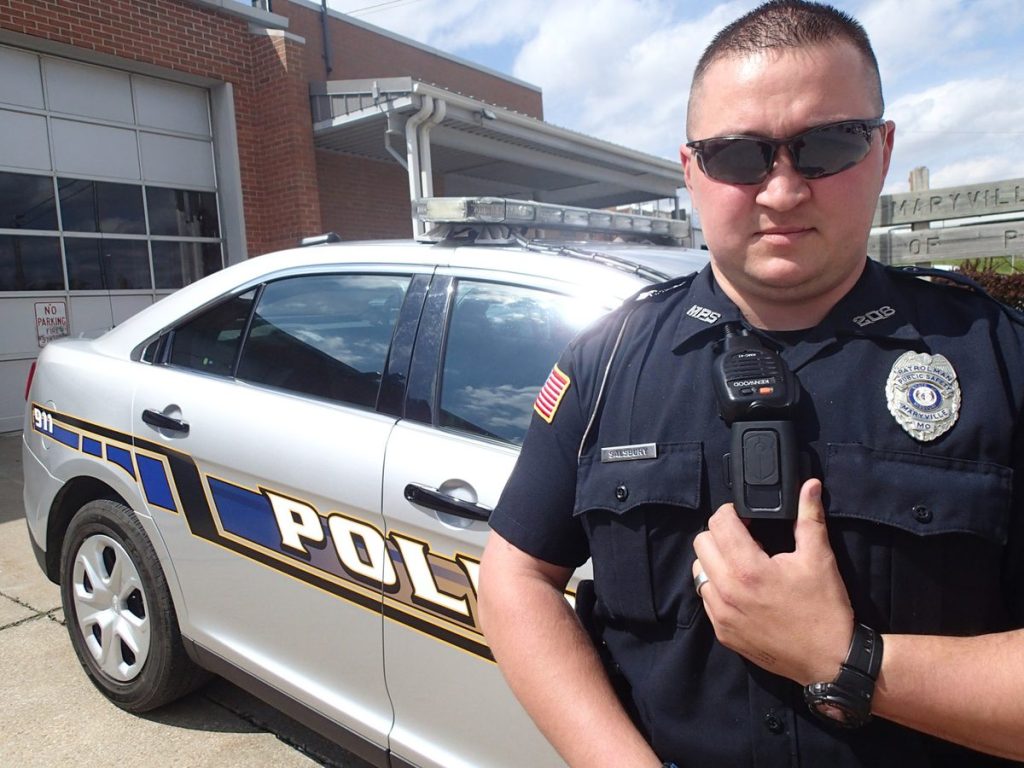
Maryville Public Safety Officer Tyler Salsbury displays his body camera Thursday outside MPS headquarters. Salsbury said he uses the camera “religiously” whenever he has any official interaction with the public.
Police body cameras and dash-mounted cameras in patrol cars are pervasive topics for law enforcement managers these days, especially in the wake of the August 9 fatal shooting of 18-year-old Michael Brown in Ferguson by former police officer Darren Wilson.
Late last year, President Barack Obama proposed reimbursing police departments for up to half the cost of buying such cameras, plus the equipment and software needed to store video files, a plan that would require Congress to authorize $75 million over three years.
According to the online news site Vocativ, more than 40 U.S. cities have currently issued body cameras to at least some of their officers, and another 25 or so are making plans to do so.
Cities named in the Vocativ report were mostly large metropolitan centers like Oakland and San Diego, California; Denver, Colorado; Dallas and Ft. Worth, Texas; Detroit, Michigan; and Miami, Florida.
But many small-town law enforcement agencies are taking a look and body and car cams, too, and in Maryville their use has already become routine.
Public Safety Director Keith Wood said Thursday his officers started wearing body cams two years ago, long before they became a hot-button issue in the weeks following the Brown shooting.
MPS patrol cars have been equipped with dash cameras even longer, about five years, Wood said.
Maryville Public Safety got ahead of the portable mini-cam curve thanks to grants provided through the Missouri Intergovernmental Risk Management Association, or MIRMA, which underwrites the city’s liability insurance coverage.
Though municipal matches were required, Wood said MIRMA funds were used to help purchase all of his department’s inventory of 20 body cams plus a half-dozen dashboard units. The wearable WatchGuard units cost about $600 each, while the patrol car cameras were acquired for around $3,700 apiece.
In addition to city police, Nodaway County sheriff’s deputies are about to join the move toward body and car cameras as well. In putting together its 2015 budget, which runs concurrently with the calendar year, the County Commission allocated $15,000 for the purchase of portable camera technology.
Deputy Jamie Vicker told the commission last week that the Sheriff’s Department has an opportunity to acquire 12 in-car cameras from the Zetronix company for around $275 each. Unlike the city’s WatchGuard units, Zetronix products are not specifically designed for law enforcement and are also marketed to truck and taxi fleets and other commercial operations.
Sheriff Darren White said growing competition between vendors has significantly decreased the cost of cameras, meaning that quality in-vehicle and body units are now available for under $1,000. He added that the Nodaway County Ambulance District is equipping its vehicles with cameras, and that he expects the technology to become universal in the near future.
While some police unions in larger cities are on record as opposing body cameras, White said the trend is clear.
“I think you better embrace it,” he said. “It’s just the way it is.”
Vicker said the cameras’ lower cost means the department will likely go ahead and purchase both car and body cameras this year for its 13-member law enforcement unit, which includes 11 deputies, one bailiff and Sheriff White.
A fourth local agency that has equipped officers with wearable cameras is the Northwest Missouri State University Police Department, which has issued body cams to all nine of its patrol officers but not to administrative personnel, such as Chief Clarence Green.
Green said this week the cameras were first deployed on Aug. 1, several days before Brown was shot.
Though mini-cam technology has been around for a while and is proving increasingly reliable and easy to operate, equipping officers and patrol cars with portable cameras is not as simple as it sounds. Agency administrators have all sorts of issues to sort through, such as when the cameras should be turned on and how long hundreds, or thousands, of hours of video records should be stored.
Storage and access are especially important concerns, since video files take up a lot of server space, and departments must guard against accidental, or intentional, deletions.
Such issues have yet to sort themselves out. Northwest police, for example, hang on to their videos for 30 days. Departments in some cities have reportedly created policies requiring electronic images to remain on file for several years.
Wood said Maryville Public Safety has yet to create a written set of rules specifying when officers should switch on their cameras or how long video files are retained. He said the regulatory landscape is in such flux right now that any policies the department created would likely have to be changed in the near future.
“We want to wait and see where all this falls out and lands,” said Wood, adding that he expects legislation at some point that will dictate how police cameras and video files are to be used and stored.
“The whole world of video and policing is in turmoil right now, as you can imagine,” Wood said
But even though the protocols are still being sorted out, Wood said his officers have been using cameras to good effect, and that most see the devices as useful tools, not an encumbrance.
As in other communities, Wood said, the number of complaints about excessive force or inappropriate police behavior has dropped locally since officers have had cameras. He added that officer videos have also proved useful in evaluating and improving performance.
“It’s not necessarily a matter of discipline,” Wood said, “but sometimes the videos have shown us something the officer could have done better. It’s more of a learning situation.”
At first, Wood said, the biggest problem with the cameras was that officers would forget to turn them on, especially in high-pressure situations when “they’re thinking about 20 things at once.” But as time has gone on, Wood said, flipping the video switch has simply become a matter of habit.
Car mounted cameras are less of a problem in that regard, Wood said, because they switch on automatically whenever the vehicle’s lights and siren are activated.
Vicker told the County Commission that the audio/video cameras the Sheriff’s Department is considering turn themselves on whenever the car is in use. The devices also capture images both inside and outside the vehicle and come equipped with a GPS function that makes it possible to display the vehicle’s location on Google Maps.
Green said the campus department has developed written policies for the use of wearable cameras, which officers are required to turn on whenever they are making an arrest or dealing with some other “critical situation,” actions that embrace everything from a traffic stop to an assault.
Aside from serving the department well as an “investigative tool,” Green said the body cams have reduced the number of incidents involving violent or antagonistic behavior directed toward officers because people know their actions are being recorded.
As for storage and access issues, Green said his officers and staff were already used to working in a digital video environment due to the number of stationary security cameras installed across campus for the past several years.