Storyteller unfolds tale of slave life
TONY BROWN DAILY FORUM
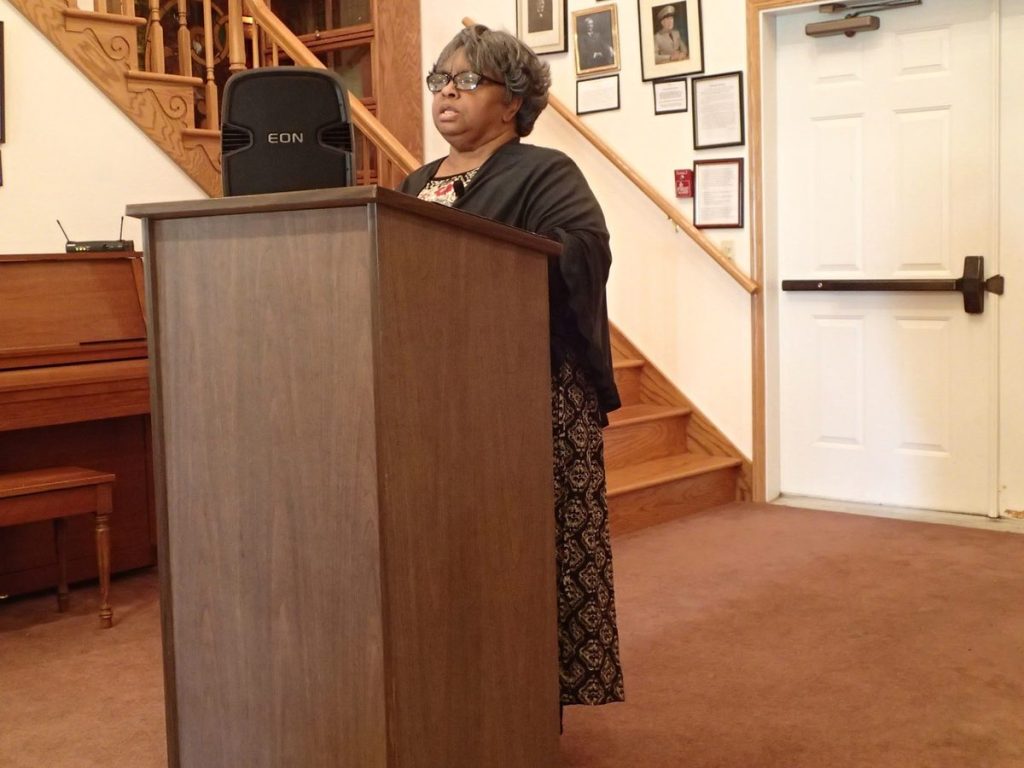
Professional storyteller Gladys Caines-Cogswell assumed the character of “Adeline” Saturday afternoon at the Nodaway County Historical Society Museum. Adeline was a slave in Savannah, Missouri, at the time of the Civil War and the great-granddaughter of Yani, a Ghanaian tribal princess captured by slavers and forced to endure the horrors of the notorious Middle Passage across the Atlantic Ocean to a plantation in the southeastern United States.
Memories of slavery and the Civil War swept through the Nodaway County Historical Society Museum on Saturday almost exactly 150 years after Confederate Gen. Robert E. Lee surrendered to Union Gen. Ulysses S. Grant at Appomattox Court House, Virginia, on April 9, 1865.
Professional storyteller Gladys Caines-Cogswell led her audience back in time in character as Adeline, a woman who spent her entire life before the end of the war as a slave in Charleston, South Carolina; Baltimore, Maryland; and finally Savannah, Missouri, where she was owned by the Warrick Family.
Caines-Cogswell’s dramatization was based on a pair of books by Virgil S. Powell, Adeline’s grandson. The family histories tell a tale dating back to the early 19th century when Adeline’s great-grandmother, Yani, a Ghanaian tribal princess, was captured by slavers in western Africa and forced to endure the horrors of the notorious Middle Passage across the Atlantic to a plantation in the southeastern United States.
Unsparing in its brutal fidelity to slave life, Caines-Cogswell’s story focused on how slave families were repeatedly broken up as husbands, wives and children were sold to different owners, often never to see their loved ones again.
Illegally taught to read by the family that owned her, Adeline, as characterized by Caines-Cogswell, was a witness to the dramatic events of her time and recalled her awareness of such figures as Sojourner Truth and Susan B. Anthony, both of whom campaigned for women’s rights and the abolition of slavery in the years leading up to the Civil War.
“These people were bold,” Caines-Cogswell/Adeline said. “They were taking chances with their lives. A war was definitely coming.”
The character of Adeline also told of the abolitionist guerrilla John Brown who was hanged after attacking pro-slavery “Border Ruffians” in Kansas and leading a raid on the federal armory in Harpers Ferry, Virginia, in 1859.
According to the family history recorded by Powell, Adeline was also a witness to one of the historic debates between Abraham Lincoln and Stephen Douglas during the Illinois U.S. Senate race in 1858, during which Lincoln gave voice to the anti-slavery views that set him on the path to the White House — and the nation on the path to war — in 1861.
“I mean he really stirred things up,” Caines-Cogswell/Adeline said.
During the museum performance, “Adeline” also offered insight into the complex stew of issues that caused the war, including states’ rights, economic pressures and cultural differences between the North and South.
While all of these factors played a part in dividing the nation, “Adeline” left no doubt that the root cause behind America’s bloodiest conflict was the “peculiar” system in which white people legally bought and sold black people, dooming them to lives of forced labor, poverty and abuse.
“Slavery was the main reason for the war,” Caines-Cogswell/Adeline said. “And we all had no doubt that the war was going to put an end to slavery.”
Adeline’s story took an odd twist after the fighting finally ended in 1865 and slavery was abolished. Together, she and her husband decided to remain with the Warrick family as paid servants.
While her daily life may not have changed dramatically following emancipation, Caines-Cogswell/Adeline said the end of slavery offered black people hope of better days to come.
“When the viciousness of the war came to an end, we found out that our problems had just begun,” Caines-Cogswell has Adeline say. “But once it was illegal to teach black children how to read, and now there are schools just popping up everywhere. Who knows? Perhaps one of these days white children and colored children will go to the same school. It may not happen in my lifetime, but I believe it will happen.”
Caines-Cogswell, who lives in Hannibal, received the 2005 Individual Artist of the Year Award from the Missouri Arts Council. She has also been honored with the Governor’s Award for Distinguished Literacy Achievement from the Missouri Humanities Council and will accept an honorary doctorate next month from the University of Missouri-St. Louis.