Senator talks energy during Nucor plant tour
TONY BROWN/DAILY FORUM
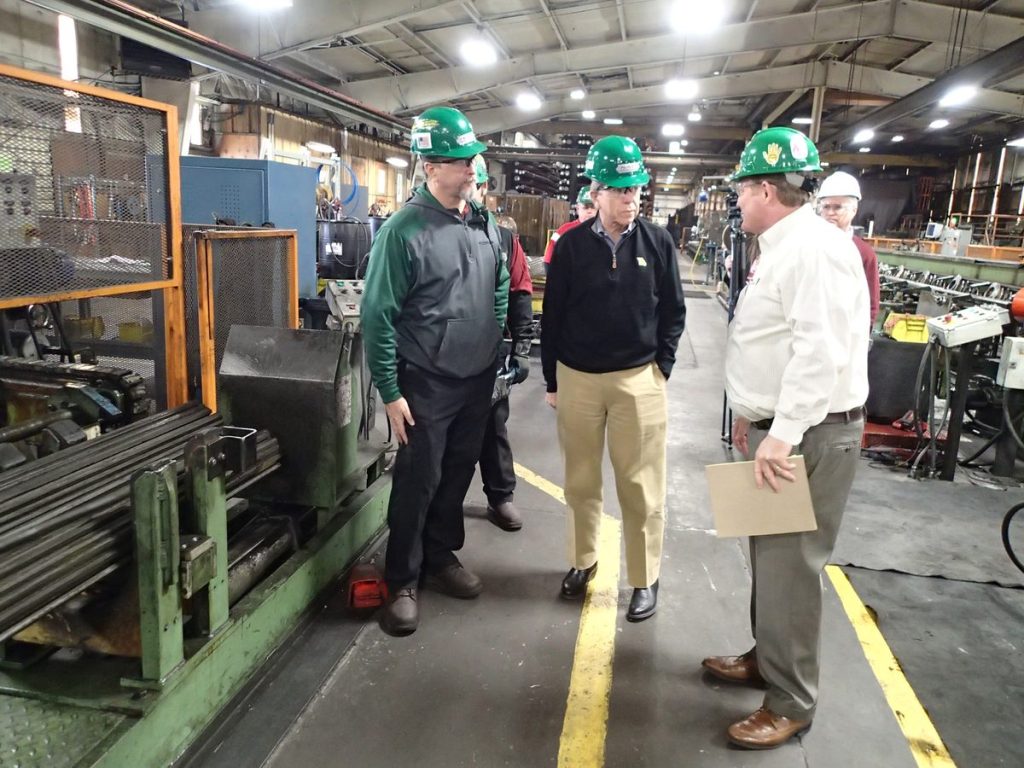
U.S. Sen. Roy Blunt, center, speaks with Nucor-LMP General Manager Kevin Van de Ven, right, during Blunt’s tour of the Maryville manufacturing facility Friday morning. In brief public remarks following the tour, Blunt called for policies that would encourage development of U.S. fossil fuel resources in order to provide affordable energy to both industry and domestic consumers.
U.S. Sen. Roy Blunt made a brief stop in Maryville on Friday to tour the Nucor LMP steel bar and wire plant on East Fist Street.
Blunt made similar stops last week in Bethany, Albany and Fairfax during a mini-tour through northwest Missouri described by his office as a chance to “meet with local job creators and leaders to discuss the impact of executive overreach and burdensome regulations on Missourians.”
While in Maryville, Blunt met privately with Nucor-LMP General Manager Kevin Van de Ven, who introduced Blunt during a public reception in the factory’s break area, saying that the two men talked about a range of issues including imports, currency, infrastructure and the impact of government regulations.
In his remarks to an audience made up mostly of Nucor employees, Blunt linked hoped-for growth in the U.S. manufacturing sector with the need for new energy policies emphasizing North American production of fossil fuels along with completion of the Keystone Pipeline System.
Designed to move oil from the Canadian province of Alberta to refineries in Illinois and Texas, a portion of the pipeline, the unfinished Keystone XL section, has generated controversy because of its routing over the Ogallala Aquifer in Nebraska.
Blunt is a part of the Republican Senate majority who favors completion of the pipeline, and said Friday that “a delivery system that works” is essential to keeping energy costs affordable for both industry and households.
“You’ve got to have a utility bill that people can pay,” he said.
Blunt dismissed concerns about Keystone’s environmental impact by saying the “oil is coming out of the ground” anyway and will probably be purchased by either the United States or China.
He argued that failure to develop Keystone to its proposed capacity would cost jobs and send more oil to parts of the world less conscientious about air and water quality than the United States.
“We lose the jobs, and whatever we’re trying to do (to improve the environment) gets worse and not better,” he said.
Blunt told the Nucor workers that developing more energy resources is essential to growth in the manufacturing sector, and that projects like Keystone bode well for the Midwest, which he described as a nexus of highway systems, navigable rivers and railroads.
“The question is how do you take advantage of that,” he said. “I’m interested in creating the new jobs after you have the energy.”
Access to affordable energy, Blunt said, would also be a boon to agriculture at a time when world food needs are expected to double by 2070.
Saying that Missouri has the potential to become the manufacturing hub of the nation, Blunt called for the creation of a “utility and transportation system that does what it has to do” in terms of fueling industrial growth.
Only manufacturing, he said, has the economic muscle to boost household incomes and produce the revenue need to strengthen public schools and other educational institutions.
Returning to Keystone, Blunt said the pipeline was important economically but also served as a symbol of the direction in which he believes the country should move.
“I think it’s a question of are we going to do smart things, or things that aren’t so smart,” he said, adding that he believes energy policy in general will be a major theme in the 2016 elections.
On other fronts, Blunt talked about what he sees as the need to limit the power of federal regulators he described as “out of control and unaccountable.”
He cited as an example recent attempts by the Environmental Protection Agency to expand the definition of “navigable waters” in a way that would increase its ability to regulate smaller streams, ponds and lakes.
Blunt also repeated earlier criticism of federal efforts to limit carbon emissions, especially with regard to the coal-fired power plants that produce most of Missouri’s electricity.
Such restrictions, he said, could potentially double utility costs.
“If you double your utility costs at home, you’re the only person who is going to pay for that,” Blunt said. “If you double those costs at work it may very well mean that your work won’t be there.”
As he has in the past, Blunt issued a call for Congress to give itself the power to rule on whether or not federal agency regulations can be implemented. He also wants a “sunset” provision attached to new regulations so that they would have to be revisited every few years.
“I think regulations and energy policy will be the big topics that the American people want to talk about,” Blunt said.