Magazine offered GI view of a world at war
STAFF IMAGE
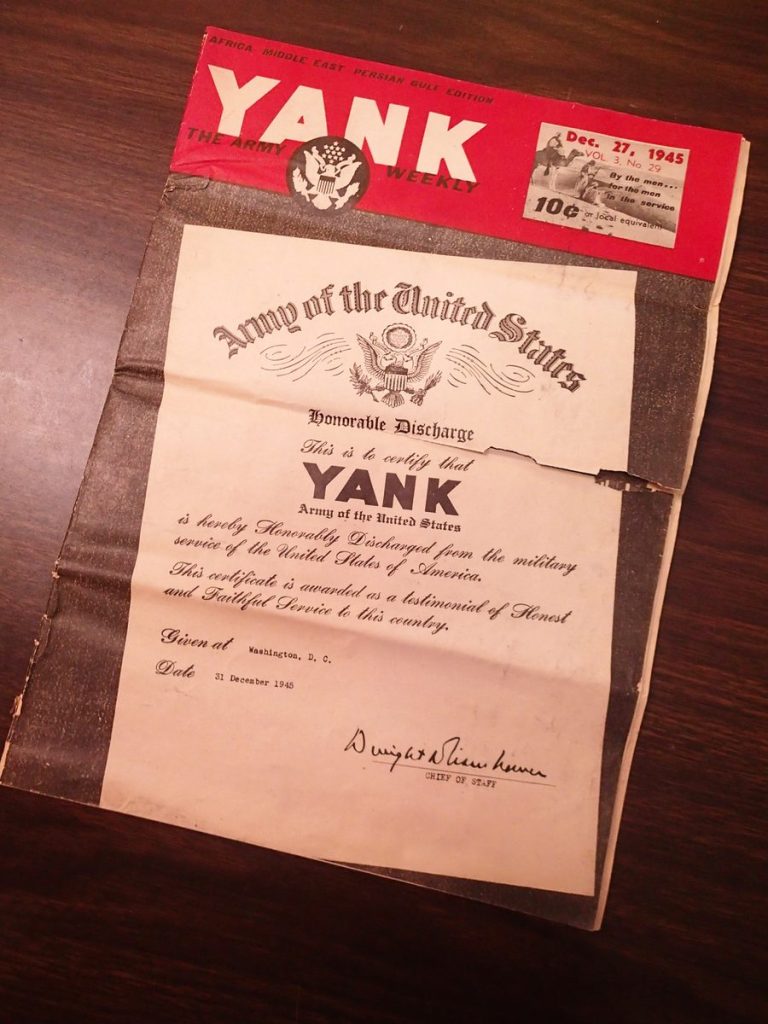
This final edition of “Yank: The Army Weekly” recently came into the possession of Ed Hurayt, a local collector of military artifacts. Published between June 1942 and Dec. 1945, “Yank” contained articles written by and for rank-and-file soldiers. Regular features included the “Sad Sack” cartoon strip and photos of scantily clad “pin-up girls.”
Local military collector Ed Hurayt recently acquired an artifact that provides a U.S. enlisted man’s-eye view into the closing days and immediate aftermath of World War II.
On a recent trip to see his uncle, Bob Brown, a WWII veteran who lives in South Carolina, Hurayt was given one of the final editions printed of the last issue of “Yank: The Army Weekly,” a publication written by and for rank-and-file American servicemen stationed all over the world.
Hurayt, an Air Force veteran of the Vietnam War, has an extensive collection of military weapons and gear spanning conflicts from the Civil War to the present day. But he said the 10-inch by 14-inch newsprint magazine is especially meaningful to him because it offers a look back at the years during which his uncle and father served in uniform.
Hurayt’s father was a demolition specialist who served as a sergeant in the U.S. Third Army, which fought in Europe under Gen. George S. Patton.
The copy of the magazine Hurayt got from his uncle is something of an odd duck. Dated Dec. 27, 1945 — four months after the war ended with the surrender of Japan — the issue is labeled Vo. 3, No. 29. However, online sources show the last issue of “Yank” came out on Dec. 28.
However, Hurayt’s copy is undoubtedly the final issue and has the famous cover showing an honorable discharge certificate made out to “Yank” and signed by Gen. Dwight D. Eisenhower.
The discrepancy probably has to do with the fact that by the end of the war “Yank” was published at facilities around the world and on both sides of the international date line for a total of 21 editions in 17 countries. Hurayt’s magazine is the Africa-Middle East-Persian Gulf edition.
Articles appearing in the final “Yank” include a piece called “Inventory, U.S.A.,” which offers a snapshot of the nation that tens of thousands of its soldiers were returning home to, some for the first time in more than three years.
The article tells veterans they can expect to find a different country than the one they left. America, staff writer Sgt. Robert Bendiner explains, is now a place where women work in factories, and where many of those same those factories are laying off employees as war production slumps.
Bendiner writes: “The case for labor, says one commentator, revolves around the cessation of overtime work. Men who during the war drew time-and-a-half for eight, 10 and even 20 hours beyond the normal schedule find themselves back on a straight 40-hour week, with a consequent loss of income in some cases exceeding 50 percent.”
The nation was also uneasy on other fronts. The article continues: “Joe (a typical serviceman) may well be excused if he looks about him with a certain bewilderment. The dreadful problems of the atom bomb, diplomatic unrest abroad and industrial unrest at home all weigh on the spirit of the country.”
Other articles in the final issue of “Yank” provide insight into the daily life of U.S. occupation forces and discuss proposed reforms in the organization of the postwar Army. One piece recounts Sgt. Merle Miller’s mixed emotions during his last few hours as a soldier.
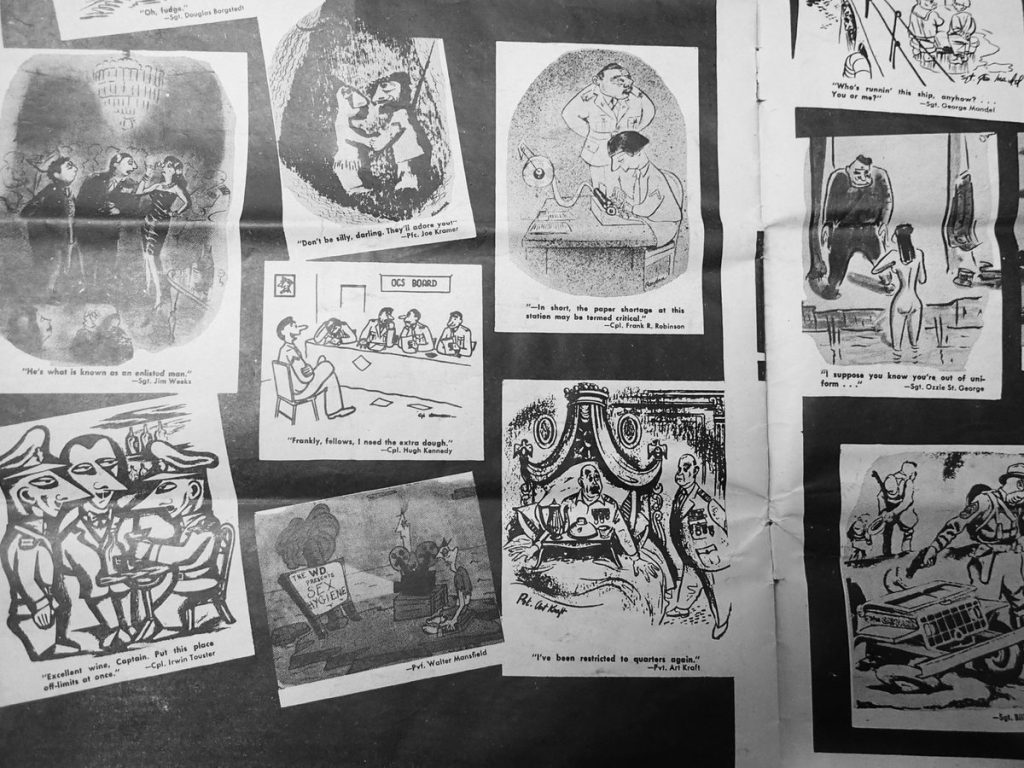
Like its predecessors, the last issue of “Yank” also included a number of regular features, such as the “Sad Sack” cartoon strip by Sgt. George Baker, which illustrated the daily travails of an otherwise unnamed private coping with the absurdities of military life.
The issue also offered a two-page retrospective containing photos of scantily clad models and actresses featured in earlier editions as weekly “pin-up girls.”
Yank remains the most widely read magazine in the history of the U.S. military, and at its height had a worldwide circulation of more than 2.6 million.
Each issue was priced between five cents and 10 cents because the Army felt if soldiers paid for it, they would hold the publication in higher esteem.
The magazine was edited in New York City then shipped for printing around the world where staff editors added local stories.
STAFF IMAGE
The photo above displays a sampling of cartoons that appeared in the final issue of World War II’s “Yank: The Army Weekly.” The publication remains the most widely read magazine in the history of the U.S. military, and at its height had a worldwide circulation of more than 2.6 million.