City, Kawasaki brokering tax plan
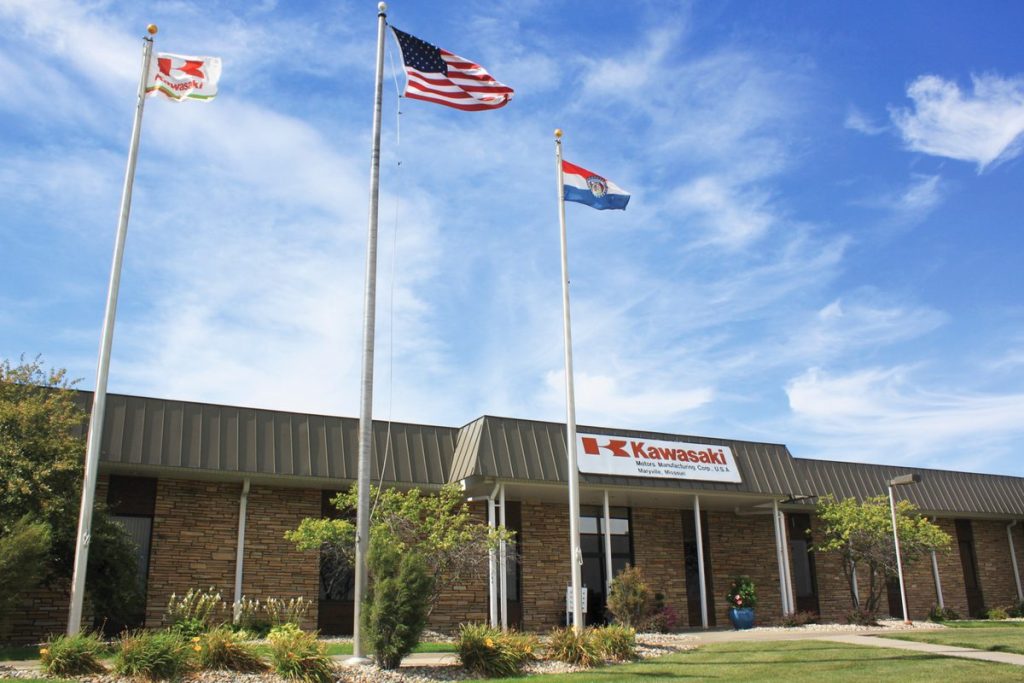
FILE PHOTO
Kawasaki’s Maryville manufacturing facility
The city of Maryville hailed the annexation of the Kawasaki Motors Manufacturing Corp. U.S.A. small-engine plant into the city limits late last year as a major economic development coup that would generate about $170,000 a year in new municipal revenue.
But seemingly left in the lurch was the Maryville R-II School District, which Superintendent Larry Linthacum told his Board of Education this week has seen decreasing personal property tax revenues from Kawasaki over the past five years, the result, according to records compiled by the Nodaway County assessor’s office, of depreciation claimed by Kawasaki on equipment and machinery classed as personal property.
However City Manager Greg McDanel said Wednesday that a deal between Kawasaki and the city is in the works that will keep the school district and other entities dependent on local property tax funds “whole” by maintaining at least the current level of revenue provided by the engine factory.
McDanel said he has met with Linthacum several times regarding the plan, which is still being negotiated. He added that Kawasaki has expressed a willingness to “go above and beyond” with regard to its personal property tax obligations in an effort to make sure local schools don’t suffer.
However, Linthacum expressed frustration this week that not only has revenue from Kawasaki decreased, but the district will apparently see no benefit over the next ten years from a planned $25 million expansion at the plant, which is being financed by City Hall through the issuance of Industrial Development Revenue Bonds.
IDBs, also known as Chapter 100 bonds, differ from traditional government revenue bonds in that they are issued on behalf of a private-sector business or corporation and do not require voter approval.
Typically used to finance industrial expansion, Chapter 100 bonds are repaid by the private-sector entity. However, the sponsoring government holds title to the underlying collateral until the debt is discharged.
This arrangement is advantageous to the private-sector partner because it provides tax-exempt status for whatever expansion or improvements are undertaken during the bond repayment period.
All of that means that, as things stand now, Maryville schools, along with other property tax-supported entities, such as the Senior Citizens Fund, Polk Township, Nodaway County, the NoCoMo Industries sheltered workshop and the Nodaway County Health Center, won’t see any property tax revenue from the Kawasaki expansion until the bonds are repaid a decade from now.
In addition, Nodaway County Assessor Rex Wallace said Wednesday that by the time Kawasaki does start paying property taxes on the expansion, the company could claim significant depreciation on any additional machinery or other goods classed as personal property.
McDanel said he understands that annexation and tax abatement controversies often come down to the impact such economic development incentives have on education. He also said he believes the proposed new agreement with Kawasaki will go a long way toward easing fears about lost revenue.
In addition, McDanel said, Maryville simply could not afford to walk away from a $25 million corporate investment expected to create jobs and swell the city’s tax base.
The city manager said he is hoping an upcoming public hearing will help educate those holding concerns with regard to “these kinds of economic tools and how they can grow the economy.”
Such incentives are simply a reality in “today’s economic development world,” McDanel said, adding that he believes similar issues will arise as the city and Nodaway County Economic Development continue seeking a new tenant for the vacant Energizer battery plant.
Kawasaki, of course, will continue to pay real and personal property taxes on its existing plant, but as Linthacum pointed out during Monday’s board meeting, those revenues have diminished since 2010 by more than $250,000.
In 2010, Maryville R-II received $781,702 in real and personal property taxes from Kawasaki, a figure that has fallen each year since, except for 2013, when the factory’s school tax bill increased from $574,040 in 2012 to $575,690. Last year Kawasaki’s property tax contribution to the district totaled $524,837.
Linthacum said that, taken together with lost revenue related to the closure of the Energizer battery plant and the Carbolytic Materials Company factory, local schools have seen annual property tax income decline by about $800,000 over the past five years.
That financial pressure, he said, has forced the district to implement a number of austerity measures, including eliminating staff through attrition and setting thermostats lower in the winter and higher during warm weather in the spring and fall.
Linthacum said R-II is somewhat unusual among Missouri school districts in that 78 percent of the district’s $18 million budget comes from local sources, with another 15 percent provided by the state and 7 percent funded through the federal government.
For other rural-area districts, Linthacum said, the state contribution often comes closer to 50 percent in terms of providing the approximately $6,100 per student per year that Missouri considers essential base funding from all sources for public schools.
Linthacum told the School Board the system unfairly punishes communities like Maryville that have a strong local tax base, but that there seems to be little will on the part of the state Legislature to make things more equitable for a minority of relatively prosperous districts.