
Waste board reviews grants, new legislation
TONY BROWN/DAILY FORUM
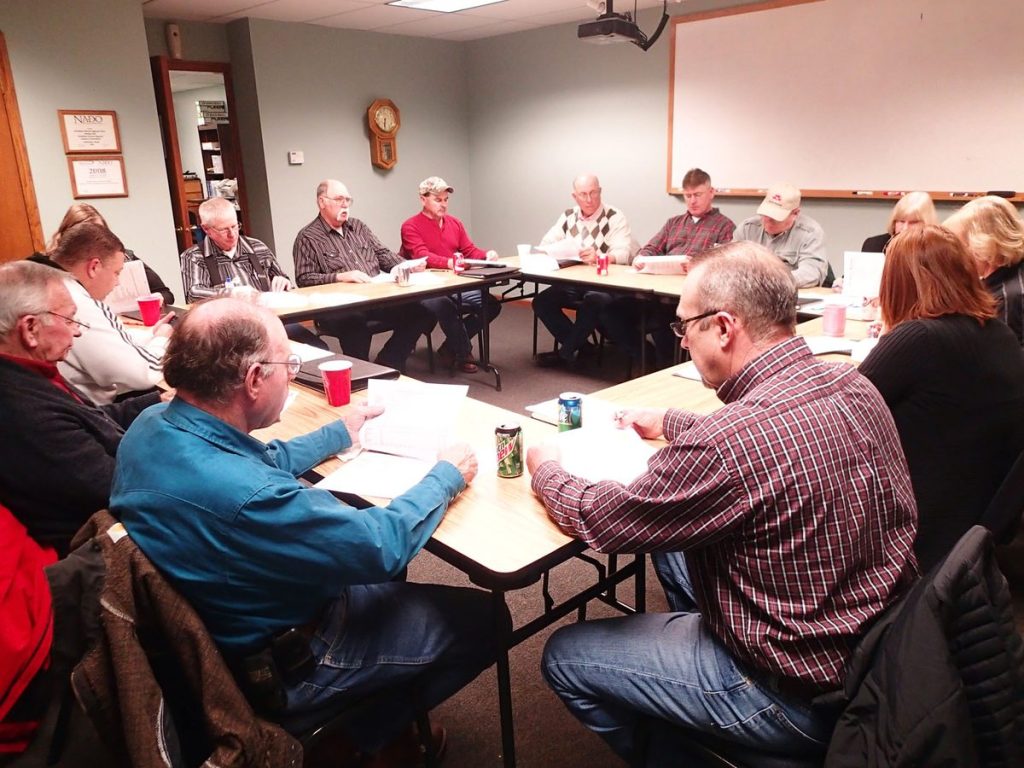
Members of the Northwest Missouri Solid Waste Management District Advisory Board met this week in order to review a half-dozen grant and outreach programs designed to reduce the amount of material across the five-county area finding its way into landfills. In addition to the grants update, environmental planner Linda Laderoute gave a brief update on solid waste legislation pending in the Missouri General Assembly.
Members of the Region A Northwest Missouri Solid Waste Management District Advisory Board convened this week for their first meeting of the new year.
The district operates under the umbrella of the Northwest Missouri Regional Council of Governments, which acts as a grant-administration and research resource for local government entities seeking to take advantage of state and federal programs. Counties served by both agencies include Nodaway, Holt, Worth, Gentry and Atchison.
Business before the advisory board, which exercises oversight with regard to grants dealing with waste disposal and recycling, included a report from district environmental planner Linda Laderoute, who summarized more than $70,000 in solid waste spending covering the period between July of last year and Dec. 31, 2015.
Included on that list is $17,000 for hazardous household waste collection events scheduled for March 28 in Grant City and April 25 in Maryville.
Such events have proven increasingly popular with area residents, since the closest sanctioned drop-off site for household waste is located in Kansas City.
In the past, acceptable waste items have included fertilizers, pesticides, household chemicals (bleach, ammonia and cleaners), batteries, compact fluorescent light bulbs, mercury, antifreeze, paint and varnish.
However, Laderoute said, a cost overrun last year means that latex paint, which is not considered a hazardous material once dry, may be stricken from the list.
Other projects on the grant list for the district include:
— A completed all-weather athletic track used by both Worth County R-II students and community residents fashioned from more than 3,000 old automotive tires, which would have added 32 tons of material to the state’s waste stream.
Cost of the project was $7,800 and included lighting and handicap-accessible restrooms.
— New collection bins for Big Brothers Big Sisters of Nodaway County, which are used to contain donations of used clothing and other items.
The youth mentoring organization depends on the sale of donated clothing to a fabric recycler for a significant portion of its annual revenue.
The $13,920 grant is to provide a total of eight collection bins to be installed in several Nodaway County communities. New receptacles have already been installed in Ravenwood and Burlington Junction.
— A $19,500 wood chipper for Worth County, which will be used to reduce the volume of organic solid waste.
– $5,129 for the city of Albany in Gentry County, which will go toward the purchase of a trailer used to collect and haul hazardous household waste, yard waste and electronic waste.
– $7,500 for a couple of composting workshops to be taught by Laderoute this spring in Grant City and Tarkio.
The district is expected to issue a call for new grant proposals early next month.
During her report to the advisory board, Laderoute also touched on legislative proposals that could affect both how much money the district receives and how those funds are spent.
As a “minimally funded” district, Laderoute said, the five-county area currently gets $95,000 a year in state appropriations. Half that money, $47,500, is distributed in the form of waste mitigation and recycling grants sought by local governments, schools, institutions, non-profits, private businesses and individuals. The other half goes toward administrative costs and education and outreach programs.
In the past, the advisory board and it’s seven-member executive board have had a fair amount of latitude with regard to determining which grant applicants get funded and for how much.
However, Laderoute said pending legislation introduced this year in the Missouri Senate could shift control over funding priorities to the Missouri Department of Natural Resources, meaning that state officials would have more say over who gets how much money and for what purpose.
If signed into law, Laderoute said, the bill would likely mean more resources for the state’s large population centers and fewer dollars for rural areas like Nodaway County.
In other business before the solid waste panel, Hopkins resident Jack Baldwin was named to a vacant seat on the executive board. The board consists of one person from each of the district’s five counties plus two members who serve at large.




