New favorites join New Year’s beverage list
TONY BROWN/DAILY FORUM
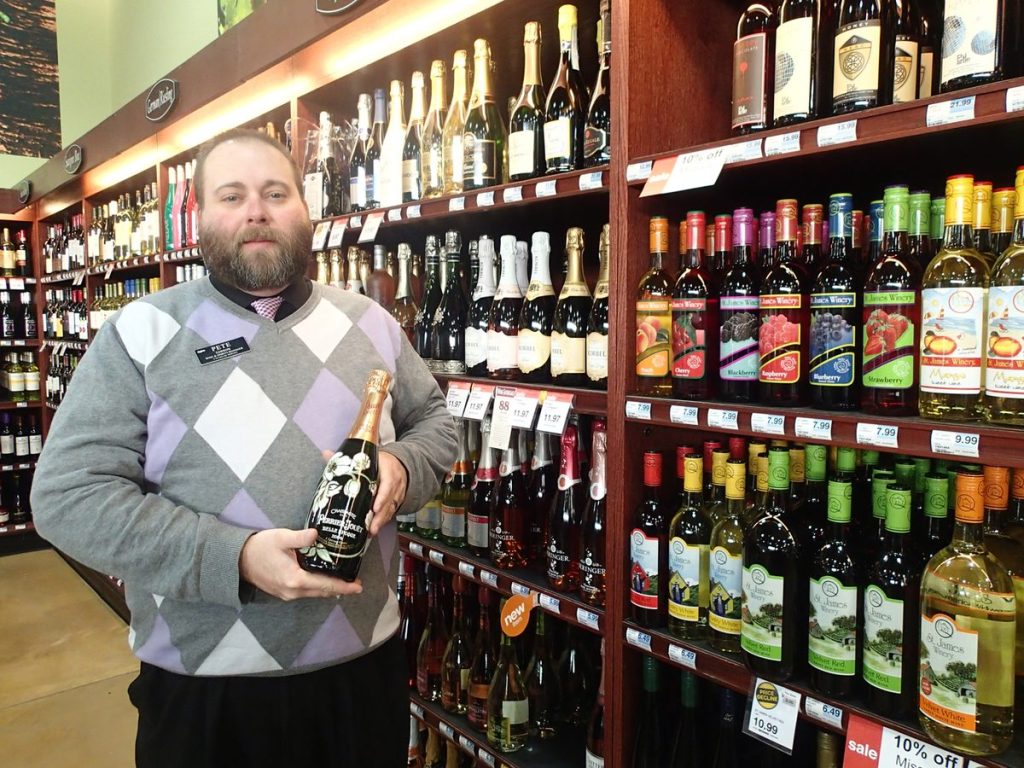
Pete Gibson, wine and spirits manager at the Maryville Hy-Vee, holds a bottle of French-made Perrier-Jouet champagne while standing in front of the store’s recently expanded selection of Missouri wines. While champagne is the traditional favorite for New Year’s Eve toasting, local shoppers preparing to celebrate the end of 2014 are displaying preferences for a growing array of beverages, including small-batch whiskies and craft beers.
New Year’s Eve is here, and a lot of folks will be stopping by the supermarket on their way home from work to pick up a bottle of bubbly — or maybe even a few bottles — for the traditional round of dinners and clock-watch parties ushering in 2015.
So what’s hot this year on the list of celebratory beverages? Champagne, of course, is the traditional choice for midnight toasts. But Hy-Vee Wine and Spirits Manager Pete Gibson said those preparing for a bit of revelry are making other choices as well — everything from premium small-batch bourbons to craft beers from all over the world and many parts of the United States.
And while a lot of sparkling wine is still getting bought as 2014 enters its final hours, Gibson said many shoppers apparently plan to salute the new year with traditional American cocktails like Old Fashioneds and Manhattans.
Such drinks, he said, are making a comeback after an extended period during which whiskey- and bourbon-based concoctions gave way to a myriad of martini-type drinks often built around flavored vodkas and other clear spirits.
For those not yet of a certain age, or who don’t remember, an Old Fashioned is made by mixing a little sugar with bitters and then adding whiskey or brandy with a twist of citrus rind. A Manhattan contains whiskey — usually rye — or bourbon along with sweet vermouth and bitters. The cocktail is stirred and strained into a cocktail glass then garnished with a Maraschino cherry.
One reason more folks are mixing up these standby drinks from decades gone by is the “whiskey revolution,” the emergence of specialty distillers — including Missouri’s Dark Horse Distillery and Spirits of St. Louis — who are making and marketing a growing variety of high-end liquors.
Reserve bourbons, single-barrel rye whiskey and “white” whiskey — the legal version of “moonshine” corn liquor — are all options available to the modern mix-master, Gibson said.
And while Maryville is largely a “bourbon town,” he said, there is still a lot of call around the holidays for premium scotch, which is especially popular as a gift item.
Champagne and cocktails aside, however, this is still the United States, and for a lot of people planning to put on their party smiles this weekend that means one thing — beer. And beer, said Gibson, is not what it used to be. It’s a lot more.
Hy-Vee currently stocks around 200 varieties of craft beer, designer beverages that have become so popular they’re crowding traditional big-brewer domestic products off the shelf.
“The domestic brewers are running a little scared,” Gibson said. “They’ve lost so much foothold. The move to craft beers is almost bigger than the whiskey revolution.”
The demand for craft beer has gotten to the point where many smaller brewers simply can’t fill orders outside their own city or region.
“They just don’t have the capacity,” said Gibson, who works to keep as many of the available brands in stock as possible.
But even for many dedicated beer drinkers, sitting down with a tableful of family and friends, or lifting a crystal glass as the clock strikes twelve, still calls for a properly chilled glass of wine, and even in this traditional realm the options are nearly infinite.
Real champagne, of course, can only be French, and even then these wines can only be made from grapes grown and fermented in that country’s Champagne district under rules that require in-the-bottle fermentation.
It is a classic process that usually demands a classic price — around $150, for example, for a bottle of Perrier-Jouet, Hy-Vee’s top-shelf offering. Gibson also keeps a variety of lesser true champagnes in stock, mostly in the $45 to $65 range.
But for many, the attraction of the label is less than the bubbles inside the bottle, and other popular sparkling wines on sale locally include Moscato d’Asti, a white wine produced in northwest Italy.
With a sweet flavor and low alcohol content, Gibson said Moscato d’Asti is especially popular with shoppers looking for a quality, but affordable, dessert wine.
Hosts who want to serve champagne, or something similar, to a large group can also opt for such lower-end products as Korbel, which Gibson said offers consistent quality for around $12 a bottle, less if it’s purchased by the case.
Known for more than a century for its St. Louis-made beer, Missouri has grown over the past couple of decades into a significant wine state, and there are currently more than a dozen different Missouri wineries represented on local store shelves.
Missouri wines used to take up a 4-foot width of shelf space in the Hy-Vee spirits shop, Gibson said. That allocation has now grown to 8 feet and includes many offerings tailor-made for the holidays.
“A lot of Missouri wines tend to be on the sweet side,” Gibson said, which means they are often appropriate both as aperitifs — drinks offered before dinner — and as a dessert wine after the meal.
Popular Show-Me wines this holiday season include several concord-based reds along with vintages created using the popular Norton grape.
Somewhat similar to a cabernet, the Norton was first cultivated in Richmond, Virginia, but is now the official Missouri grape and considered to be the cornerstone of the state’s wine industry.
Another Missouri wine available locally is produced by the Windy Wine Co. in Osborn, a small community near Cameron.
Gibson said Windy Wine makes a sangria-like concord with raspberry and strawberry flavors that has become popular with hosts looking to add a sweet touch to parties and family gatherings.