Agricultural groups break down Farm Bill
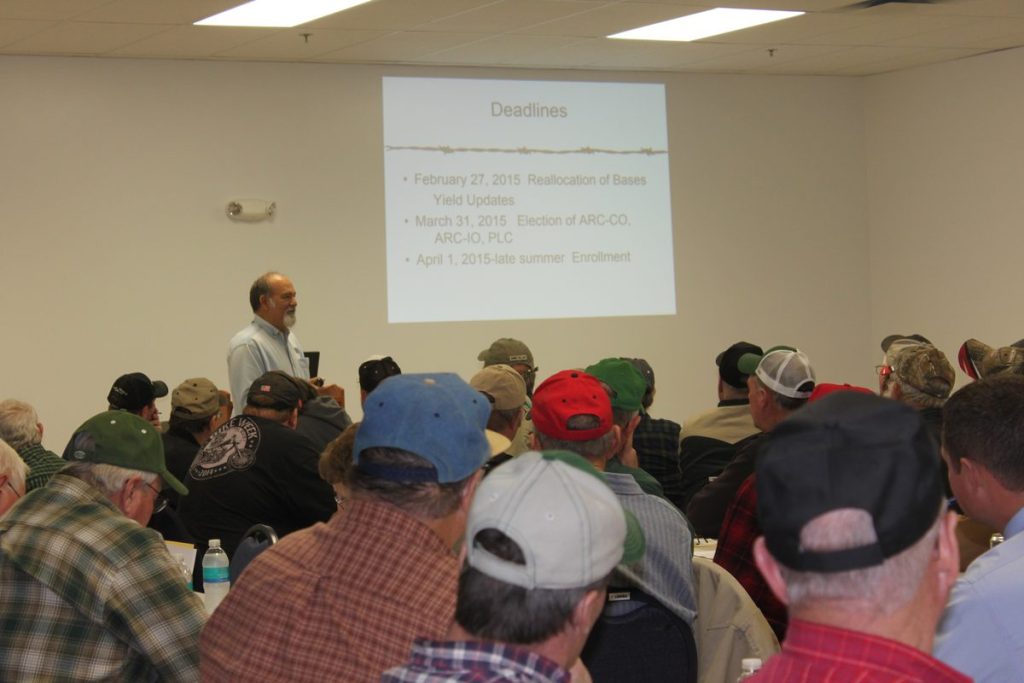
KAITY HOLTMAN/DAILY FORUM
The 2014 Farm Bill changes the way crop growers apply for assistance from the government. County leaders from the Farm Service Agency and University of Missouri Extension gathered Nodaway County farmers to explain the new programs the bill has created.
When congress passed the 2014 Farm Bill, they authorized two new programs, Agricultural Risk Coverage (ARC) and Price Loss Coverage (PLC).
The two programs serve as what sound like two choices to make growers’ decisions simple. But when two brand new choices surface that a nation of growers have never seen or been through before, the simplicity takes longer to find.
USDA Farm Service Agency (FSA) executive director Tim Dreier said these programs serve more as a safety net than past programs.
“Producers won’t see direct pay anymore,” Dreier said. “Now they’ll choose ARC or PLC and those will serve more as an insurance policy than up-front money.”
Basically, when growers see a good year, they will receive little or no government money.
But the question most discussed at the Farm Bill meeting last Monday was “which program is better?” in reference to ARC and PLC. Nearly 150 producers from Nodaway County and the surrounding areas attended the Monday, Dec. 15 meeting hosted by FSA and the University of Missouri Extension.
“I can’t give one blanket suggestion because this is a completely individual decision,” Dreier said. “It varies from person to person, and even from farm to farm.”
Dreier and the other presenters stressed that the most important step right now is for landowners and operators to go into their FSA office to work out the details and make a plan that would work best for them. He said not making a decision is not an option.
“If producers don’t make a decision, they’ll receive no payment for 2014 and will automatically be enrolled in the PLC option.”
Weigh the options
The Price Loss Coverage option is a price protection program. In this choice, producers will receive payment when the national marketing year average price is less than the reference prices as established by statute. Payments are made on 85 percent of base acres for the crop, and planting of crop is not required.
On the other hand, the Ag Risk Coverage breaks down into two options, county or individual.
ARC-County is a revenue-based program that uses county-level data. Payments are made when the ARC-County actual revenue is less than its guarantee. That guarantee equals 86 percent of the benchmark. Like PLC, payments are made on 85 percent of base acres for the crop, and planting is not required.
ARC-Individual is based on revenue as well but uses the individual producers’ farm level data. This option is dependent upon the actual planting of the commodity. All farms included in this option will be enrolled in benchmark and guarantee calculations. Payments are made when the individual’s actual revenue is less than the guarantee. This option offers producers individual-level choices that the other two do not. Payments are made on 65 percent of the total base, and planting is required for payment eligibility.
Follow the steps
The process is broken down into three steps to make a complicated process a little simpler. The first part includes updating base acres, and this step is running until Feb. 27.
All owners and operators received a letter in August asking for verification of certified acreage as reported to the Farm Service Agency (FSA) during the years 2008-2012. The letter showed the current base and yield information for each FSA farm number. The data contained in that letter is the foundation that will need to be used for the decision making process over the next few months.
Through the end of February, landowners have the one-time opportunity to reallocate base acres. For each farm number, the decision must be made to retain the current base acres on the farm or to reallocate the base acres using the certified acreage history from 2009-2012. PLC and ARC-County both pay on base acres if payment triggers are met.
Owners can also update their counter-cyclical yield at this time. The last time FSA allowed yield updates was in 2002. The updated yield will be calculated using 90 percent of the simple average of the 2008-2012 yields. Because this yield update is a certification process, FSA will not require evidence of these yields. However, all certifications will be subject to spot check.
“The most important thing producers can be doing is updating yields,” Dreier said. “This is the first chance they’ve had to match more with what they actually produce. To show what they’ve yielded over the last five years, they should bring in their federal crop insurance production report. We will make a copy and use that report to figure yields.”
The updated yields will only affect the PLC program. The FSA is strongly encouraging all owners to update yields, whether enrolled in the PLC program or not. These updated yields will offer a more accurate analysis when comparing PLC to ARC. In addition, it is unknown how the yields may be used in conjunction with future FSA programs.
The ARC and PLC election is also currently running and has a deadline of March 31, 2015. Producers must elect between PLC or either ARC-County or ARC-Individual, which will remain in effect for crop years 2014 through 2018.
The first choice would elect to participate in PLC or ARC-County on a covered commodity-by-commodity basis. This decision is made for each base crop on each farm. The election can be made to have one crop in PLC and another in ARC-County or vice versa, if there is more than one base crop.
The second choice would elect to participate in ARC-Individual for all covered commodities on the farm. This decision is made at the farm level. The farm, for ARC-Individual purposes, is the sum of the producers’ interests in all ARC-Individual farms in the state.
Program enrollment is scheduled for mid-April through summer 2015. At that time producers will sign contracts to participate in the programs for both the 2014 and 2015 crop years. Just as in past years, producers must sign a contract each year to participate in their elected program.