Firefighter’s legacy one of courage, service
TONY BROWN/DAILY FORUM
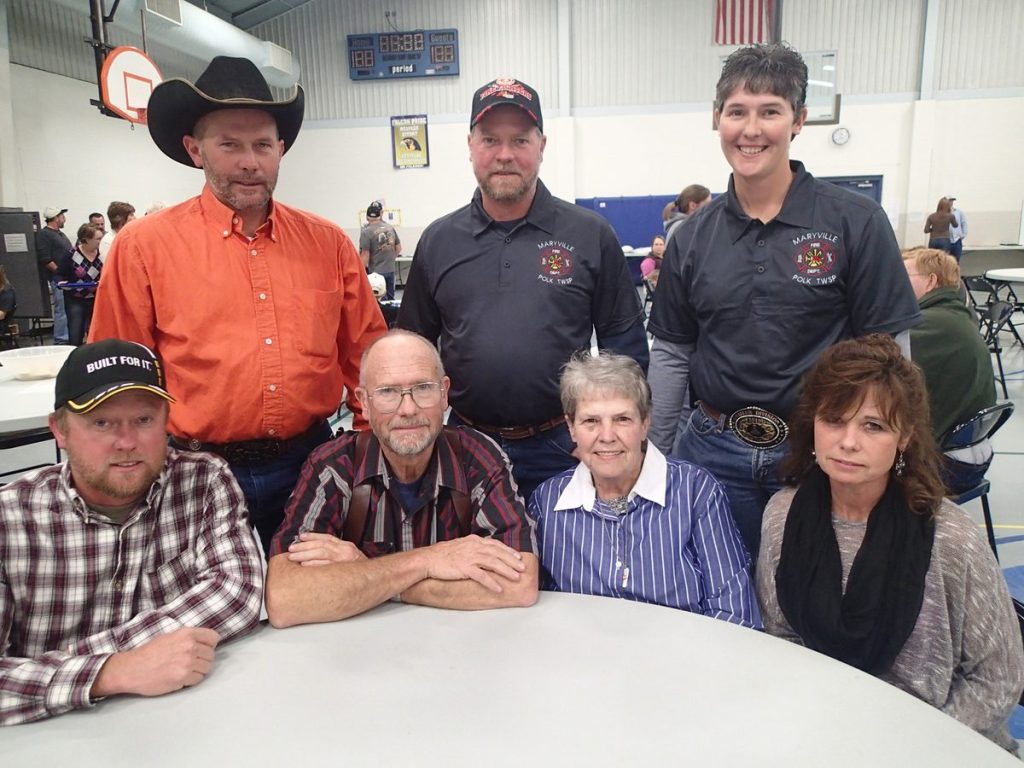
Veteran Maryville firefighter John Redden, third from left, is pictured with his family during a Saturday fundraiser in the St. Gregory’s School gymnasium. The event raised money to help cover medical expenses for Redden, who is battling cancer. Also pictured from left are Redden’s sons, Brad, Chris and John; his wife, Alice; and daughters Angie and Pam.
A friend in need, so the saying goes, is a friend indeed. And on Saturday night Maryville area residents turned out by the score to honor a man who has always acted as a true friend and neighbor when the need was greatest.
Recently retired as the longtime facilities director at Northwest Missouri State University, John Redden is perhaps best known for his nearly 40 years as a volunteer firefighter with both Maryville Public Safety and the Polk Township Fire Protection District.
Though technically separate, the two departments effectively act as a single 30-member force in accordance with a mutual aid agreement.
Redden, who served as a volunteer captain with MPS and a Polk fire district board member, is battling cancer and has finally laid aside his helmet, boots and turnout suit.
But for decades, the wiry man with the broad shoulders, loud cowboy shirts and knowing smile has symbolized the essence of the skilled, committed small-town fireman who, unlike his big-city counterparts, is paid only with gratitude, respect and the satisfaction of doing a dangerous job well.
Capt. Phil Rickabaugh, the professional firefighter who supervises the MPS fire division, has served with Redden since 1985. During a benefit dinner and silent auction Saturday at the St. Gregory’s school gymnasium to help raise money for Redden’s medical expenses, Rickabaugh reflected on his friend and colleague’s years of service.
“He truly cares about these guys (other firefighters) and their well-being,” Rickabaugh said, “and he cares about this community. I could always rely on John when we had a problem. He was somebody we could go to.”
Also attending the chili supper was Redden’s wife, Alice, and the couple’s children: Brad, Pam, Chris, Rick and Angie.
Of the five Redden offspring, Angie, Chris and Rick, are Maryville firefighters as well. All say they learned lessons from their father about the value of service and commitment.
“He’s my dad, and he’s a good one,” Rick Redden said. “We’ve had a lot of good times together, but when you were in trouble, you knew it.”
Added son Chris, “And when you were in trouble and needed something — he was there then, too.”
Daughter Angie Jones said her dad has always made a habit of putting others first, whether that meant members of his family or members of his community.
“Dad worked hard to make sure we had what we needed,” Jones said, “us and anybody else for that matter. He is all about helping people.”
Asked why he decided to become a firefighter, Rick Redden answered, “to follow in Dad’s footprints.”
As for John Redden, he recalls stepping up to serve as a firefighter all those years ago simply because it was “something that needed to be done.”
“They needed volunteers,” he said. “When I started, they would supply us a pair of boots, a coat and a helmet, but no pants. So we went to St. Joseph and bought canvas pants from an Army surplus store. Now it takes $3,000 to put a guy in fire gear.”
Equipment and training for volunteers has improved vastly since the 1970s, said Redden, who neglects to add that many of those improvements came about due to his leadership and guidance.
Time was, he recalled, when firefighters in Maryville entered a burning structure with nothing but a hose, hand tools and a prayer. Nobody wore air tanks
“You’d be inside fighting the fire as long as you could stand it, and then run outside for some fresh air before going back in,” Redden said. “These days, nobody is allowed to go through more than two tanks (of air) and then you’re done.”
In addition to smoke and noxious fumes, firefighters in years past often had to deal with bitter cold in an era when old furnaces and overburdened electrical systems were the rule rather than the exception. The same thing could he said for strict building codes, fire-retardant construction materials and sprinklers.
Redden said that after his “first big, hot fire,” which destroyed a farm supply business on the north side of the Maryville square, he went home literally covered with ice.
“I had to stand in the bathtub while my wife beat the ice off my coat,” he said. “It seems like we never had a big fire unless it was colder than hell.”
An exception to the cold-weather rule was the catastrophic fire that nearly destroyed the Northwest Missouri State University Administration Building on July 24, 1979. But though firefighters didn’t have to battle the elements for a change, the blaze itself was fraught with danger.
Redden helped fight the flames both on the ground and from the inside of the towered campus landmark.
With the fire raging through Deerwester Theater, what was then the north wing, firefighters decided to sacrifice that part of the structure in order to prevent the blaze from moving deeper inside the building.
Redden moved with a group of firefighters onto the second floor where thick smoke made it nearly impossible to see.
“(The statue of) Abraham Lincoln was standing there, and they thought there was somebody standing there, and they kept yelling at him,” Redden said. “He didn’t move and we finally just picked him up and moved him.”
Then the roof of the theater collapsed.
“It just rattled that whole building up there,” Redden said. “It busted windows. There was such a hellacious fuel load. You couldn’t get into it because there was brick all around it, and when the roof burned out, it finally vented and went out. If that roof hadn’t burned off it would have come back into the main building.”
In recent years, Redden has helped develop the university’s growing emergency disaster management program, often assisting with Campus-Community Emergency Response Team training and Missouri Hope, a large-scale disaster simulation held each fall at the Mozingo Outdoor Education Recreation Area.
A storm-ravaged “town” built of large, steel transport containers and used for much of the Missouri Hope simulation is named Redden Village in his honor.
“He gets it,” said Matt Johnson, a Northwest history instructor who teaches in the EDM program and also serves as a Maryville firefighter. “He gets what this university is about and the meshing of the university and community needs.”
EDITOR’S NOTE: Some information and quotes for this story were courteously provided by Mark Hornickel, media relations specialist at Northwest Missouri State University.