Record grain harvest ensures bright future
KAITY HOLTMAN/DAILY FORUM
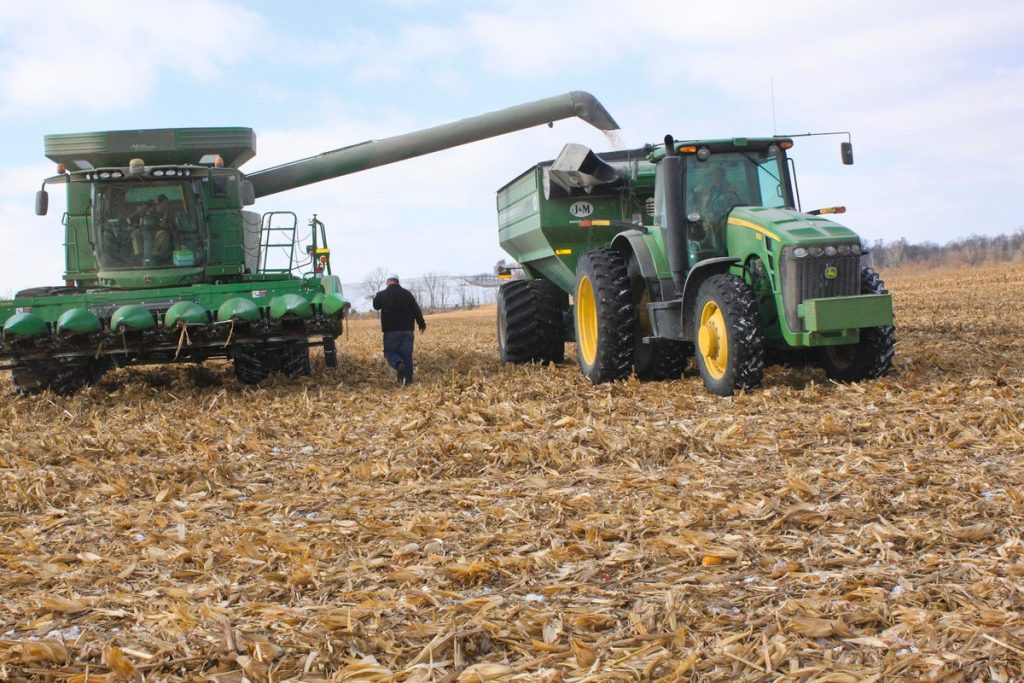
Tim Meyer finished his last day of harvest on Nov. 19, following the season’s first snowfall the previous Saturday. High amounts of rain late in the growing season pushed harvest back by a couple weeks for many growers in Nodaway County.
It’s not every year farmers unload their trucks onto huge piles of corn lying on the ground.
But high rainfall totals and a perfect growing season across the county, state and much of the nation have lead to an overflowing corn and soybean harvest in terms of both quantity and quality.
The United States Department of Agriculture has estimated that the harvested area will total around 3.33 million acres of corn statewide, which is an increase of 4 percent from the previous year. However record-breaking yields are turning the small increase in harvested acres into large increases in total production.
Nodaway County Farm Service Agency Executive Director Tim Dreier attributes high yields and excellent crop conditions to plentiful rainfall.
“The whole state had above-average rainfall, but we were well above average in this region,” Dreier said. “In Nodaway County and in this whole region, Mother Nature took good care of us.”
Northwest Missouri’s progress was slightly behind much of the state as of Nov. 17, but the crop condition in this area is well above other areas of Missouri. Good and excellent crop condition percentages in this area are 49 and 48 percent respectively. In comparison, the area with the next highest quality is northeast Missouri at 59 percent good and 11 percent excellent.
The county’s five-year average was around 120 bushels of corn per acre prior to this year.
“I wouldn’t be surprised to see 160 or even 170,” he said. “With no drought conditions like in 2013, yields have really increased here.”
The Missouri corn yield is forecasted at 181 bushels per acre, up 45 bushels from 2013. If realized, this would be the highest yield on record, surpassing the 2004 crop when producers averaged 162 bushels per acre.
As of Nov. 1, Missouri ranks high in yield and production, according to a report from the U.S. Department of Agriculture’s National Agricultural Statistics Service. The state ranks eighth in corn production, compared to 10th in 2013 and 12th in 2012. Missouri’s yield rankings have jumped considerably at ninth, compared to 24th in 2013 and 39th in 2012.
In terms of soybean production, harvested area is forecasted at 5.6 million acres, which is down slightly from 2013. However, because soybean yields are expected to be 45 bushels per acre, up nine bushels from last year, total production could reach 252 million bushels and break the 2013 record high by 25 percent.
Compared to other top soybean-producing states, Missouri ranks sixth in total production, just above the 2013 ranking of 7th and the 2012 ranking of 8th. In yield, or bushels per acre, Missouri ranks 13th, far above their status as 26th in 2013 and 28th in 2012.
With increased production comes increased exports. Historically, Missouri exports around 30 percent of its corn crop.
“Considering this year’s record corn crop and competitive U.S. corn prices in the world market, this percentage is expected to increase,” said Missouri Corn Merchandising Council Chairman Morris Heitman, who farms in Mound City.
In 2013 Missouri growers produced 435 million bushels of corn, which at a 30-percent rate of export means 130.5 million bushels were exported. If this fall’s production realizes the 603 million-bushel forecast, a 29-percent increase over the 2004 record of 467 bushels, nearly 181 million bushels would be exported.
“On exports, there’s a strong connection between the amount of exports and farm income,” said Missouri Soybean Association executive director Gary Wheeler. “A year of strong yields would give the U.S. more of a crop to export, which certainly helps producers, as well as consumers and our state as those dollars are invested back into our communities.”
High production may make up for low commodity prices. Piles of corn on farms and at grain elevators that aren’t exported will go to livestock feed and ethanol production.
“Livestock consumption has remained steady the last few years, so higher production provides opportunities for increased corn exports and ethanol usage,” Heitman said. “Higher yields are helping some growers compensate for lower corn prices.”
A year of strong yields also means more of the crop would be available for end users, whether that’s a livestock or poultry producer using soybean meal for feed or biodiesel plants converting soybean oil into renewable fuel.
While high yields can be somewhat attributed to a nearly perfect growing season, technology also plays an ever-growing role.
“Our soybean breeders are highly innovative, crossing varieties of soybeans from across the globe to raise yields, as well as the quality, oil and protein content of the crop at harvest” Wheeler said. “Advances in technology help our growers continue to do more with less, from increasing yields to producing more and higher quality fuel.”
This year’s record production reinforces farmers’ abilities to meet all the demands for feed, fuel and exports.
State Agriculture Director and Bethany-area farmer Richard Fordyce commends commodity organizations for developing new markets.
“This year’s outstanding harvest is a great opportunity for Missouri agriculture, but it’s also a challenge to move such a large amount of grain through traditional streams of distribution,” Fordyce said. “The work that has been done over the past decade is going to pay off by providing additional outlets for producers to sell their excess grain.”
Breaking records this year means growers must look ahead to how to break this record to feed an ever-growing world population.
“We’re setting new records in corn production, but our job doesn’t end when the grain is in the bin,” Heitman said. “As we continue to farm smarter, we have to keep our customers in mind. Building relationships with foreign buyers, livestock producers and our ethanol plants is vital to the future success of our industry.”