Aquaponic farming connects family to Haiti
KAITY HOLTMAN/DAILY FORUM
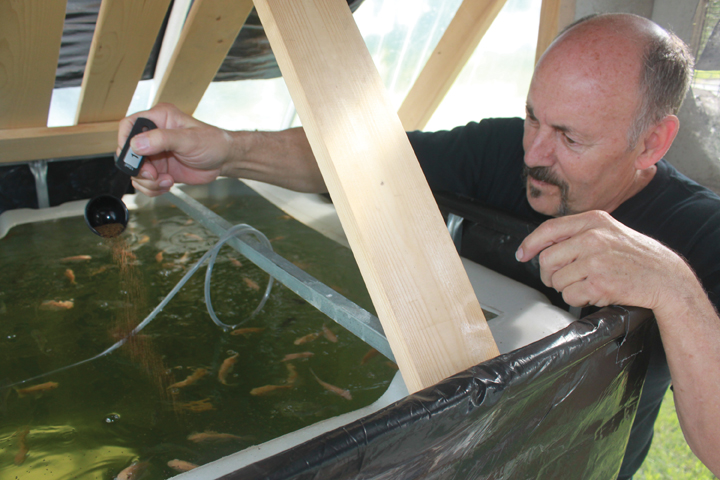
Charlie Bowen feeds the tilapias in his aquaponic greenhouse twice a day. The fish provide nutrients needed to grow a variety of produce for his family.
For the last three years, Maryville resident Charlie Bowen has been raising produce using hydroponic — water-based — methods. This spring, however, he took on a new challenge that goes beyond just produce. He’s making his first attempt at “aquaponics.”
Aquaponic farming combines aquaculture, or raising fish, and hydroponics, or growing produce in water. The fish and produce balance and sustain each other and help each other grow.
In Bowen’s case, he’s raising 100 tilapias in a large fish tank right next to a bed of tomatoes, green beans, watermelons, cucumbers and other produce. He does this in a small greenhouse in his backyard on First Street in Maryville.
Bowen’s raised bed garden is capable of growing enough produce to feed about eight people. The average 4-by-8 foot bed is enough for a family of four.
Bowen’s adopted daughter Lonia came from a family of four in Haiti. She and her birth family are the inspiration for Bowen’s work with aquaponics.
He and his wife, Teresa, adopted Lonia when she was only 11 months old. Because of a medical condition, Lonia couldn’t live at home with her parents and brother, so the Bowens brought her to live with them in Maryville.
“The ultimate goal of fine-tuning aquaponics is to go back over to Haiti and teach families like Lonia’s how to do this,” Bowen said. “Then they could provide for themselves and maybe even have other produce and fish to sell at market.”
Lonia, who sometimes helps Bowen feed the fish, will be 7 years old at the end of July. The Bowens hope to return to Haiti soon to help families in her community with hydroponic and aquaponic farming methods.
Bowen started the produce portion of his aquaponic greenhouse at the beginning of May and added the tilapia about two weeks later.
“The fish serve as a natural fertilizer for the produce,” Bowen said. “So this actually requires less input and work than even hydroponics.”
The system uses water to carry the proper nutrients between the two crops. It fills and drains itself and utilizes a natural process called the nitrogen cycle.
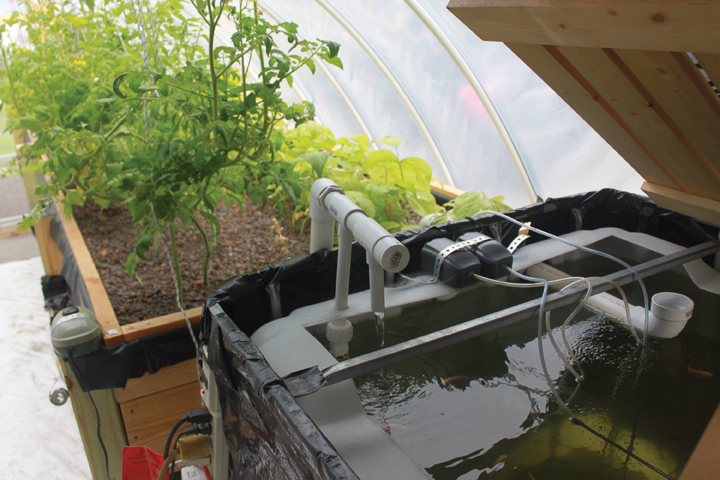
The fish tank fills with water in about 45 minutes. Once the tank is full, another pipe drains the water, impregnated with ammonia from fish waste, along with oxygen, into a reserve tank below the plants in about 20 minutes.
The produce is planted in a bed of pH neutral rock, which is about 12 inches deep. Water submerges about 10 inches of the rock. Bowen chose expanded shale, which he was able to find nearby in Dearborn.
The reserve tank sits under the produce with tarpaulins surrounding it, protecting it from the elements. The tarps keep out the sun and algae, but allow good bacteria to keep growing.
Bacteria — the good kind — convert ammonia to nitrites, and then more good bacteria within the system convert nitrites into nitrates. The produce absorbs the nitrates they need to grow, and bacteria within the rocks absorb the rest.
Nitrites are to fish as carbon monoxide is to humans, which is why the good bacteria are needed to clean toxins from the water before it is drained back into the fish tank.
“When that water drains back into the fish tank, it’s almost completely pure,” Bowen said.
And the cycle begins again.
Bowen feeds the fish twice a day, once in the morning before work and once in the evening. He uses regular fish food and duckweed, which floats on water, grows constantly, and serves as a source of concentrated nutrition.
“The biggest problem can be overfeeding,” he said. “That obviously increases the amount of ammonia they produce and can cause a nitrite spike, which would create more work and possibly missed nitrites for the bacteria on the produce side.”
To make sure this isn’t happening, Bowen runs pH, ammonia and nitrate tests daily.
Bowen bought a combination of blue and white tilapias from a fish farmer in Smithville and hasn’t lost on yet. In eight or nine months the fish will be ready to eat after growing to one or one-and-a-half pounds.
“I chose tilapia fish because they are a hardy fish and usually very tasty,” he said.
Once the bacteria are in full swing, which takers three or four months, the produce should grow two to three times faster than plants cultivated in the traditional manner. The greenhouse system allows production to continue throughout the winter.
“Come winter, I’ll put a double layer of plastic over the greenhouse, put compost around the edges on the ground, and install a solar unit to provide heat,” Bowen said. “It’s said that the double layer of plastic alone puts temperatures about two temp zones south of wherever you are.”
Bowen estimates his start-up cost at between $500 and $600, though he already had a lot of the materials on hand from gardening hydroponically.
“It feeds my family, so the money I don’t spend on groceries means this system repays itself pretty quickly,” he said.
And it’s that sustainability that Bowen hopes will bring a variety of benefits to the families in Haiti.
In the meantime, here in Maryville, Bowen has been discussing what he’s learned with the Lettuce Dream organization, which hopes to build a greenhouse operation that will provide jobs for people coping with developmental disabilities.
“I’ve been giving them advice and have told them I’d help them as they need as they get up and running,” he said.
KAITY HOLTMAN/DAILY FORUM
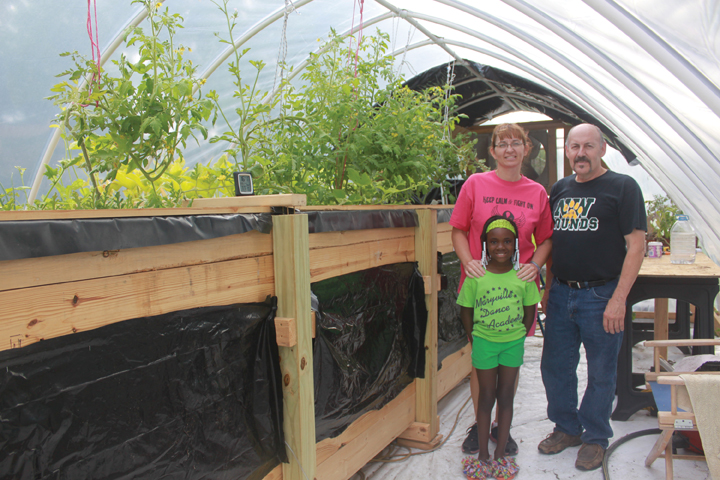
Charlie Bowen poses with his wife, Teresa, and their daughter Lonia next to the produce he is raising as part of a family aquaponics operation.
KAITY HOLTMAN/DAILY FORUM
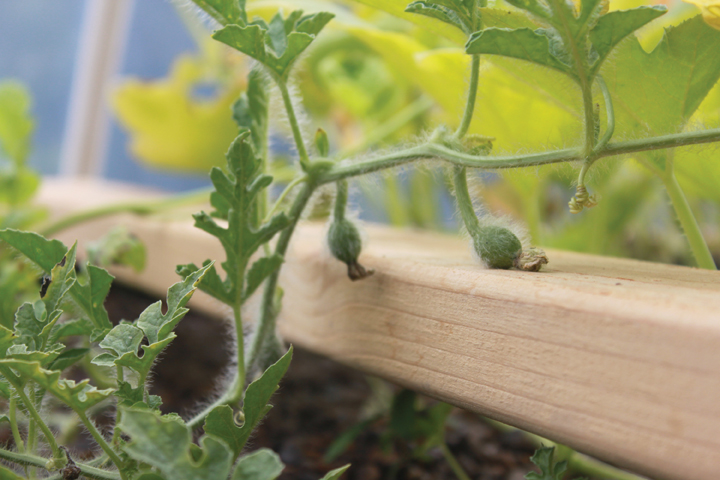
Charlie Bowen has planted a variety of produce in his aquaponic greenhouse, including green beans, tomatoes, cucumbers and watermelons. Once the system is in full swing in the next couple months, the produce is expected to grow two to three times faster than traditionally cultivated plants.
KAITY HOLTMAN/DAILY FORUM
This aquaponic garden allows fish and produce to balance and sustain one another. A drainage system carries water and proper nutrients back and forth between the two crops so that both can continue to grow and provide for the Bowen family.