The big bull of the pull
TONY BROWN/DAILY FORUM
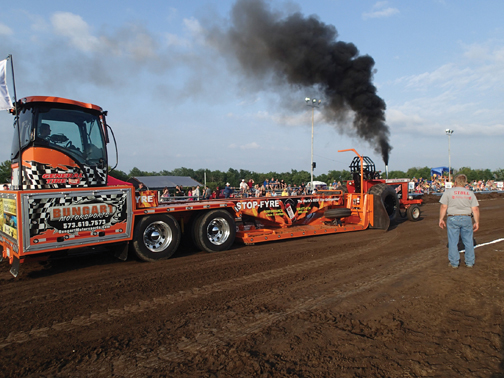
The X-Factor sled adds friction to the rear wheels of a competitor Saturday during the inaugural Graham Lion’s Club tractor pull at Dakota Bronc Sisk Arena. X-Factor is owned and operated by Brandon Bungart, who with his dad, Donnie, owns Bungart Motorsports of Jefferson City. Bungart said he works about 80 such events every summer.
No doubt about it, in northwest Missouri June and July make up of the heart of tractor pull season, which has evolved into a serious motorsport in this part of the country.
A half-dozen pulls have taken place in Nodaway and nearby counties in Missouri and Iowa over the past week or so, attracting scores of drivers and thousands of spectators.
On Saturday evening, nearly 1,000 people attended the Graham Lion’s Club pull at Dakota Bronc Sisk Arena southwest of Maryville. It was the first year for the event, which attracted drivers in eight different classes embracing both tractors and modified trucks.
Tractor pulling has become so popular in the Midwest that the basics of the sport are known even to most town folks. Lovingly customized and heavily souped-up machines are hooked up to a mechanical sled that gradually increases the amount of drag on the tractor’s rear wheels over the course of a straight 300-foot dirt track.
The tractor that travels the greatest distance wins. It’s as simple as that.
For the spectators in the stands, naturally enough, the gaily painted, smoke-belching tractors and trucks attract the most attention. But the device that makes modern tractor pulling possible — that has taken it out of the gravel-road world of county fairs and town picnics into the Interstate realm of big-time sponsors and satellite television — is the sled.
In the early days of tractor pulling in the 19-teens and ’20s competing tractors, often driven onto the fairgrounds straight from the field, hauled sleds weighted down with rocks or concrete blocks.
Later on, after World War II, the step-on method was used, when bib overall-clad men in straw hats and seed caps would sit along the track in folding chairs, then step onto the weighted sled as it moved down the track until the accumulated friction slowed the tractor to a grudging halt.
Then came the mechanized sled, a self-propelled contraption that doesn’t have to be hauled back to the starting line.
Today’s sleds employ a weighted, sliding box which progresses down a massive “pan” that gradually adds to the friction applied to the pulling tractor’s rear wheels. The sled uses a complex system of gears, weights and “grouser bars,” short metal rods that dig into the track, to create the drag needed to stop a pulling machine powered by several hundred horsepower.
At most pulls the drivers are amateurs, usually young farmers or the children and grandchildren of farmers. It’s not uncommon for competitors — of both sexes — to get into the sport at age 13 or 14. And announcers enjoy pointing out the irony that some drivers of these mammoth machines won’t be able to legally get behind the wheel of a car for two or three more years.
But the person operating the sled is a different matter. These folks are grownups, and they have a very difficult and demanding job.
At Graham, the sled driver was Brandon Bungart, who with his dad, Donnie, owns Bungart Motorsports of Jefferson City.
Brandon completed in tractor pulls as a teenager and has been involved with building and driving high-tech sleds for the past ten years. He’s 25.
“I pulled when I was 12, 13, 14 years old,” Bungart said. “Then we began to realize there was a need for sleds in this part of the country.”
These days, Bungart and his father run what is basically a two-man operation with Brandon doing most of the hands-on fabricating.
“I don’t let dad in the shop,” he said.
Bungart Motorsports has built about a dozen sleds, eight of which are owned and used by the company. The others have been sold to operators in other parts of the U.S. Fabrication of the complex machines is accomplished almost completely in house.
“We start with two W-beams (an I-beam with a wide flange) upside down on the floor,” he said.
Both men drive, and Brandon’s dad, Donnie, was behind the sled wheel at the annual Burlington Junction Kiwanis Club pull in late June.
Brandon Bungart said he drives sleds at about 80 events a year, and that Bungart Motorsports provides sleds for 350 pulls annually using contracted operators.
Driving a pull sled, as Brandon describes it, is what in baseball terms would be referred to as a “skill position.” Every track is different, but the relative friction load on the tractors is supposed to be the same.
“It’s not an easy job,” Bungart said, explaining that sled drivers, with the help of a tractor pull manual, make educated guesses about how wet the track is and at what rate friction should be applied to the drivers’ rear wheels.
Which may be why the rig used at the Graham pull, blazoned with sponsor logos, is called the X-Factor.
The sled, powered by a 200 horsepower Deutz motor, weighs 32,000 pounds and, depending on the class, can add between 6,000 and 8,000 pounds of friction as the pulling vehicle muscles it down the track.
Saturday’s pull was a first for the Graham Lion’s Club. Member Kurby Kenny said the event was an effort to produce more revenue for the group’s charitable efforts, which include the service organization’s international vision-impairment program and local scholarships for college-bound young people.
Kenny expressed gratitude for sponsors countywide who made financial and in-kind donations in support of the pull. He also congratulated his fellow club members, who began organizing the pull only six weeks ago.
“The club has really come together and worked together to pull this off,” he said. “We also have a number of young volunteers helping us today, and our hope is that we can introduce them to Lionism and recruit younger people into our club.”