Faith, faithful put Byler’s back in business
TONY BROWN/DAILY FORUM
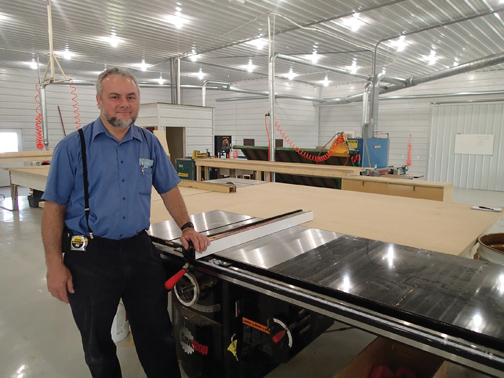
Dale Byler stands in the main shop at Byler’s Woodworking northwest of Maryville. The business was destroyed in a large fire in March, but the Byler family was able to rebuild with the help of their fellow Mennonite believers, scores of whom came to help from across at least three states.
Just a little more than two months after a devastating fire that destroyed virtually everything the Dale Byler family owned, the well-known local cabinetmaker and custom furniture builder is back in business in a rebuilt workshop on Route AB about ten miles northwest of Maryville.
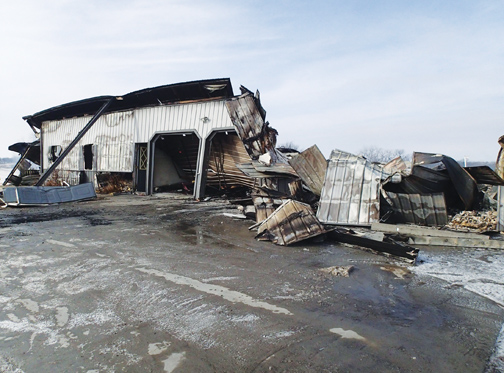
The fire, which claimed both the family’s home and Byler’s workshop/showroom, destroyed tens of thousands of dollars worth of woodworking tools and inventory. It was ignited March 16, while the family was on vacation in Montana, when an engine heater connected to a parked tractor inside the shop malfunctioned.
By the time rural firefighters brought the flames under control, nothing was left but twisted metal and smoking debris. Byler, whose Mennonite faith precludes him from buying insurance, estimated the damage at well over a quarter-million dollars.
But the same faith that prevented Byler, 48, from purchasing fiscal security from a corporation provided assurances of another kind — an abiding belief that God would provide during a time of trial, and the knowledge that his fellow believers would rally to the side of one of their own.
Within days — hours really — after the fire, Mennonite men and women from at least three states began arriving at the Byler homeplace, many of them hauling trailers filled with construction tools and building supplies.
In less than a week the debris was cleared away, and crews of men with carpenter’s belts strapped around their waists were raising framed walls, repairing fire-blackened concrete floors and installing new metal siding.
Standing in the now-glistening, fully equipped woodshop Wednesday morning, Byler said the new facility — at 6,200 square feet — is a third again larger than his old workspace and also includes a 1,600-square-foot showroom.
The shop’s mechanical capabilities have been upgraded as well with an industrial grade dust-removal system and a vintage power upcut saw that will soon be combined with programmable electronics capable of performing 14,000 calculations a second.
The computer power means Byler, along with his son and shop foreman Mervin Byler and full-time woodworker Irvin Sommers, can make cuts with tolerances measured in thousandths of an inch in addition to achieving the maximum number of cuts per board.
Another of the shop’s tools, a massive table saw, is equipped with an electronic sensor that shuts the blade down in literally a fraction of a second whenever it detects moisture. Byler said the safety feature means that a worker inadvertently touching the rotating blade will likely escape with no more than a scratch and all fingers intact.
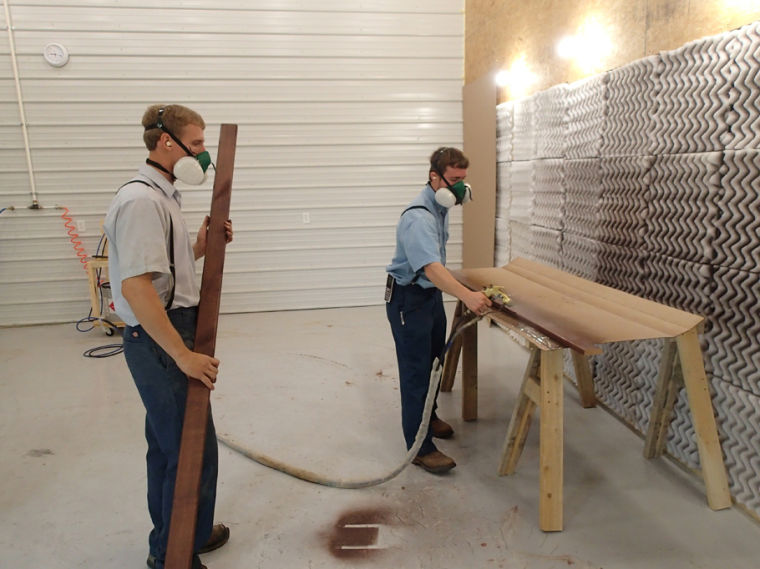
One of the more fascinating additions is a “clean” staining and varnishing room with a ceiling mounted ventilation system that moves a steady stream of air in a single direction from one end of the large space to the other. As workers apply premium wood finishes using pressurized nozzles, small particles of airborne varnish are wafted into a foam wall behind which a large fan pushes the cleansed air outside.
Besides making for a healthier, cleaner workspace, the rig also ensures that excess varnish doesn’t end up back on the lumber where it can roughen the finish.
Though the fire was a heavy financial and emotional blow to Byler, his wife, Mildred, and their five grown children, four of whom still live at home, Byler said the help and support of his brothers and sisters in faith did much to take the sting out of the loss.
Relying on “brotherhood assistance” rather than insurance, he said, is an act of faith that allows Mennonite families to “trust the Lord to meet our needs on a daily basis.”
“We trust God in times of loss,” he said, citing the Bible verse that reads, “Bear ye one another’s burdens.”
Altogether, Byler said, several hundred people arrived in the days after the fire to help the family rebuild, with crews of as many as 50 men and boys working at one time.
And the job isn’t quite finished yet. The shop is rebuilt, but the Byler family is still living with relatives. Byler said he plans to turn part of the currently empty showroom into a temporary residence, but that the family eventually intends to construct a new house nearby.
Byler’s Woodworking, however, is a going concern again, and after several weeks of being shut down for the rebuild, Byler is clearly pleased to be back in business.
“The phone,” he said, “has been ringing off the wall. We’ve got eight or ten cabinet jobs lined up.”
TONY BROWN/DAILY FORUM
Irvin Sommers, left, and Mervin Byler, apply varnish to cut pieces of lumber in the finishing room of Byler Woodworking on Route AB northwest of Maryville. A special airflow system blows excess stain and varnish particles into the foam wall shown at right, which allows craftsmen to create a smoother finish for the shop’s custom-cabinets and hand-built furniture.
TONY BROWN/DAILY FORUM
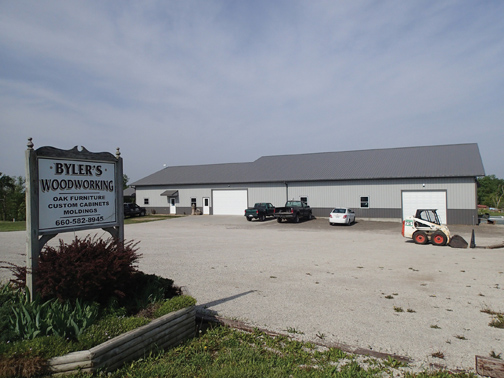
Only a little more than two months after a devastating fire destroyed Byler’s Woodworking, the business is up and running again. The workshop and showroom were rebuilt by crews of Mennonite craftsmen who came to the Bylers’ aide almost before the charred debris of the old shop, which also served as the family’s home, had grown cold. Such “brotherhood assistance” is common within the Mennonite faith tradition, which discourages members from buying insurance.
TONY BROWN/DAILY FORUM
Only a little more than two months after a devastating fire destroyed Byler’s Woodworking, the business is up and running again. The workshop and showroom were rebuilt by crews of Mennonite craftsmen who came to the Bylers’ aide almost before the charred debris of the old shop, which also served as the family’s home, had grown cold. Such “brotherhood assistance” is common within the Mennonite faith tradition, which discourages members from buying insurance.