Honey farmers taste sweet success
STEVE HARTMAN/DAILY FORUM
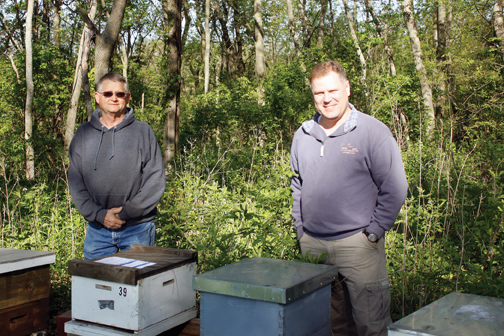
Keith Dougan, left, and Ryan Hargrave own Black Bee Honey Farm located east of Maryville. The two started the company with five hives in 2009 and have since expanded to 60 hives.
What started as a hobby five years ago has grown into a full-scale business for partners Keith Dougan and Ryan Hargrave, co-founders of Black Bee Honey Farm located east of Maryville.
“We started reading about beekeeping and honey production several years ago,” Dougan said. “There was a lot of publicity about bees and honey production, so in 2009 we started the business with five hives.”
The company has expanded quickly. Last year, Black Bee had 48 hives, and this year, they’ve expanded to 60.
“We’ve been producing 1,500-1,800 pounds of honey per year,” Dougan said. “We hope to increase that this year with 60 hives. The goal is to get 60 pounds of honey per hive.”
Several area beekeepers suffered higher-than-normal colony losses this past winter, which was unusually severe. Many colonies reportedly loss rates of up to 50 percent. Dougan has a theory on why this occurred.
“We had such a dry summer in 2013,” Dougan said. “To increase production, a lot of beekeepers, including myself, left the “supers” in too long. We collected too much honey and didn’t leave enough for the bees to have for food during the winter. Bees don’t freeze to death in the winter, they starve.”
To allow their colony to rebuild itself, Dougan and Hargrave shipped their bees to Texas for the winter. Normally, the colony winters at the farm just outside Maryville.
“Several beekeepers winter their bees in Texas or California,” Dougan said. “There is more money in selling bees than in producing honey, so that can be a pretty profitable addition to the honey business.”
Having a queen bee for each colony is crucial for production. Queen bees bring $20-$30 dollars each. A three-pound package of bees, including a queen, sells for $100. While that may sound expensive, the three-pound package contains approximately 10,000 bees. Dougan and Hargrave buy their bees from companies in California and Minnesota.
“We will spread our hives out as the weather warms up,” Dougan said. “In our region, I don’t like to have more than 10 hives in a specific area.”
Bees will collect pollen in a three-mile radius from the hive, and they can travel at speeds of up to 15 miles per hour. While bees don’t collect much pollen from corn, they do well when the hive is located close to soybean fields.
“The bees are pretty self-sufficient,” Dougan said. “You need to keep a constant source of water close to the hive, and I keep a mineral block out for them too.”
Honey extraction occurs during a two-week period from August 1 to August 15. Dougan revealed a lesson he’s learned from his years as a beekeeper.
“I’m kind of a procrastinator by nature,” Dougan said. “But I have learned when it’s time to extract the honey you stop everything else and get it done.”
Black Bee Honey can be purchased at the Maryville Hy-Vee Supermarket and Maryville Florists. In addition to retail sales, the farm sells about 60 pounds of honey a month to the Wabash Junction Restaurant in Stanberry.
“Wabash is a great customer,” Hargrave said. “They work hard to use locally produced ingredients whenever possible, and we supply the honey they use to cook with.”
In addition, many physicians prescribe locally produced honey to patients who suffer from allergies, and Black Bee has several regular customers who buy their honey for that purpose.
Dougan also belongs to Northwest Bee Busters, a club dedicated to helping aspiring beekeepers get started in honey production.
“We have about 20 people at every meeting,” Dougan said. “Bees are so important to the ecosystem here, and there are not many feral bees around the area anymore. So through the club and a class we teach every spring at Northwest Technical School, we try to educate people on beekeeping and help get them started.”
Hargrave shared a story about the bee’s specialized sense of smell.
“I have been stung several times while working with the bees,” Hargrave said. “I began noticing whenever I got stung, I would smell a sort of musky smell. That smell is the bee’s way of alerting the rest of the colony that a threat is in the area. When the rest of the colony smells that musky smell, they will attack.”
Dougan and Hargrave are quick to point out the unique qualities of bees and the honey they produce.
“Bees are unique in that they are the only insect in the world that produces more food than they can use,” Dougan said.
“Honey doesn’t go bad,” Hargrave added. “The worst thing that happens is it can crystallize, but if you warm it up, it’s still good.”