Massive pipe organ permeates basilica with sacred sounds
KEVIN BIRDSELL/DAILY FORUM
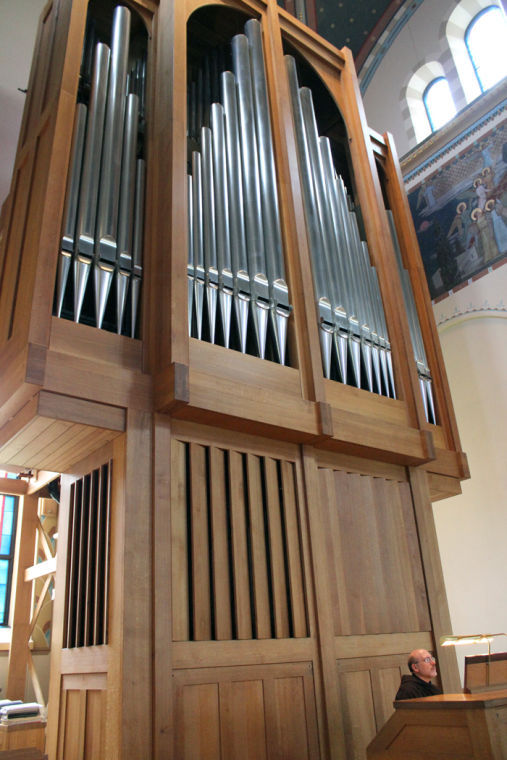
The tallest pipes for the organ in the basilica at Conception Abbey stand more than 16 feet tall. Shown at the keyboard in the lower, right-hand corner of this photo is Brother Michael Marcotte, who, along with Father Timothy Schoen, serves as an organist during abbey worship services.
In 1999, the monks and priests at Conception Abbey in eastern Nodaway County completed a $9 million restoration of the Basilica of the Immaculate Conception, the sanctuary where the brothers meet for Mass and prayers.
One of the highlights of the restoration was the organ, a world-class instrument of the kind usually found in large cities and famous cathedrals.
“It was the very first contract that was signed when we were working on the renewal of the church back in 1991,” said Brother Michael Marcotte, who serves the abbey’s organist. “It kind of went in fits and starts, depending on the fundraising. At certain points they slowed their activity on this because they didn’t want to finish it before the church was done because they wanted to be able to know what the acoustics would sound like.”
Construction of the organ was completed in 1995, but the instrument wasn’t installed until four years later.
“This one was built in 1995 and installed in 1999,” Father Timothy Schoen said. “We were renovating the entire building at the time, and that took longer than we thought. It turns out the organ was ready before the church was.”
The monks decided to go with a mechanical action organ, which uses a mechanical rather than an electric linkage for the keys and pedals that allows air to move through the corresponding pipes.
“We discovered and felt that mechanical action organs are of a higher quality than other organs,” Schoen said. “We discovered we had to replace the organ because of the plans of the renovation of the church building. Given that freedom, we went in this direction. It has been a joy and a pleasure to have it.”
More than 32 feet tall and 18 feet wide, the organ contains 39 ranks of pipes, which contain 2,009 individual pipes. Some of the pipes are made of metal and others are metal.
“It affects the quality of the sound you get, the warmth of the sound you get,” Marcotte said.
The tallest of the pipes stands more than 16 feet, the shortest only a few inches. In order to produce very deep tones, two 16-foot pipes at the rear of the instrument have a connector that allows air to pass through twice. This produces the same sound that would be made by a single 32-foot pipe.
“It is an amazing instrument,” Marcotte said. “In terms of organs, it’s a medium sized instrument. … but there’s no question that it fills this space. It’s the right size for us.”
Once the organ was installed, getting the correct acoustics for the basilica became the first priority.
“The old church had a wood floor, plain wood, unfinished,” Marcotte said. “We knew that changing to brick would be quite a different sound. The acoustics were much more alive when the church was first finished.”
“The acoustic in the building is marvelous,” Schoen said. “To have the two work together is quite an experience. … It was dramatically different right after the renovation, and we discovered we had to temper it a little bit. We had to put some absorbent panels around here and there to temper the sound.”
When the organ was first installed, the sound had a seven second reverberation time, which was too long.
“It’s less now,” Marcotte said. It’s about five-and-a-half now. It’s hard to get a balance between what’s good for singing, what’s good for the organ, and what’s good for public speaking since all are important. We’ve worked hard to try to hit a happy medium between them.
“Music is such an important part of our liturgy, and we wanted this instrument to be able to perform the literature and to accompany the choir. That’s the way it was designed.”
A small company in American Fork, Utah, built the abbey organ. M.L. Bigelow & Co. used a team of about six people to craft all the wood for the instrument. The metal pipes were imported from Holland.
The organ consists of three levels of stops. Stops are the mechanisms that allow air to escape from the pipes and produce sound.
“The stops at the bottom level speak right out to the monastic choir where the monks are chanting for their daily prayers,” Marcotte said. “There are two more levels up above. There’s a division right behind the front pipes called the façade pipes. Then, way up above, there’s another division. You can think of the levels as soft, loud and loudest.”
The keyboard has three levels for the hands plus a single row of pedals.
“The bottom keyboard is called the choir and that controls (the bottom level of pipes),” Marcotte said. “Most of those stops are softer in character. … (The top level) is called the swell, and it controls the middle. Those are mostly solo stops. (The middle) is called the great manual. These are all of the loudest stops. We would only use those for bigger occasions.”
The foot pedals sound lower notes that correspond with the tallest pipes at the rear of the instrument.
In addition, the keyboard console contains pullout switches, also called called stops.
“The stops control motors that control a bar that moves back and forth beneath the pipes,” Marcotte said. “When the holes are lined up with the pipes, the air can come up through the pipes and they can sound. When they are offset, it doesn’t sound. When you pull (the stop) it moves the slider so that the holes are aligned with the pipes and all those pipes are free to speak.”
Some stops are duplicated, depending on which level of pipes they correspond with, which is why there are more stops on the organ than there are sets of pipes.
Stops can be used in conjunction with one another to present a fuller sound. The organ can play a wide range of octaves using only a few keys if multiple stops are pulled.
“It’s kind of like different members of the orchestra,” Marcotte said. “It’s like one person is suddenly multiplying himself.”
The organ’s sounds range from the common tone known as the principle to flute sounds, trumpet sounds and low woodwinds, Marcotte said.
Both Marcotte and Schoen play the organ during services, and both said it was an honor to make music on such a grand instrument.
“There’s a joy and pleasure to give accompanimental support to the community as a worship experience,” Schoen said.