Virus prompts youth to read news
Skye Pournazari
Finley Moutray South Nodaway Fifth Grader
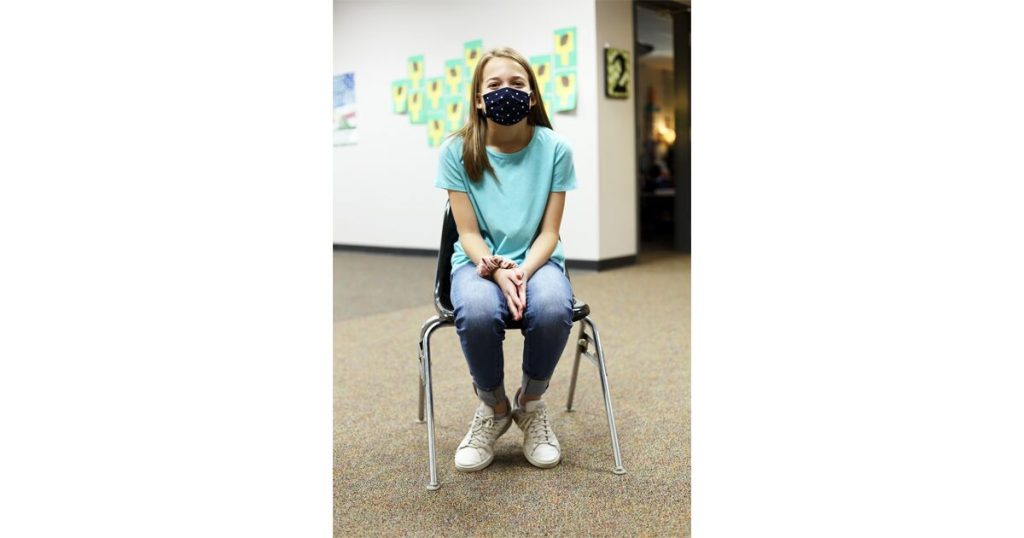
BARNARD, Mo. — Like most K-12 students in the country, Finley Moutray has experienced the COVID-19 pandemic in school and at home. However, this South Nodaway fifth grader, daughter of Josh and Stacey Moutray, has taken it upon herself to be as informed as possible.
“I just think (the school and community) have dealt with it very well,” she said.
Moutray has received a lot of information about the virus and has been paying close attention to her asthma, but it hasn’t been a problem.
“Even wearing a mask hasn’t (bothered me),” she said.
Moutray said the pandemic is discussed often in her family, with her cousin in quarantine and her great-grandmother already beating the virus,
“She’s 95 and beat it,” she said.
One thing she didn’t like this summer was having to stay at home and not being able to go anywhere for summer vacation.
“We couldn’t go this year,” Moutray said. “We were going to go to Yellowstone in Wyoming.”
She is hopeful that her family will get to go next year.
“That’s what we’re planning,” she said.
Another big difference involves her family choosing to have only close family at upcoming holiday meals.
“My great-grandma, she just really wants to be around people, so we decided to just have close family at my grandma’s house,” Moutray said. “We normally have like friends and cousins and everyone.” She said it will be very different, “cause it’s normally big.”
At school in mid-November, Moutray said the district started a mask mandate, which was new for students at South Nodaway.
Wearing a mask has been the most difficult difference to deal with this year compared to last year.
“It’s kind of annoying because you get itches and you can’t take it off,” she said. “It gets hot.”
They do get to remove them when eating, taking drinks, in PE and at recess, which Moutray said is also somewhat changed.
There are two spots on the football field and one on the wood chips area where each class can play separately and take off masks.
“Sometimes if a ball gets loose we can go grab it and come back,” she said.
Moutray explained that other than having to eat lunch in their classrooms, her year had been fairly similar. Previously all elementary school classes ate lunch in the elementary commons.
“I enjoyed seeing … friends in other classes,” Moutray said. “It’s not horrible, but it’s not my favorite thing either.”
Moutray said two of her classmates have been exposed to the new coronavirus.
“There’s one that’s staying home and doing it virtual,” she said.
She said her class has been practicing how to access the online versions of their textbooks and other digital ways to learn remotely in case they would have to switch.
“It’s not quite the same, but … we know how certain things (work) and what to expect,” she said about the experience. “The only thing that would be harder would be like questions. You can’t just go up to her and ask (the teacher).”
Early in the 2019-2020 school year, Moutray said she didn’t have to worry about it, but then had to go virtual in the spring. She enjoys in-person classes a lot more than trying to learn virtually, for numerous reasons.
“I like it a lot better, the only thing that’s kind of nice about not having to be here is you (don’t) have to wake up early,” she said while laughing.
While working virtually, Moutray said there were some difficulties with being muted and learning how to virtually “raise your hand,” so that teachers could see it on the cameras, but the hardest part was not seeing friends.
“That was really hard, not seeing my friends, but we got to do Google Meets, which is like a Facetime or Zoom, and we got to see each other and talk,” she said.
One of the things they did virtually was describe an item with three words so that others in the class could guess it. She chose a softball, because she plays that sport and her classmates were able to guess it.
Moutray also plays fifth and sixth grade basketball, but she doesn’t know how many people will be allowed to watch in person.
“We’ve had one basketball practice so we’re early on,” she said. “I’m nervous that maybe my brother and parents will be the only people who can come.”
She would much rather play with fewer audience members than not play at all.
“I like to play with my friends and it keeps me busy because I can go outside and dribble,” she said.
With the hope of getting things back to normal, Moutray is closely watching the news about possible vaccines.
“I’m hoping that they will have a vaccine, the only thing, I mean they’re kind of trying to rush it, I feel like something could go wrong,” she said.
Reading TIME Magazine for Kids in the classroom, Moutray has learned about companies trying to make a vaccine as quickly as possible.
“I want it to be as quick as possible, but I don’t want them to rush it and it not work,” she said.
Moutray said even if a vaccine becomes widely available, she still thinks everyone will need to be careful next year.
“We’re not that big of a school, so it might be not as bad as others, if it’s still (around),” she said. “It’s not just going to go away.
Editor’s Note
This feature was published in The Maryville Forum as a two-part series on Thursday, Dec. 3 and Thursday, Dec. 10. Articles may have been edited for space within the print edition, but will be available at full length at The Forum’s online focus on COVID-19 in the Community.
To give readers an idea of student knowledge and concerns regarding the pandemic, one student’s story will be posted each weekday at 6 p.m. through the end of 2020.