Mosaic administers first COVID-19 vaccine in county
SKYE POURNAZARI/THE FORUM
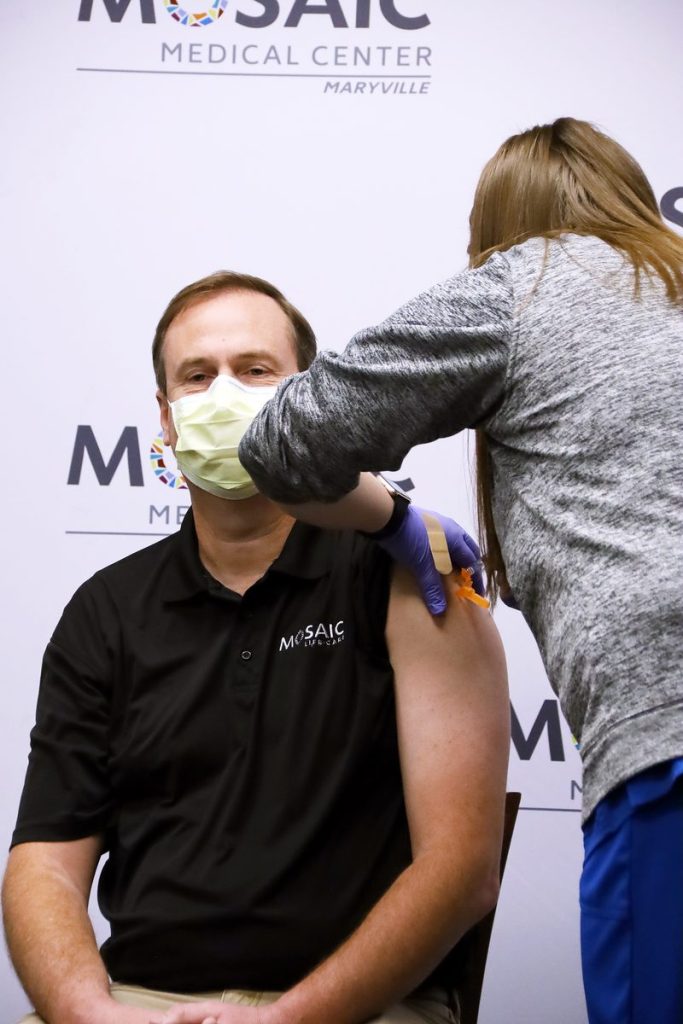
Dr. J. Michael Feuerbacher, family practice physician, receives his first dose of the Pfizer COVID-19 vaccine Tuesday from nurse Brooke Wolf at Mosaic Medical Center – Maryville. He spoke about mechanics of the vaccine and how it works to combat the COVID-19 virus.
MARYVILLE, Mo. — The first vaccine for COVID-19 in Nodaway County was administered Tuesday at Mosaic Medical Center – Maryville.
A day after the hospital received its initial shipment of Pfizer-BioNTech’s vaccine, Dr. Sally Bomar, a family practice physician at MMC-M, became the first in the county to receive it during an event held for local media Tuesday afternoon. Four others also received the first doses of the vaccine: Dr. J. Michael Feuerbacher and nurses Patricia LaFoy, Misty Millions and Andrea Sandusky-Ury.
Over the next week, the hospital expects to administer more than 100 doses, and additional doses will be given based on demand by health care workers. The first ones will be given to frontline workers who have direct contact with patients, and have not had COVID-19 within the last 90 days. MMC-M President Nate Blackford said that employees will sign up to receive the vaccine and will be encouraged to do so, but will not be required. He said about 75 percent have signed up so far, with more expected as the eligibility pool expands.
The volunteers Tuesday, who will return in 21 days for their second dose, said they wanted to be the first in order to show confidence in the vaccine.
“I think people want to know if you individually are willing to do it — and obviously I am,” Bomar said. “I’ve had that question asked of me a lot the last couple of weeks.”
Blackford said that health care workers are frequently fighting an uphill battle against misinformation, whether it’s unfounded rumors about the effects of the vaccine — which he said so far have been mild — or the far-reaching effects of the virus itself.
“It’s kind of frustrating sometimes to see those who maybe don’t appreciate what’s really happening,” Blackford said. “It’s a big deal. A lot of lives have been impacted.”
Nowhere has that impact been more evident than at hospitals like MMC-M. The doctors and nurses present Tuesday were in a jubilant mood over the vaccine’s arrival, and the turning of a corner that it signaled — mostly because it means they can remain at work. At one point in November, up to 10 percent of MMC-M staff were quarantined because of COVID-19 — making the availability of doctors and nurses just as important as the availability of beds and equipment, Blackford said.
“The ultimate goal is to get our caregivers vaccinated so that they can work,” said Debbie Hoffman, vice president of patient services at MMC-M. “We need our caregivers here to take care of our patients. It puts a strain on our staff if they get sick, so that is the ultimate goal, is to keep our caregivers here, keep them healthy so that we can keep taking care of our community.”
In addition to being inundated with more patients and more stress, nurses have found themselves with even more responsibility for patients since they can’t receive visitors.
“They’re meeting all their needs, you know?” said Sandusky-Ury, nurse manager, infusion house supervisor at MMC-M. “They’re drawing their blood, they’re providing the medications and assessments that they normally do, but they’re also the only social interaction that our patients are receiving when they’re here.”
“Ten months of dealing with this is exhausting,” Blackford said. “It’s difficult for our patients, it’s difficult for our caregivers. Our caregivers have shown just an amazing amount of resiliency and willingness to deal with the unknown and the uncertainty that’s come with this, and I can’t be more proud of the group that each of these individuals represent. At the same time, it doesn’t take away the human side of this, which is, we’re tired, we’re worn out, we’ve seen sad stories, we’ve seen tough circumstances.
“… At the risk of being too dramatic, we have some real heroes running around here who have done some amazing things without complaining, without a lot of … media attention on the difficulty that’s going on here.”
That difficulty, the health care leaders assembled Tuesday agreed, has become a way of life for doctors and nurses at the hospital.
“When someone that’s not (in) health care is under quarantine, they have to stay home for 14 days,” Feuerbacher said. “Well, we still go to work, we’re still constantly being exposed. So we have that fear of, what are we doing to our families when we go home? And we’ve been having to do that for months now.”
LaFoy said that the vaccine gives her hope that she’ll be able to see her own mother soon.
“My mother just had a liver transplant and I can’t go see her,” LaFoy added. “I don’t know when I’ll be able to go see her. She called me the other day crying because she wants to see her family. Well, I’ve got a sister who’s a nurse too — we can’t come see her. But soon.”
Blackford cautioned that although the first vaccine being administered in Nodaway County is a big step, there are several months of steps left until the threat posed by COVID-19 can truly be mitigated through a vaccine administered widely to the general public.
“As much as this is an exciting day and we’re starting to turn the corner, this is not the end of our battle with COVID,” Blackford said. “So, masks, social distancing, hand hygiene — all the tools we have available to us are going to continue to be very important over the next several months as we continue to battle this.”
Vaccine FAQs
Are the vaccines safe?
Yes, an FDA analysis shows that the two vaccines being administered across the country now show “no specific safety concerns.”
When can I receive a vaccine?
Probably not for at least a month or two. The Missouri Department of Health and Senior Services’ vaccine rollout plan places the highest priority on health care workers who work with the elderly, are patient-facing or have underlying health conditions themselves. This rollout has begun in Nodaway County, with doctors and nurses at Mosaic Medical Center – Maryville having begun to receive the vaccine, and with about 75 home health workers throughout the county set to receive their first shots next week.
The next tier includes first responders, high-risk people age 65 or over, child care workers, teachers and other school employees, essential utility workers, critical manufacturing workers, agricultural workers and other essential employees. Then comes the general population.
Because that terminology is vague, the exact rollout will likely vary county by county, but Nodaway County Health Department Administrator Tom Patterson has said that he expects it will take at least a few months for the vaccination pool to expand to significant portions of the general population, and Mosaic Medical Center – Maryville President Nate Blackford said the process could extend into the fall of 2021.
What side effects should I expect?
In the Pfizer and Moderna trials, recipients reported mild symptoms like sore arms, redness at the injection site, headaches or fatigue, and some more moderate symptoms of those types could be expected.
Should I still wear a mask and social distance after receiving the vaccine?
Yes, the CDC recommends continuing mitigation strategies because the vaccines have been tested on whether they prevent symptoms, not whether they prevent infection. So, it’s possible that even if you receive the vaccine, you can still catch — and pass on — COVID-19. Since not many people have received the vaccine yet, it’s safest to continue wearing masks and social distancing.
What’s the difference between the two vaccines?
Both Pfizer BioNTech’s and Moderna’s vaccines deliver mRNA that tell your body’s immune system to make antibodies to the familiar spikes on the coronavirus, making it ready to fight off any infection from them. Both vaccines have shown similar efficacy levels of near 95 percent.
Pfizer’s vaccine comes in two doses 21 days apart, while Moderna’s comes in two doses 28 days apart.
Pfizer’s vaccine must be kept in extremely cold storage of about -75 degrees Celsius, while Moderna’s can be stored at normal freezer temperatures of about -20 degrees Celsius.
SKYE POURNAZARI/THE FORUM
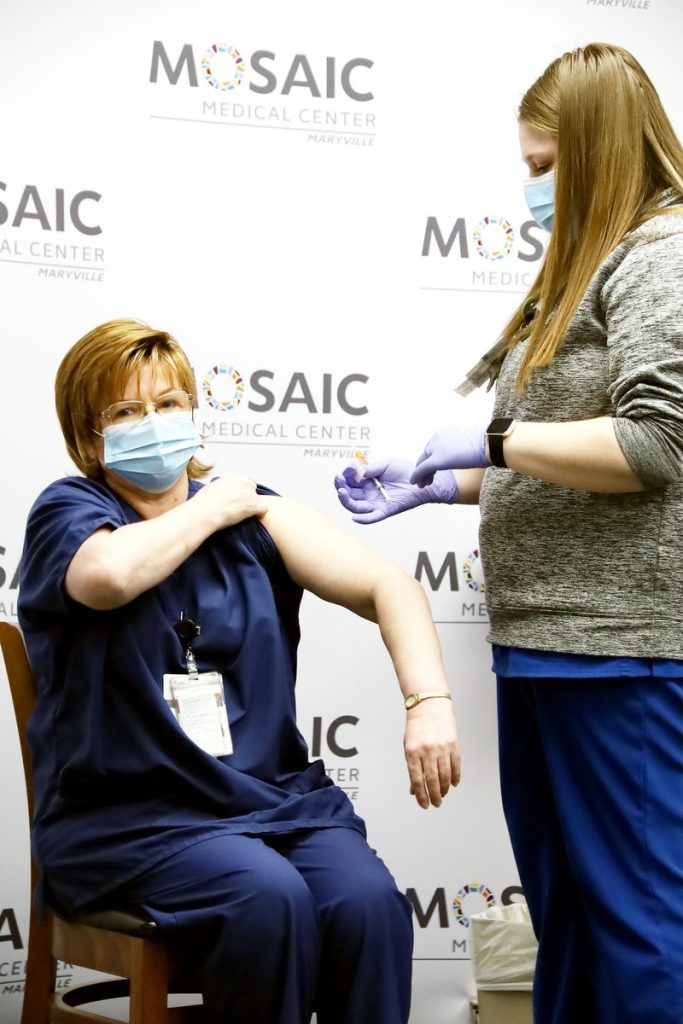
Registered Nurse Patricia LaFoy, left, who works in the COVID-19 unit at Mosaic Medical Center – Maryville, rolls up her sleeve to receive the Pfizer COVID-19 vaccination from nurse Brooke Wolf on Tuesday at Mosaic Medical Center – Maryville.
SKYE POURNAZARI/THE FORUM
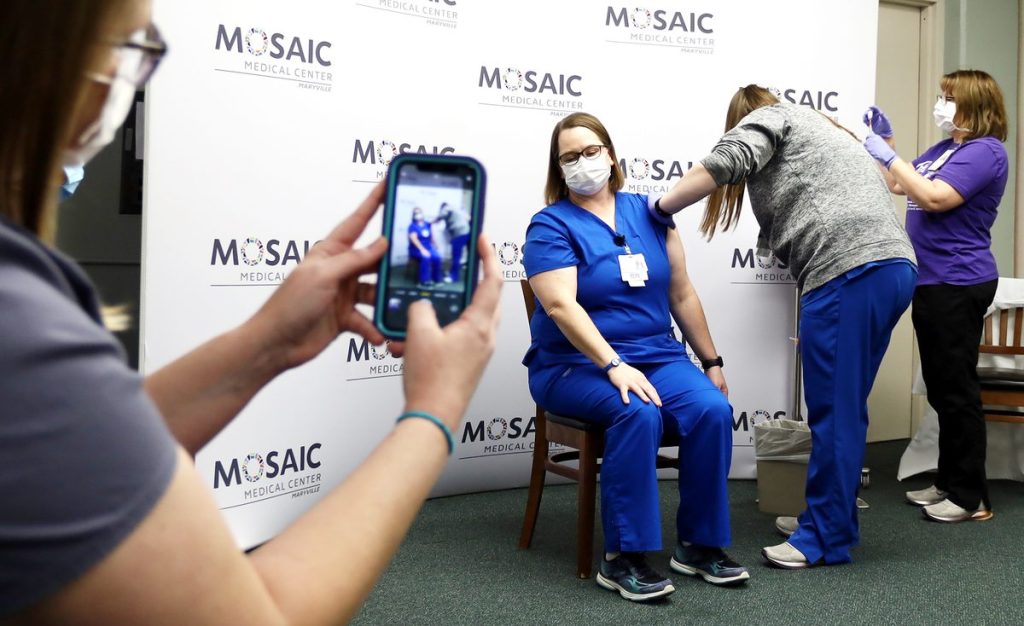
Misty Millions, LPN, takes a photo of fellow nurse Andrea Sandusky-Ury, RN, BSN, as she readies to receive her first dose of the COVID-19 vaccine during a news conference held Tuesday at Mosaic Medical Center – Maryville. Nurse Brooke Wolf and Dr. Sally Bomar prepare the COVID-19 vaccine to be given. According to Community Liaison Bridget Kenny the vaccine comes frozen, is then thawed and mixed with saline before it can be given.
SKYE POURNAZARI/THE FORUM
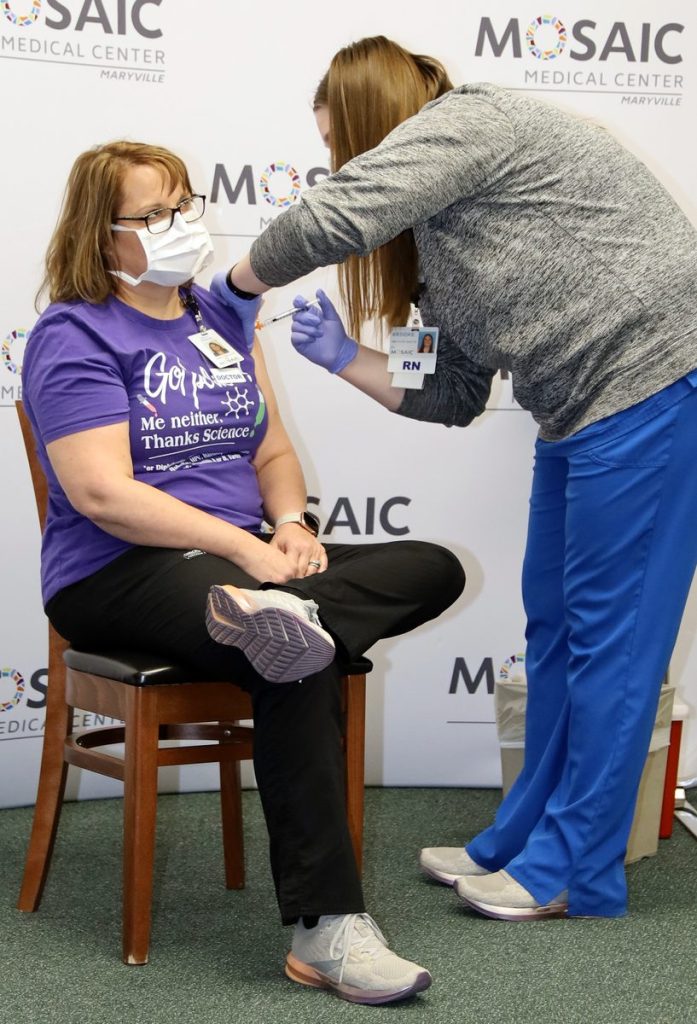
Dr. Sally Bomar, family practice physician, receives her first dose of the Pfizer COVID-19 vaccine from nurse Brooke Wolf on Tuesday at Mosaic Medical Center – Maryville. Bomar expressed her trust of the vaccine and hope that by getting the vaccine she will help others in the community feel safe receiving it when it becomes available to them.
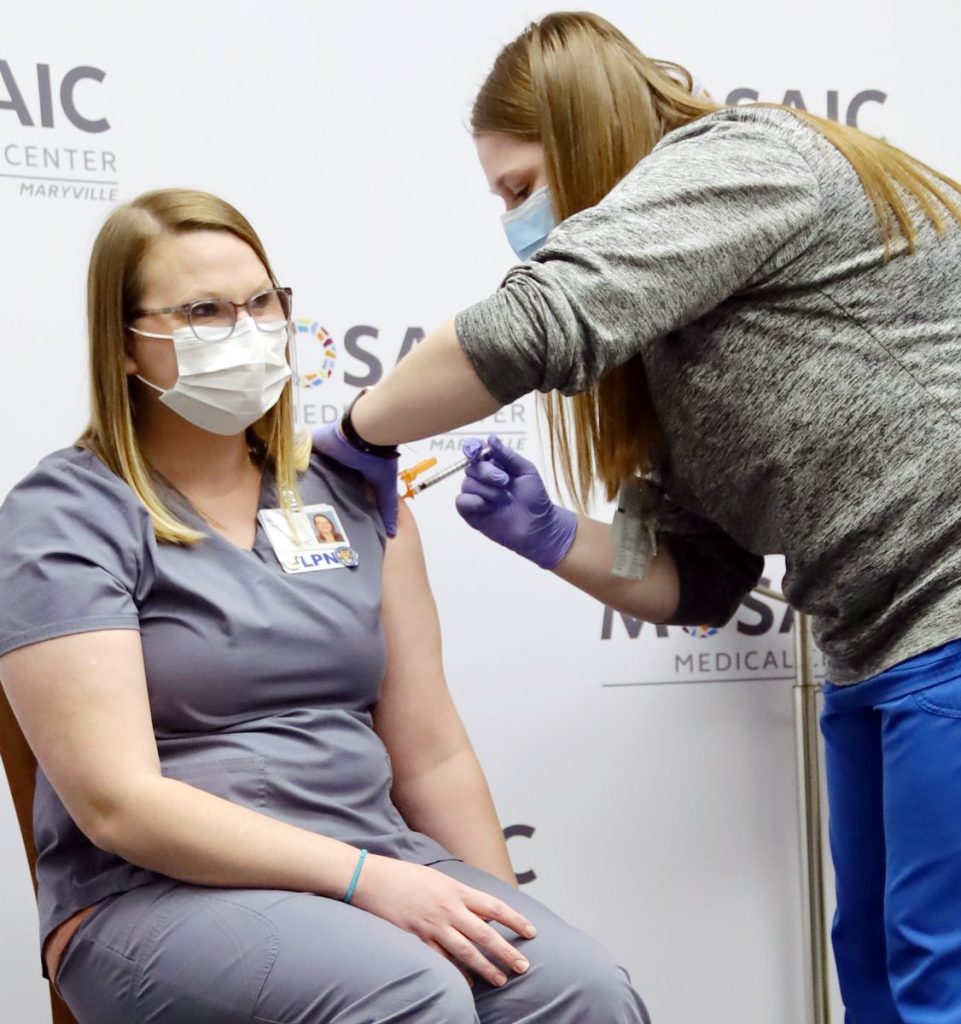
SKYE POURNAZARI/THE FORUM
Misty Millions, LPN, receives her first dose of the Pfizer COVID-19 vaccine Tuesday from Brooke Wolf, RN, at Mosaic Medical Center – Maryville. Millions works at MMC-M’s walk-in/respiratory clinic and said early in the pandemic the clinic saw 100 people a day. Though that number has decreased since that time, she noted that it still increases and decreases around big holidays and gatherings.
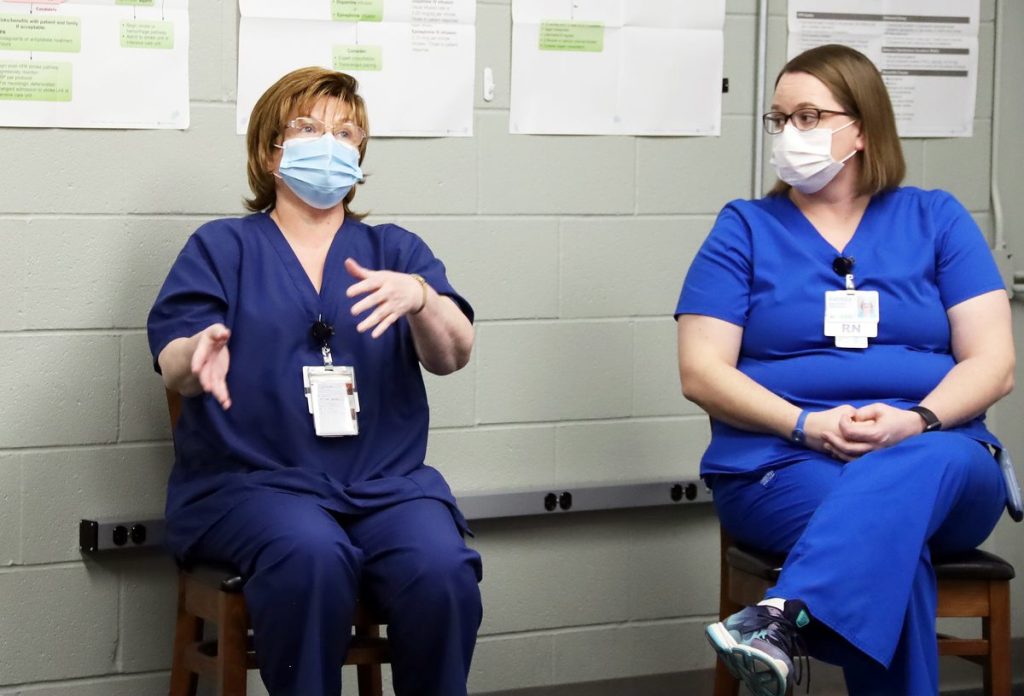
SKYE POURNAZARI/THE FORUM
Registered Nurse Patricia LaFoy, left, who works in the COVID-19 unit at Mosaic Medical Center – Maryville, talks during a news conference Tuesday afternoon at the hospital. She spoke about encountering difficulties not being able to see her mother who recently had a liver transplant, because of her need to stay quarantined from family while working through the pandemic. RN Andrea Sandusky-Ury, right, listened and expressed some of her own struggles during the pandemic.
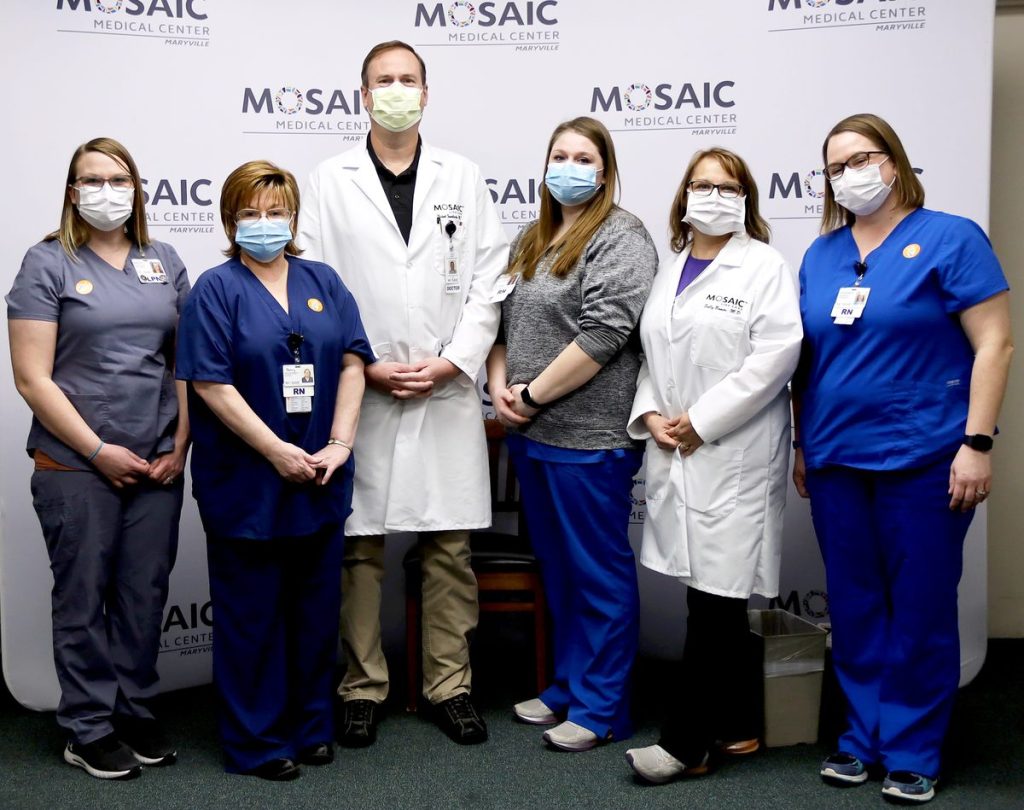
SKYE POURNAZARI/THE FORUM
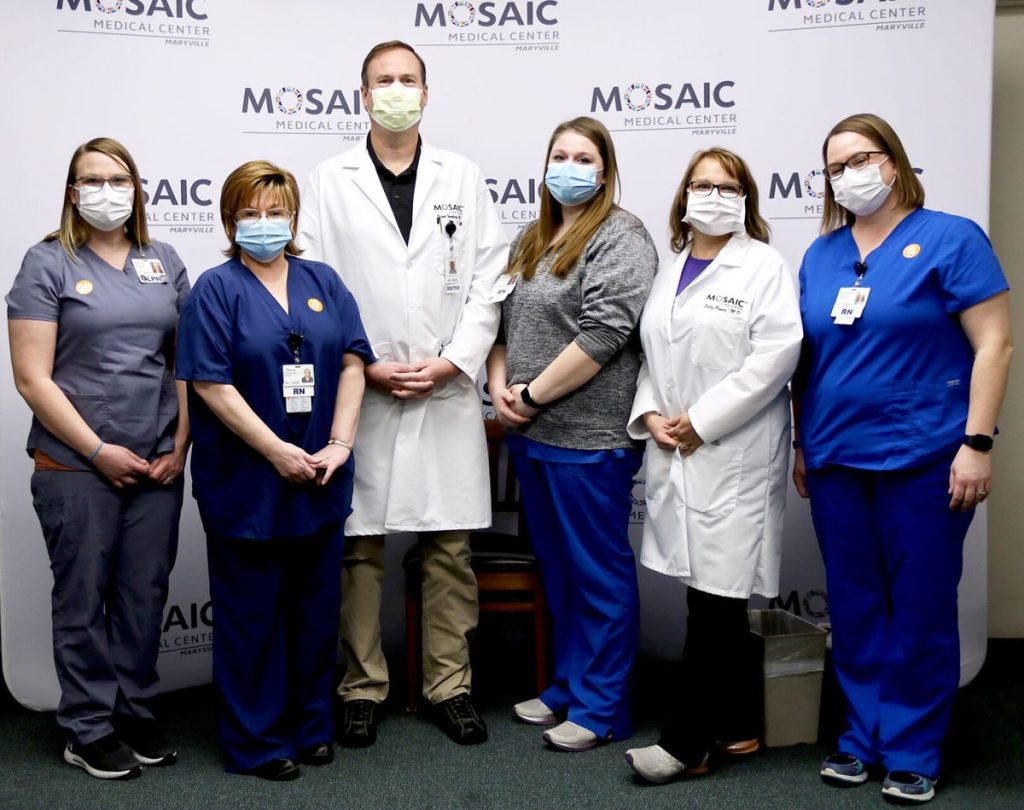
To show their confidence in the COVID-19 vaccines, five staff members at Mosaic Medical Center – Maryville received a first dose of the Pfizer COVID-19 on Tuesday during a press conference held at the hospital. Shown from left are: Misty Millions, LPN, practice manager, at Mosaic Specialty Care – East in the Walk-in/Respiratory Clinic; Patricia LaFoy, RN, medical/surgical (inpatient COVID-19) unit; Dr. J. Michael Feuerbacher, MD, family practice physician; Brooke Wolf, RN; Dr. Sally Bomar, MD, family practice physician; and Andrea Sandusky-Ury, RN, BSN, nurse manager, infusion and house supervisors. Wolf gave the vaccinations.
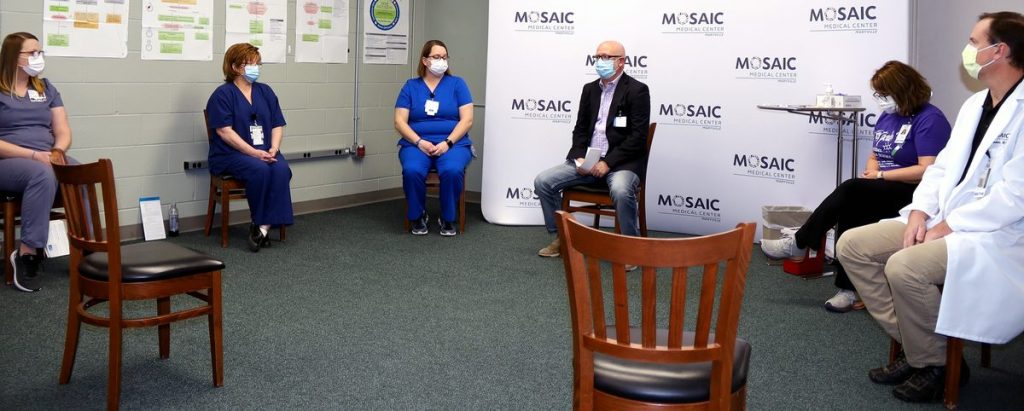
SKYE POURNAZARI/THE FORUM
At center, Mosaic Medical Center – Maryville President Nate Blackford talks about the Mosaic Life Care system’s use of the COVID-19 doses it received during a news conference Tuesday afternoon at the hospital. To show their confidence in the vaccine, five members of the MMC-M staff received their first dose of the Pfizer vaccine during the conference.