Use tax revenues up as online shopping increases
CITY OF MARYVILLE
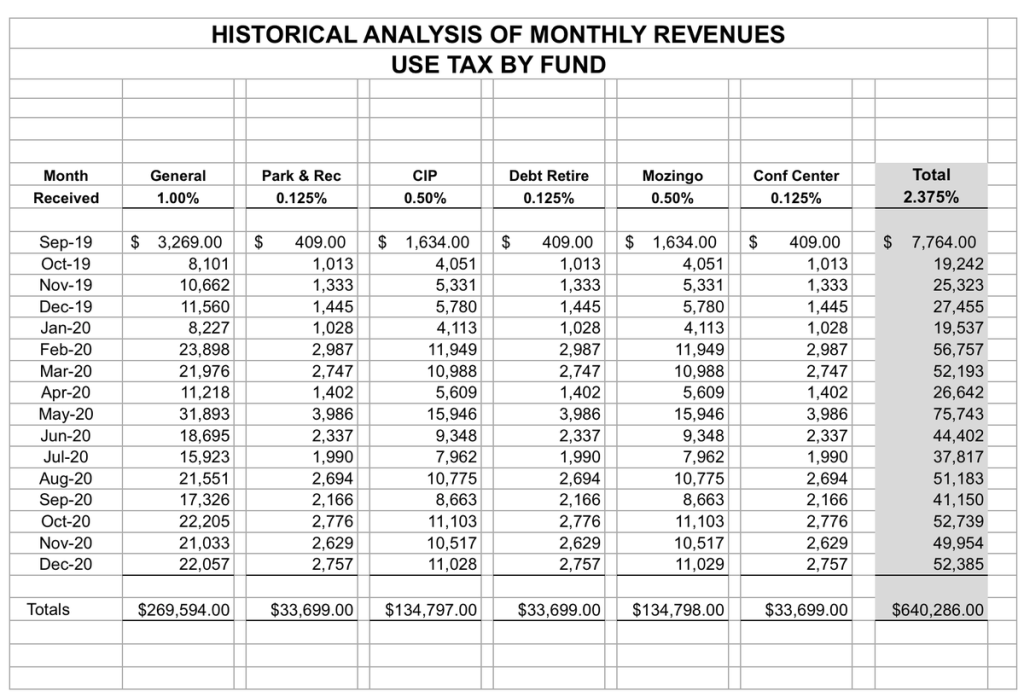
Historical analysis of Monthly Revenues Use Tax Fund
MARYVILLE, Mo. — Despite the pandemic, sales tax numbers have remained relatively steady, but use tax revenue in particular has spiked significantly as many shoppers turn to online options.
According to records provided by Maryville City Manager Greg McDanel, use tax revenues reached record highs this summer, especially during the period of statewide and citywide stay-at-home orders, and continue at far higher levels than last year.
The use tax, passed by voters last year, applies the same 2.375 percent municipal sales tax to online purchases as the one applied to in-store purchases within city limits. Prior to its passage, online purchases shipped within city limits were subject only to state and county sales taxes, not the city’s sales tax.
From October 2019 through March 2020, the first six full months the city collected use tax revenues, the city averaged $33,418 in use tax revenue per month. Over the next six months, the monthly average was $46,156, and year-to-year comparisons of the same months show significant growth as well.
Overall in fiscal year 2020, the use tax brought in $477,444 — nearly double what the city had estimated a typical year might look like.
“In November 2018 and April 2019, the city used 2017 online sales data from the State of Missouri Department of Revenue and anticipated a full year’s revenue being $250,000,” McDanel told The Forum in an email. “In line with the growing trend of online sales, the use tax continues to increase which provides support and additional revenues for various voter approved initiatives.”
The highest month of revenue, by far, was collected in May: $75,743 — nearly $19,000 higher than the next-highest month. McDanel said that a month’s revenues typically reflect about a two-month lag from when the money was spent, but depend on when the state, which collects the tax, distributes the revenue back to municipalities.
Additionally, revenues from October-December have come in at more than double last year’s totals for each month as well, averaging $51,693 per month over those three months.
McDanel said that much of the money is not only being spent on out-of-town online retailers, but locally as well — revenues that would not have been generated for local residents without the use tax.
“Anecdotally, while the pandemic has undoubtedly hurt local sales it is believed that more customers are shopping online (use tax) and often in the community vs. St. Joseph, KC, etc.,” he said. “When customers take advantage of ‘convenience’ shopping during the pandemic, such as ordering online pick-up at the local Walmart, they are still contributing to the public purposes through the use tax. Prior to its approval in April 2019, this was not the case.”
Revenues from the use tax go to several city funds, with the biggest chunk going to general revenue.