Superintendents call for shorter quarantine times
CDC
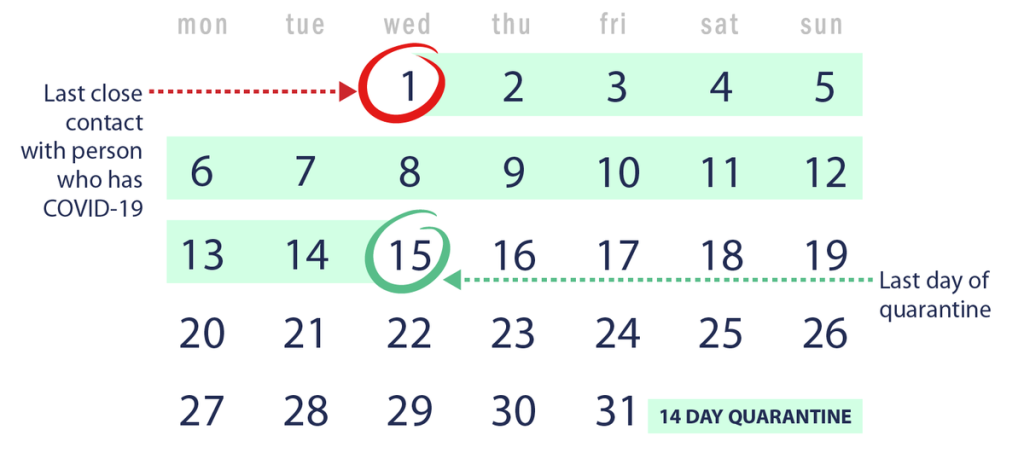
This calendar from the Centers for Disease Control and Prevention shows its recommended 14-day quarantine period. Local superintendents have signed a letter sent to Gov. Mike Parson regarding possible changes to quarantine guidance.
MARYVILLE, Mo. — Last month, more than a dozen northwest Missouri superintendents — including all superintendents representing Nodaway County public schools — sent a letter to Gov. Mike Parson and other state officials asking to shorten the length of quarantine for students who have come in contact with those who have tested positive for COVID-19.
The request is similar to other efforts by parents and school administrators across the state — and nation — to reduce the time that students must spend in quarantine. Each time a student is deemed a close contact of someone with COVID-19 — that is, spends 15 minutes within six feet of someone who has tested positive — the student is sent home for 14 days to help prevent the spread of the virus.
That has disrupted classrooms across the country, including in Nodaway County. In the letter, the northwest Missouri superintendents estimated that 1,430 students had been quarantined in their districts while only 59 students had tested positive.
The quarantine guidelines issued by the Missouri Department of Elementary and Secondary Education are in lockstep with the state health department and the CDC, all of which recommend 14 days of quarantine for close contacts. But some health departments and school districts in the state have changed their local rules to allow for shorter quarantines in some cases.
In Newton County, some districts accepted new guidance from the local health department and allowed close contacts to attend school as long as they wore a mask and did not show symptoms. The Seneca R-VII district in Newton County went further, forcing close contacts who return to school to also submit to two temperature checks per day and separating them during meal times.
Last week, the Boonville R-I school district voted to begin a trial period for a new policy that would not require close contacts to quarantine as long as both parties were wearing a mask at the time of exposure. And health officials in Randolph County are looking at a similar measure. That strategy has been implemented statewide in Iowa as well.
In Nodaway County, the idea has already gotten some traction with public officials. In addition to the superintendents, who unanimously supported the idea of a shortened quarantine, the Nodaway County Commission looked into the possibility of classifying students as “essential,” much like teachers in the county already are, which would grant them an exemption from quarantine rules.
In September, the commission met with its attorney to discuss the possibility and contacted some superintendents about the plan, but ultimately decided that it couldn’t do so without opening itself up to liability. Presiding Commissioner Bill Walker said at the time that state officials would need to be the ones to change the policy, and encouraged them to do so.
The letter sent by the superintendents asks those state officials to reduce the quarantine period to 5-7 days, citing conversations with “many” local health experts who “shared evidence of approximately 5 days as the optimal range for symptom onset.”
“A shortened quarantine, perhaps 5 to 7 days, would respect this contagious window and simultaneously preserve students’ education,” the letter states.
The CDC notes that the median time from exposure to symptom onset is thought to be 4-5 days, but does not link symptoms to how contagious a person might be. Many people who test positive for COVID-19 are asymptomatic.
“I’m not aware of specific information about significantly lower contagiousness after a week,” said Tom Patterson, Nodaway County Health Department administrator, in an email to The Forum. “That would be more applicable to a positive case if accurate.”
Although the CDC is reportedly looking at whether there is enough data to support a claim like that made by the superintendents, it has issued no new guidance to that effect, nor have local health officials.
“‘If’ development of disease occurs primarily in the first half of the 14 day quarantine we might expect changes to guidance,” said Patterson said. “However, as is common with communicable diseases, the overall response strategy can be boiled down to identifying and containing the disease. We should anticipate that CDC will hold off on any adjustments to quarantine until data supports it.”
Patterson said that the 14-day quarantine period mirrors the disease incubation period, which is backed by the CDC’s current guidance.
“While in quarantine, development of symptoms could signal disease,” he said. “Since people can be contagious for up to two days prior to symptom onset, and because COVID-19 is primarily transmitted by way of contact with a positive case, close contacts are asked to quarantine. If they’ve made it to the end of (the) 14 day incubation period without issue they should be clear of that episode.”
The letter also advocates for eliminating quarantine periods entirely if both the close contact and the person who tested positive were wearing masks at the time of exposure, saying that such a measure would likely result in students being more willing to wear masks as well.
Patterson said he supports the districts’ efforts to figure out the best way forward for them individually.
“I encourage all of us to support our school districts,” Patterson said. “Each of them are implementing strategies that work best for them to comply with state guidelines. And people should keep in mind that there are other viewpoints too.”
Complicating the superintendents’ pleas, however, is their refusal to release regular data on how COVID-19 has affected their districts. Currently, the only district in Nodaway County that regularly releases data on the number of students in quarantine or who have tested positive is Maryville R-II — every other public school in the county has stayed true to their promise to not do the same, with some citing privacy concerns.
Without numbers from individual districts, it’s unclear how big of an issue student quarantines are for each one. In Maryville, the district has seen 424 student quarantines from 22 positive cases as of the most recent update on Oct. 30.
Letter to Gov. Parson
October 20, 2020
Governor Parsons,
MO Department of Health & Senior Services Deputy Director Fischer,
Department of Elementary & Secondary Education Commissioner Vandeven:
On behalf of the children and families in our communities, we as a collective group of school superintendents from Northwest Missouri request changes in quarantine guidance given to our county health departments. We feel sufficient evidence exists to support our suggestions and respectfully request your immediate consideration.
We suggest the following changes to quarantine recommendations for students:
- Shorten the length of quarantine.
- a. Many of our local health experts have shared evidence of approximately 5 days as the optimal range for symptom onset. A shortened quarantine, perhaps 5 or 7 days, would respect this contagious window and simultaneously preserve students’ education.
- Eliminate a quarantine if the close contact with a positive occurred while both individuals were wearing face coverings.
- a. Many of our districts, and some towns, have mask mandates. Staff and students are following these to add layers of protection. If wearing the face covering would eliminate the need for quarantine, compliance would be viewed more favorably, easier to explain, and preserve students’ education.
We believe the positive impacts of making either or both of these changes far outweigh the potential consequence of spreading the virus. Our districts are all hosting in-person classes, and there doesn’t seem to be many students contracting or spreading the virus. In a poll of 20 school districts in rural Northwest Missouri, a total of 1,430 students have suffered through at least one quarantine during this fall term. Some have endured multiple quarantines. Of these, only 59 students (4.1% of those quarantined or .0046% of these districts’ total enrollment of 12,732 students) have actually tested positive for Covid-19. Generalizing the typical school day is in the vicinity of seven hours and a quarantine is for ten weekdays, this means 95,970 hours (or 13,710 school days) have been missed by 1,379 healthy kids already this year.
The list of positive consequences resulting from changing quarantine recommendations is longer:
- Improved Education – The best education is face-to-face with a dedicated, engaging teacher. Our students are struggling with remote learning needed during extended absences. The younger the student, the more difficult remote learning is. Many can’t independently manipulate the technology and don’t have needed adult support at home. While independently manipulate the technology and don’t have needed adult support at home. While be regained or replicated. Students are failing courses they’d be successful in if they were attending school.
- Improved Supervision – Students, particularly young ones, need supervision as Improved Supervision – Students, particularly young ones, need supervision as multiple days in a row, with no one to encourage schoolwork or physical activity and no one to discourage risky behaviors.
- Improved Mental Health – Students are feeling frustrated, anxious, and distracted. They are often more worried by the fear of quarantine than they are by contracting the actual illness. Sadly, this is true for a lot of school staff, as well.
- Improved Nutrition – Many students depend on the school to eat. Despite the extended availability of meals through food services, we know some students at home are still not getting the nutrition they need.
Improved Working Conditions for Teachers – Teachers are hard working, dedicated professionals, but Covid-19 has significantly increased their workload. Not only do teachers have to continue their normal responsibilities, they are also accountable for dozens of students with extended absences. Keeping students who are out of the classroom for two consecutive weeks current and engaged is beyond challenging. Sometimes, half the class is absent for quarantine, and teachers must juggle in-person with remote learning while having only 50 minutes per day to plan in Missouri where the average teacher salary ranks 49th lowest out of all 50 states.
We understand our nation, state, and communities, are in a public health crisis. However, the quarantines of school age children are resulting in an educational crisis. Lengthy quarantines are disrupting families, workplaces, schools, and even local economies. School officials and county health employees are inundated with patron outcry to the point that it’s difficult to conduct normal business. A shortened quarantine period would ease this burden and dramatically reduce negative consequences for children. Healthy students need a quicker return to school to learn, eat, interact with peers, and benefit from adult supervision and guidance.
We also understand the importance of public health, hierarchy, and rules. While some counties are electing not to follow guidance, we prefer to work collaboratively with you to find appropriate middle ground, and we believe a shortened quarantine period is it. Our local health departments indicate the need for your guidance and approval on this issue so we welcome an opportunity at your convenience to further discuss our suggestions or other viable options. Please see signature lines for phone numbers and email addresses where we can be reached.
Thank you. Respectfully on behalf of Northwest Missouri Rural Superintendents,
Becky Albrecht, Maryville R-II School District
Danny Johnson, King City School District
Mitch Barnes, West Nodaway
Karma Coleman, Tarkio
Matt Martz, Worth County
Ethan Sickels, Rockport
Brenda Dougan, Northeast Nodaway
Johnnie Silkett, South Nodaway R-IV
Korey Miles, Mound City
Mark McDaniel, North Andrew
Bob Heddinger, Stanberry
Jeff Blackford, Nodaway-Holt R-VII
Chris Turpin, North Nodaway R-VI
Bob Ottman, South Holt
Tim Jermain, Jefferson
Dustin Freeman, Albany