R-II’s Albrecht signs letter sent to Gov. Parson
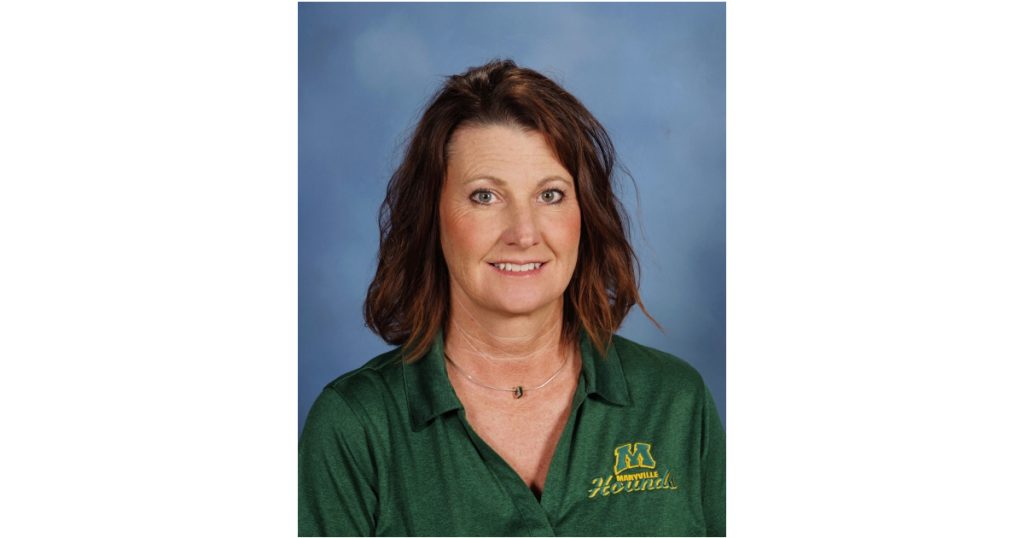
Becky Albrecht Superintendent Maryville R-II School District
MARYVILLE, Mo. — Superintendent Becky Albrecht presented an update regarding the district’s COVID-19 response to the R-II Board of Education at its regular meeting last week.
“There’s been a lot of discussion about quarantine times and procedures and how that’s different in different counties throughout the state,” she said. “There’s a group of several of us from northwest Missouri who drafted a letter and that was sent (Wednesday, Oct. 21),” to Missouri Gov. Mike Parson; Brett Fischer, deputy director of the Missouri Department of Health and Senior Services; Margie Vandeven, education commissioner of Department of Elementary and Secondary Education; State Sen. Dan Hegeman, R-Cosby; and State Representative Allen Andrews, R-Grant City.
In the letter, — signed by all Nodaway County superintendents — northwest Missouri rural superintendents suggest two changes to quarantine recommendations for students: Shorten the length of quarantine to 5 to 7 days and eliminate a quarantine if the close contact with a positive occurred while both individuals were wearing face coverings.
“So far we’ve had one contact back from one of the legislators about discussion about that,” Albrecht told the board last week. “So we’ll see if that gains any traction or not, but it is something we’re discussing. … There are some states around us that are doing some things differently. There are some school districts in southern Missouri that are doing some things differently.
“We just pointed out what some of those things were … and instead of going out and going against their guidance we would like to work with them cooperatively and find a better solution.”
In other COVID-19 related updates, Albrecht also told board members that in response to the pandemic, DESE did not administer MAP or EOC testing and removed attendance from the state accountability system. As a result of these changes, DESE has now determined it will not issue an Annual Performance Report for the 2019-2020 school year.
On the tracking side of the pandemic, Albrecht noted in her report that DESE has partnered with the state of Missouri, the Missouri Hospital Association and Missouri School Board Association to publish a dashboard to show the total number of COVID-19 cases among school age children (public, private and home schooled) by district.
She said it will use statewide testing data, not school reports and that it does not include any data regarding staff. Visit https://showmestrong.mo.gov/public-health-school-districts/ for more information.
Seamless Summer
Assistant Superintendent Steve Klotz told board members that the district received communication from DESE that the USDA Seamless Summer Option is likely to continue through June 30, 2021.
He said the district will be sure to continue to update its applications to make sure it can offer free breakfast and lunch for all children age 1 to 18 within the community.
The district has averaged about 10 meal pickups through the “Cafe to Go” program at the high school. An average of 20 students also pick up meals at the end of the day.
“Participation of our students is going well,” Klotz said. “I figured up that from Sept. 14 when we started ‘til the end of the school year — if a student were to take advantage of that at the middle school or high school — it’s a little over $600 savings for the family not to pay for breakfast and lunch.”
Other news
- Klotz told board members that he and School Resource Officer Ian Myers met with Northwest Audio Visual to discuss the possible expansion of the current security camera program. He said they hope to add more exterior cameras at the middle school and high school as well as expand interior cameras at the high school office, library and Northwest Technical School Commons. Additional cameras at Eugene Field Elementary also would provide coverage for interior hallways on the second floor.
- Albrecht told the board that after Walmart’s unsuccessful protest, the district received $151,599.98 in taxes as of Sept. 22.
Personnel
Board members approved three staffing recommendations from Albrecht.
The first two recommendations are related and include the reduction of a full-time speech implementer position to part-time to enable the addition of a part-time elementary guidance counselor position.
The third recommendation is adding a paraprofessional position at the Maryville Early Childhood Center. She said due to the addition of more students in special education who require Individualized Education Programs. Albrecht also noted that when comparing numbers of paraprofessionals from this year to last year, the district still has one fewer in pre-K through fourth grade.
Board members approved the following personnel changes.
Resignations
- Ernema “Bing” Boettner, health science technology teacher at tech school, effective June 30, 2021
- Bailey Fergison, paraprofessional at elementary school, effective Oct. 21
- Mollie Von Behren, paraprofessional at elementary school, effective Oct. 21
Reassignments
- Erin Pohren, full-time speech implementer, has been reassigned to part-time parent educator and part-time kindergarten special education teacher.
- Amy Skidmore, part-time kindergarten special education teacher, has been reassigned to part-time speech implementer.
- Taylor Deen, full-time parent educator, has been reassigned to part-time parent educator and part-time counselor for the elementary school and early childhood center.
Recommendations for employment
- Kathleen Euler, paraprofessional at elementary school, effective Nov. 2
- Mollie Von Behren, youth development worker, effective immediately
Letter to Gov. Parson
October 20, 2020
Governor Parsons,
MO Department of Health & Senior Services Deputy Director Fischer,
Department of Elementary & Secondary Education Commissioner Vandeven:
On behalf of the children and families in our communities, we as a collective group of school superintendents from Northwest Missouri request changes in quarantine guidance given to our county health departments. We feel sufficient evidence exists to support our suggestions and respectfully request your immediate consideration.
We suggest the following changes to quarantine recommendations for students:
- Shorten the length of quarantine.
- a. Many of our local health experts have shared evidence of approximately 5 days as the optimal range for symptom onset. A shortened quarantine, perhaps 5 or 7 days, would respect this contagious window and simultaneously preserve students’ education.
- Eliminate a quarantine if the close contact with a positive occurred while both individuals were wearing face coverings.
- a. Many of our districts, and some towns, have mask mandates. Staff and students are following these to add layers of protection. If wearing the face covering would eliminate the need for quarantine, compliance would be viewed more favorably, easier to explain, and preserve students’ education.
We believe the positive impacts of making either or both of these changes far outweigh the potential consequence of spreading the virus. Our districts are all hosting in-person classes, and there doesn’t seem to be many students contracting or spreading the virus. In a poll of 20 school districts in rural Northwest Missouri, a total of 1,430 students have suffered through at least one quarantine during this fall term. Some have endured multiple quarantines. Of these, only 59 students (4.1% of those quarantined or .0046% of these districts’ total enrollment of 12,732 students) have actually tested positive for Covid-19. Generalizing the typical school day is in the vicinity of seven hours and a quarantine is for ten weekdays, this means 95,970 hours (or 13,710 school days) have been missed by 1,379 healthy kids already this year.
The list of positive consequences resulting from changing quarantine recommendations is longer:
- Improved Education – The best education is face-to-face with a dedicated, engaging teacher. Our students are struggling with remote learning needed during extended absences. The younger the student, the more difficult remote learning is. Many can’t independently manipulate the technology and don’t have needed adult support at home. While independently manipulate the technology and don’t have needed adult support at home. While be regained or replicated. Students are failing courses they’d be successful in if they were attending school.
- Improved Supervision – Students, particularly young ones, need supervision as Improved Supervision – Students, particularly young ones, need supervision as multiple days in a row, with no one to encourage schoolwork or physical activity and no one to discourage risky behaviors.
- Improved Mental Health – Students are feeling frustrated, anxious, and distracted. They are often more worried by the fear of quarantine than they are by contracting the actual illness. Sadly, this is true for a lot of school staff, as well.
- Improved Nutrition – Many students depend on the school to eat. Despite the extended availability of meals through food services, we know some students at home are still not getting the nutrition they need.
Improved Working Conditions for Teachers – Teachers are hard working, dedicated professionals, but Covid-19 has significantly increased their workload. Not only do teachers have to continue their normal responsibilities, they are also accountable for dozens of students with extended absences. Keeping students who are out of the classroom for two consecutive weeks current and engaged is beyond challenging. Sometimes, half the class is absent for quarantine, and teachers must juggle in-person with remote learning while having only 50 minutes per day to plan in Missouri where the average teacher salary ranks 49th lowest out of all 50 states.
We understand our nation, state, and communities, are in a public health crisis. However, the quarantines of school age children are resulting in an educational crisis. Lengthy quarantines are disrupting families, workplaces, schools, and even local economies. School officials and county health employees are inundated with patron outcry to the point that it’s difficult to conduct normal business. A shortened quarantine period would ease this burden and dramatically reduce negative consequences for children. Healthy students need a quicker return to school to learn, eat, interact with peers, and benefit from adult supervision and guidance.
We also understand the importance of public health, hierarchy, and rules. While some counties are electing not to follow guidance, we prefer to work collaboratively with you to find appropriate middle ground, and we believe a shortened quarantine period is it. Our local health departments indicate the need for your guidance and approval on this issue so we welcome an opportunity at your convenience to further discuss our suggestions or other viable options. Please see signature lines for phone numbers and email addresses where we can be reached.
Thank you. Respectfully on behalf of Northwest Missouri Rural Superintendents,
Becky Albrecht, Maryville R-II School District
Danny Johnson, King City School District
Mitch Barnes, West Nodaway
Karma Coleman, Tarkio
Matt Martz, Worth County
Ethan Sickels, Rockport
Brenda Dougan, Northeast Nodaway
Johnnie Silkett, South Nodaway R-IV
Korey Miles, Mound City
Mark McDaniel, North Andrew
Bob Heddinger, Stanberry
Jeff Blackford, Nodaway-Holt R-VII
Chris Turpin, North Nodaway R-VI
Bob Ottman, South Holt
Tim Jermain, Jefferson
Dustin Freeman, Albany