Council recommends major Halloween events be called off
FORUM FILE
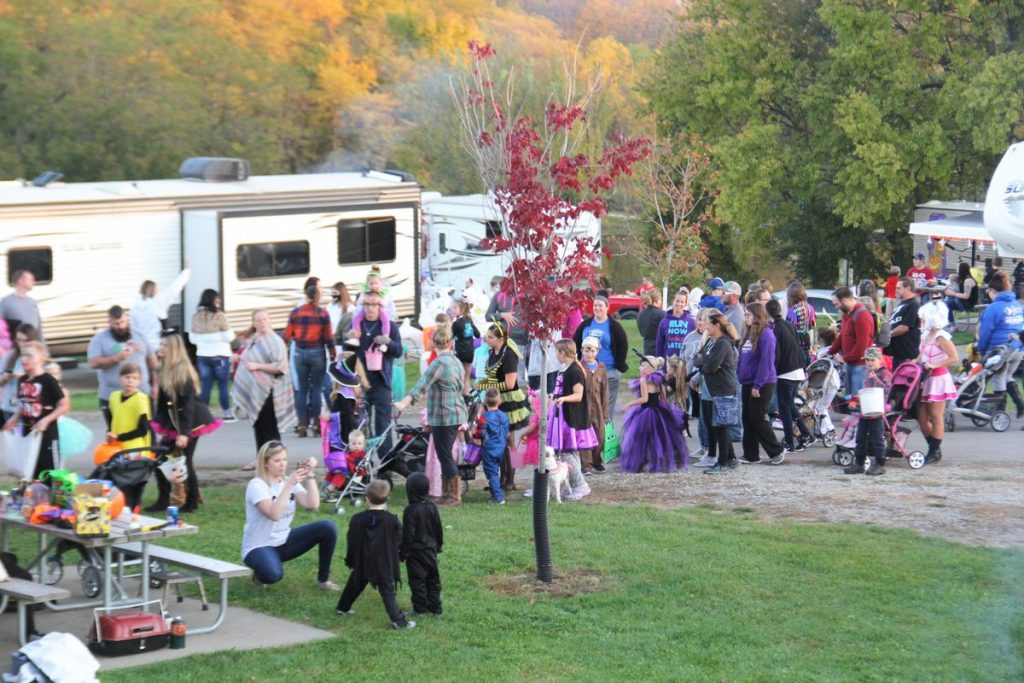
Trick-or-treaters gather at the annual Haunted Campground last year at Mozingo Lake Recreation Park. Because of concerns over the spread of COVID-19, the City Council recommended Monday that the Haunted Campground and the Downtown Trick-or-Treat not go forward this year.
MARYVILLE, Mo. — Maryville city officials will encourage two well-attended Halloween events not to go forward this year after City Council members voiced concerns over COVID-19 risks for the large crowds that typically participate.
At its regular meeting Monday evening, the City Council discussed the city’s involvement with the Downtown Trick-or-Treat and the Haunted Campground. The Downtown Trick-or-Treat, an event put on by local businesses and organizations downtown and organized by Kathy Rice, would see its 25th iteration this year. The Haunted Campground, held at the RV park at Mozingo Lake Recreation Park and organized by Twyla and Tom Martin — usually attracting between 3,000 and 5,000 people — would be looking at its 13th year.
“I’ll be honest, I’m worried about both of these events just because there’s such a large number of people that are crammed together in a small area,” said Council member Tye Parsons.
Most of the Council echoed Parsons’ concerns.
“I personally love Halloween,” said Council member Rachael Martin. “If you’ve driven past my house, there’s a massive spider crawling up my house named Hagrid and my kids love him. So it pains me to say that … I think that these events, us saying that we think that it’s fine to do that, I feel like it’s reckless, and at a time where we need to continue forging forward with keeping the (number of positive COVID-19 cases) low.”
All Council members said that they had been to and enjoyed at least one of the events in the past, but for the most part agreed that there was no practical way to safely ensure COVID-19 protocols are met in crowds that would be large and clumped up.
“What does contact tracing look like for something like that?” Rachael Martin said. “Because that’s where my mind goes is, how are we helping (the health department) if we do have a breakout? How are we helping them keep track of what’s going on where and not continuing the spread? Because I don’t see how that’s possible.”
Twyla Martin, who was in attendance at the meeting, agreed that because of the concentrated, large crowds, mitigation measures would be impossible to effectively enforce.
“You can’t (enforce social distancing), you can’t, with that many kids,” she said. “It’s just … so many kids and so many people. It would be hard to social distance.”
Although city involvement in both events is minimal, the city does close down the streets during the Downtown Trick-or-Treat. Council members indicated they would not approve doing so this year, but acknowledged that there is likely little they can do to stop individuals from privately deciding to continue on with similar events if they so choose.
That possibility prompted Rachael Martin and Council member Matt Johnson to propose that city officials come up with ways to help mitigate risk for those who do decide to go trick-or-treating in a large group on Halloween, including providing items like masks and gloves in addition to best practices guidance to be issued by the city.
“I’m not going to sanction (large trick-or-treating events), but at the same time, I know it’s going to happen,” Johnson said. “So the best course of action, if it’s going to happen anyway, is to provide them with another level of safety. … (But) I wouldn’t take my kids.”
Twyla Martin said that she was prepared to go along with the Council’s recommendation either way.
“It’s a great activity, it’s always been popular,” she said about the Haunted Campground event. “But … I understand, I really do. Because I’ve been going back and forth with this for a couple of months now thinking, ‘What am I going to do? Are we going to do this? Should we do this?’ … We’ll try it next year.”
City Manager Greg McDanel said that the city will put out guidance for trick-or-treaters soon based on CDC holiday guidelines released last week.
“This whole thing is putting a numerous amount of decisions on City Council that are no-win scenarios,” McDanel said. “You also shouldn’t look at it as the Council that’s taken away Halloween — Halloween is still going to continue. How many people participate or not is going to be up to each individual person.”
“I think that the safest thing that we can do is recommend that these events are not held this year,” Rachael Martin said. “We can’t enforce this, and I don’t ask that we do. But I think that we can make a statement that we don’t think this is a good time for those events.
“And I think that’s so sad.”
2021 strategic goals
The council approved its 2021 strategic goals list, comprised of four items carried over from last year along with one new goal:
- Efficiently implement improvements to the South Main Corridor
- Strengthen economy by promoting and elevating tourism assets
- Redevelop the physical, economic, and cultural viability of Downtown Maryville
- Improve community livability and quality of life
- Enhance source water protection efforts and management practices at Mozingo Lake
Each fiscal year the council reviews the goals and the previous year’s progress. This year, the council marked as completed a longstanding goal to build the Maryville Public Safety facility: The R. Keith Wood Public Safety Facility will begin operations in earnest on Wednesday.
That goal was replaced with the aim to enhance source water protection and management practices at Mozingo Lake, a priority that emerged from discussions by council members during the budget process for next year.
More details on the strategic goals implementation plan are available here.
“I really encourage people to go out and look at that document,” Parsons said. “It’s really a road map for where the city is going in the next 12 months.”
Watershed projects
City staff are “excited” about progress already made towards that newest strategic goal, announcing the results of a federal grant program designed to encourage landowners in the Mozingo watershed area to overhaul agricultural practices in ways that will reduce runoff into Mozingo Lake.
Agricultural runoff is one of the leading causes of cyanobacteria, which plagued the city’s chief water source for much of the winter.
According to McDanel, the USDA received 34 applications to the National Resources Conservation Service’s Environmental Quality Incentives Program (EQIP) for projects on Mozingo Lake resulting in:
- $192,000 obligated to watershed projects
- 1,250 acres of cover crop planned to be seeded this fall
- 1 waterway improvement
- 1 pond at Mozingo Creek that will exclude cattle access by using a fence
- 200 additional acres of no-till that had not been previously
McDanel said that he expects more funding opportunities soon for similar projects.
Other City Council notes
- City Council approved a request by Burny’s Sports Bar for a liquor by the drink – Sunday license.
- Council members approved the purchase of powder activated carbon, a compound used to remove contaminants from water at the wastewater treatment plant, for $26,400 from Jacobi Carbons, Inc.
- Council approved the purchase of six EZ Valves, used conjunction with an EZ Valve machine to — as the name suggests — easily install valves throughout the water distribution system, for $23,141.08 from Core & Main.
- Bids for the soon-to-be-former Maryville Public Safety building on Vine Street are due to the city by Oct. 16.