Maryville R-II board issues reentry plan, masks required
SKYE POURNAZARI/THE FORUM
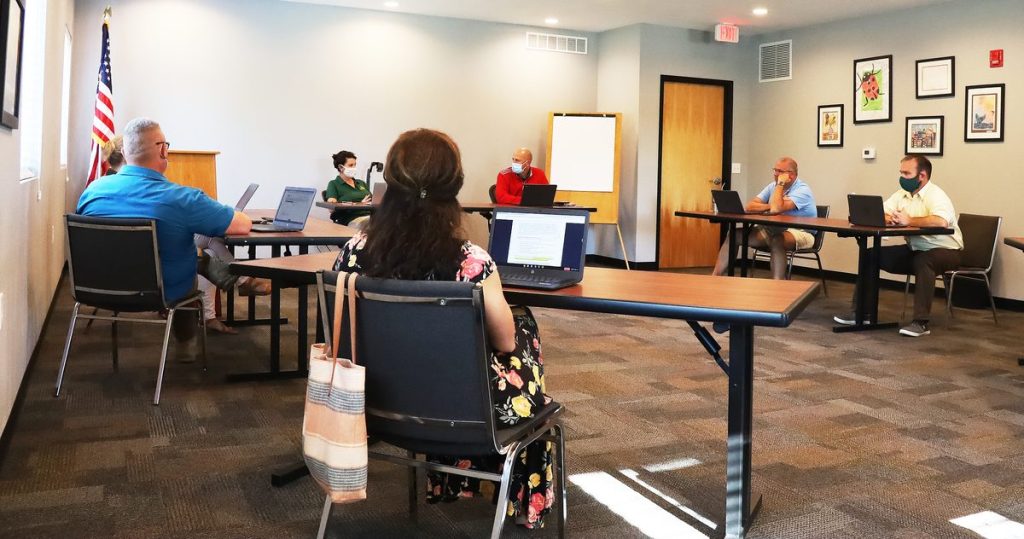
Maryville Board of Education members set farther apart to discuss the district’s reentry plan during Tuesday’s special meeting at the district administration building. The district plans initially to offer two plans, one for in school and one online called Spoofhound Academy. The in-school plan does have a remote learning aspect should the district be required or choose to close all or part of its district due to the COVID-19 pandemic.
MARYVILLE, Mo. — In a special work session Tuesday night, Maryville Board of Education members sat farther apart than they do at regular meetings and per city ordinance many of them wore masks while discussing the district’s reentry plan.
Released to parents and staff Wednesday morning and the public that afternoon, the district is initially offering two options for students to return to school on Aug. 25.
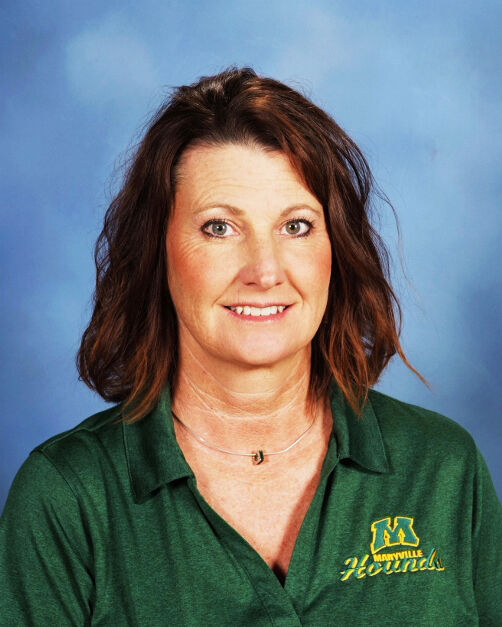
“We’ll do it as normally as we can, but normal is going to be slightly different,” said Becky Albrecht, R-II superintendent. “We’ll have a lot of different protocols than what we usually do. For families who aren’t comfortable with that we’ll have an online option. That will be very different than the school that we have here, but it does provide them a choice so that they’re not trapped into coming if they don’t want to.”
She also explained that none of this is set in stone, because the situation is very fluid and the district plans to provide as much information to parents and families as possible during the school year.
Assistant Superintendent Steve Klotz told board members that this plan has been created after a lot of research into what other districts are doing throughout the state. He said many schools take part in a shared online “drive,” where they’ve uploaded their plans for other districts to read.
Maryville’s first Fall 2020 school option is to allow students to attend in person.
Under this plan, the district will ask parents to screen their children about their health and check their temperature each day before sending them to school where students also will encounter a lot of new changes, such as being required to wear masks on school buses while sitting in assigned seating to and from school. Students will only be allowed into the building after 7:30 a.m. and then required to immediately go to their classrooms where they also will be assigned seating.
Albrecht explained that in order for the district to adhere as much as possible to social distancing and be able to contact trace should someone test positive for the virus, students will not be allowed to mingle in the hallways and must stay in designated locations throughout the day.
“We won’t be able to social distance at all on the bus,” she said, further explaining that family members will be asked to sit together, but that won’t always be possible.
“We are going to encourage families to bring their kids to school,” Albrecht said. “That would cause some traffic problems, but we can’t social distance on the bus.”
She said working with the bus barn, each bus will be cleaned and sanitized after each ride.
Physical distancing within the classroom, Albrecht said there are very few classes that students will be able to be six feet apart. When feasible work tables will be changed out for individual desks.
“That’s not possible across the district because we don’t have desks for that,” she said. “Over the years, we’ve pushed collaborative learning so hard that we don’t have furniture to accommodate that. We’ll do it as much as we can. We’ve gotten all of our desks out of back inventory.”
Chromebooks will be issued on a one-to-one basis second through 12th grade, to help lessen shared contact of equipment. The district also will ask teachers to leave their doors open for less handle touching.
Other changes include constant supervision. Albrecht told the board, that teachers and staff likely won’t enjoy that aspect, because it could cause some changes to the school day.
She described a day starting with a teacher arriving around 7:20 a.m. in order to have their doors open for those students arriving at 7:30 a.m. Albrecht said many teachers don’t typically arrive until closer to the start of school at 8 a.m.
She said if students were hanging out together in the gym waiting for school to start, and someone tests positive for COVID-19, then the health department would quarantine all of those students.
“If we have a hundred kids and we don’t know where they are because we can’t do a seating chart for a hundred kids to make sure that they’re there — and that’s not practical — then we’ll lose that entire group of kids and we won’t be having school.”
The district has purchased cleaning supplies for each classroom to wipe down desks universally throughout the district, however, Albrecht said there will need to be different requirements at each of the school buildings, based on age.
An example is that masks will be required for students in fifth grade and higher, due to the city ordinance, she said. However the ordinance doesn’t require children age 10 and younger to wear one, so they will only be required to have one for transportation purposes, where it will be required by the district.
All water fountains have been turned off throughout the district, but bottle filling stations will be turned on for students to fill their bottles. Albrecht said some of the CARES Act funds will be used to convert all fountains to filling stations.
She said a lot of discussion was held regarding lockers and that they will be used, but in a limited fashion. She said asking students to carry backpacks and coats around with them as the year continues is not practical.
Meals will be served in sacks and may be eaten in classrooms, according to the plan.
Albrecht told board members that visitors will be allowed by appointment only and only when absolutely necessary. She notified Northwest Missouri State University that the district will not host practicum students this year.
The term “remote school” is used throughout the plan to describe what would happen, should the district be required to close part or all of its buildings due to the pandemic. It will be completely separate from the Spoofhound Academy option.
With it, Albrecht said teachers will be expected to hold regular school hours from 8 a.m. to 3 p.m. and post lesson plans by 8 a.m. while also providing around 60 to 100 minutes per week of online connection and instruction with their students. Teachers also will provide office hours for students and parents to contact them throughout the week.
In the event the district resorts to remote schooling, Fridays will likely be used for staff meetings and professional development.
Board member Josh McKim asked if part of the plan includes going back into school, should the district have to shut down.
Albrecht said it does, but that the district’s goal is to keep students in school as much as possible.
“When we shut down to go to remote learning how do we know when it’s OK to pick back up?” Albrecht asked. “At what point do you know when you have enough subs and teachers? So we hope to avoid that at all costs.”
She said the district also has looked at the possibility of shutting down specific buildings rather than a full closure, if more cases are found in one building.
“We’re pretty well aware that our plan isn’t a perfect plan,” Albrecht said. “We’re just trying to make the best one that we can and go from there and change it if we need to.”
Spoofhound Academy
While the in-person option is full of new requirements, the new Spoofhound Academy fully online school option also will present some different hurdles for students and parents.
Students will be required to sign up for the online option for an entire semester at a time. Albrecht is requesting that be done by Sunday, Aug. 12, so the school can have the numbers to submit to a third-party provider.
The school will not provide Spoofhound Academy for preschool or kindergarten students, because at that age school attendance is not compulsory.
Albrecht told board members that the district hasn’t yet finished discussions with online school providers, so it’s not yet known which will provide the online instruction, but R-II teachers will not be involved in it.
“It will be very different,” she said. “They will be teaching the same standards in these online classrooms that our staff will be, however, they won’t be the same activities.”
She explained that for those who opt for the online option someone on staff will be available to check in with students and keep parents abreast of their progress, but grading and instruction will be up to the online instructors. Albrecht mentioned that the Launch program out of Springfield, Missouri, is one of the providers the district is in discussions with for the service.
She didn’t want to estimate cost per student while still talking with providers, but said in one case, a single, semester-long class for one student costs $225. So for a student taking seven courses over the semester, it could add up quickly. The district is looking to only provide a core class bundle of four classes for students during a semester.
Also of note, students participating in the academy will not be allowed to attend school activities, events such as dances or games or participate in athletics.
Board member Frank Grispino questioned why the district won’t allow all the students to attend extracurricular activities.
Albrecht explained that because the students and parents who choose the online option do so with the intent to limit and avoid exposure, not to mention a lot of different rules for citizenship and attendance that students in district classrooms have to abide by.
She said administration has consulted with district attorney Duane Martin and it has the right to do so. They may even look into rewording school policy to require in-school seat time in order to participate in any school activity.
Frequently asked questions
Albrecht said the plan has a frequently asked questions section for students and families, but as the year continues administration plans to address issues with regular communication through the school website and social media. Should a substantial change be required, she said it would be placed on an agenda for an upcoming board meeting.
She’s already been getting calls from parents wanting to know more about the plan. She’s also heard from teachers who have said they might answer differently now, the survey they filled out in June.
“People will be declaring what they want to do,” Albrecht said. “I have no idea what the numbers will be. … We’re going to do the best we can with it.”
McKim told her that he appreciated the hard work that went into creating the plan.
“You did a really good job of trying to think through all the different angles,” he said. “I know every time you make a decision or adjustment there’s half dozen other things you think of, if you don’t just take action eventually you just get lost in the details.”
To see the plan, visit the district website at http://www.maryville.k12.mo.us/.
Editor’s Note
COVID-19 has been declared a pandemic by the World Health Organization. To help our community combat the outbreak, we are providing this content for free. Please consider supporting our efforts in providing local coverage by subscribing to The Maryville Forum.
Becky Albrecht Superintendent Maryville R-II