County, university work on student testing plans
GEOFFREY WOEHLK/THE FORUM
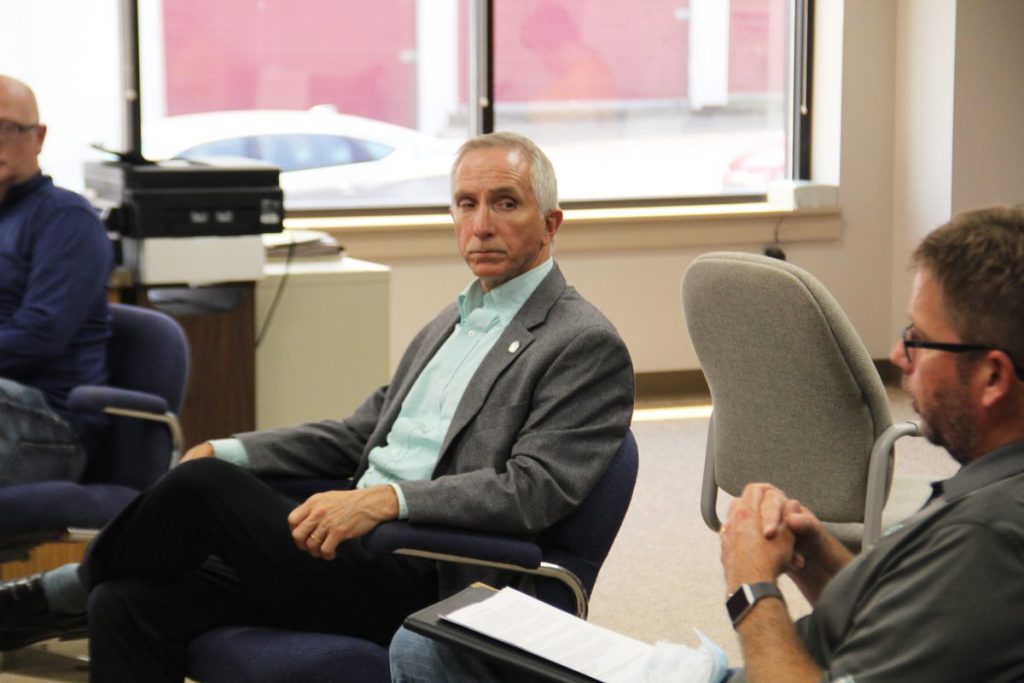
Northwest Missouri President John Jasinski, center, along with Vice President of Student Affairs Matt Baker and Mosaic Medical Center – Maryville President Nate Blackford met with county officials Tuesday to discuss testing options and funding to help mitigate and track the spread of COVID-19 when college students return in the fall.
MARYVILLE, Mo. — Northwest Missouri State University, health and county officials met Tuesday to discuss strategies for the return of students this fall in an effort to mitigate the spread of COVID-19.
Mosaic Medical Center – Maryville president Nate Blackford reiterated Tuesday that the impending influx of thousands of college students is the “greatest … health threat to our community,” potentially bringing COVID-19 with them.
“And what we have found … is a surprising number of patients who are asymptomatic, who have no idea that they have the virus,” Blackford said.
Currently, Matt Baker, Vice President of Student Affairs at the university, said the school does not have the resources to conduct any testing on its own. When classes begin, the university will take a number of steps to help mitigate the spread, Baker said, including seating charts in classrooms to help with contact tracing, social distancing in classrooms, occupancy limits and many more measures aimed at keeping students at a safe distance and out of crowds.
Additionally, the university will also implement a face covering requirement for anyone in a public space on campus, including shared spaces in residence halls and in classrooms if the classrooms are not large enough to accommodate social distancing.
“This is a marathon, not a sprint, and we’re just at the starting line still,” Blackford said.
But testing students is proving to be the biggest hurdle so far for university officials.
Testing could be done in one of two ways: through mass testing clinics that test a large number of people at one time, or through what’s called surveillance testing, which could mean more scheduled, regular tests for targeted areas like residence halls, sports teams or other particular student clusters.
If students do test positive, they would be encouraged to quarantine at home for two weeks rather than at the university, though Baker said the school could house up to about 100 students in quarantine at a time. But he cautioned that space could be taken up quickly just by a few positive tests once contract traces are taken into account.
At Tuesday’s meeting, the university and county officials reached a handshake agreement to reimburse the university through CARES Act funds for the cost of conducting testing up to a certain amount that has not yet been decided. University representatives said they preferred the reimbursement approach so that they would only be reimbursed for actual costs.