Gumm named baseball official of the year


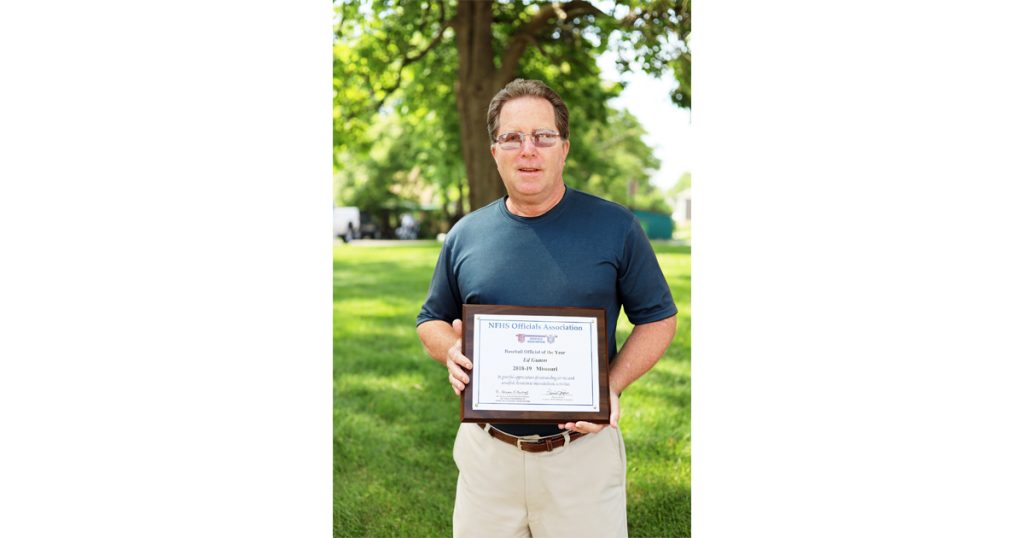
SKYE POURNAZARI/THE FORUM
Ed Gumm is shown last week with his award recognizing him as Missouri’s NFHS Baseball Official of the Year.
MARYVILLE, Mo. — There is something about Ed Gumm’s windowless office, which sits along Main Street near Maryville’s downtown square, that makes it seem balanced. It feels even.
Sitting in from of the realtor, atop is desktop, are two pens and a pair of laptops — each with its own wireless. Mounted to the wall behind Gumm’s workspace are two nine-point bucks. And across from Gumm’s desk, now, there are two awards from the National Federation of State High School Associations — one he won for officiating softball in 2014, and the other he was sent earlier this month for being named Misssouri’s NFHS Baseball Official of the Year.
“Rounded. I like evenness,” Gumm said. “When I won it for softball, my goal was to win it for baseball. The funny thing is, I’ve done the same thing in the state playoffs. I’ve been to softball five times and baseball five times. It’s even.”
But after winning the state’s NFHS Softball Official of the Year award in the 2013-2014 award cycle, Gumm, who’s been an MSHSAA official since 1997, wasn’t quite sure to go about winning the award for work he does every spring. He said he wasn’t sure exactly how or why he won the award for his softball officiating. He just kept doing what he was doing.
Even now, after winning the state’s top award for sports officials in two separate sports in a span of six years, Gumm isn’t sure what he did to earn it.
“You’re just chosen,” Gumm said. “I think it’s a combination of coaches’ comments, other people’s comments, I suppose. … I don’t know. I’ve tried to figure out how they — what their criteria are, but I can’t anything anywhere. So I just — I’m not really positive.”
In any case, Gumm is glad he won the award — despite the fact that he’s unsure of what he did to win it. He showed up on time and did his best to call games fairly. He was polite, yet firm, with every coach he interacted with. He did what he’s on baseball and softball diamonds scattered across this corner of the state for 24 years, and now his award display — once he gets a frame to mount his latest certificate — will be even.
Things aren’t exactly the same for Gumm as they were when he started out. His body aches easier now, of course, and his hair’s gone gray. He’s grown older and wiser, and through years of ejecting fans and being hassled by overzealous coaches who think they saw something different than Gumm did, the umpire has changed in ways beyond just his hair color.
He’s grown used to rants from coaches and jeers from fans. He’s learned how to hold his own in arguments without coming off as disrespectful. It’s not a part of the job he enjoys, of course, but it’s part of the job nonetheless — one he’s grown more relaxed in over the last 24 years.
“I’ve mellowed,” Gumm said. “I put up with a little more than probably what I should at times anymore. But I’ve been around so long it doesn’t bother me.”
The reality of his situation is that Gumm didn’t need his latest award. He’s glad he won it, of course, but it’s not the type of thing he values, and certainly not the type of thing he tends to brag about. Gumm is publicizing his accomplishment for a reason: the sport he’s been around for most of his life is in trouble.
More than 60 percent of MSHSAA officials are over the age of 60 years old now, with close to two-thirds of the state’s workforce inching their way toward retirement. Gumm, an umpire assigner for the Northwest Missouri region, said there are only four MSHSAA umpires living in Maryville. Not as many as there should be, he said.
Gumm assigns the officials for games at more than 20 area high schools, he said, and usually, there are enough area umpires to fill the schedule. But four or five of the officials under Gumm’s assignment are nearing retirement. Gumm, now in his 60s, didn’t count himself.
Gumm has no plans for retiring anytime soon, he said. He still enjoys the job as much as he did in 1997. He hopes publicizing his award might draw interest in officiating, that it might serve as a recruiting tool. He’s hoping a crop of young officials might sprout to replace Gumm and his aging peers, who will do it as long as they can, Gumm said. But he’s not sure how long that is.
“Depends on my body, I suppose,” Gumm said. “As long as I can walk maybe — I don’t know. Or see. Of course, there’s some people now that don’t think I can see.”