Charitable foundation to focus on regional economic vitality
SKYE POURNAZARI/THE FORUM
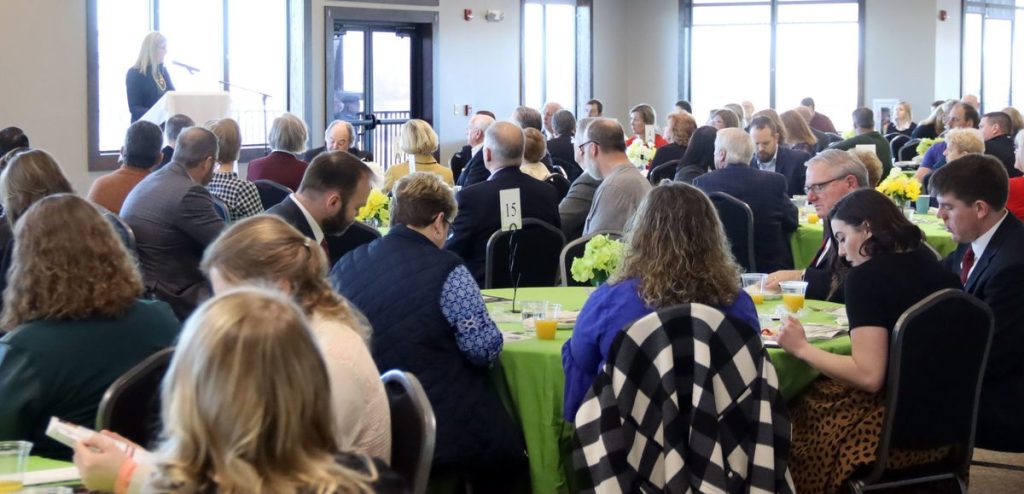
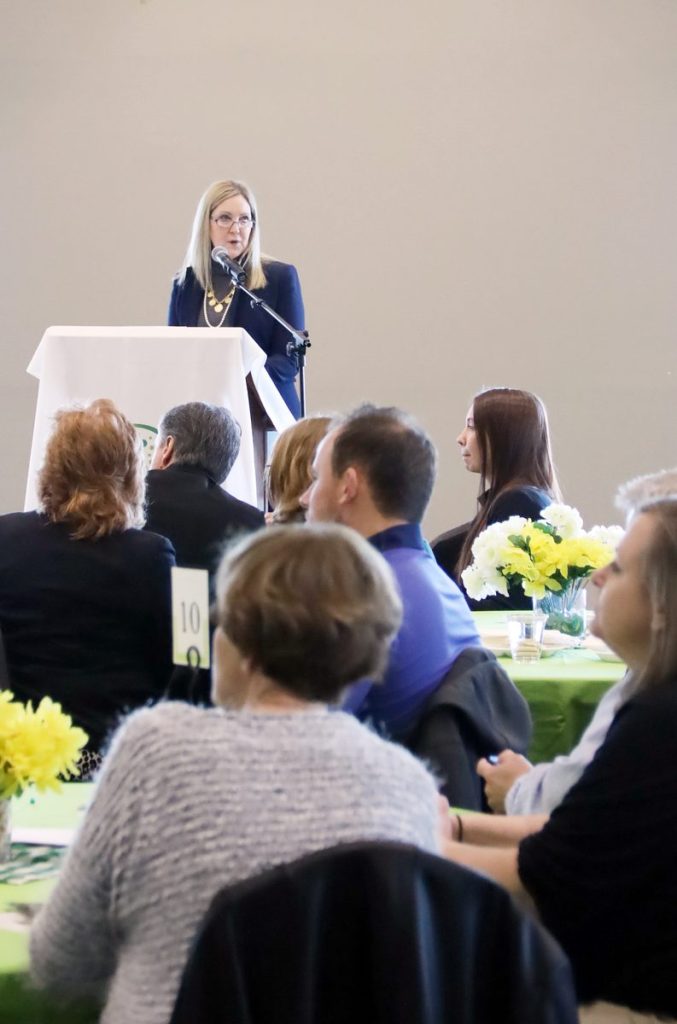
Mary Hinde, CEO and president of the Community Foundation of Northwest Missouri, speaks at the organization’s annual even held Feb. 21 at the Mozingo Event Center.
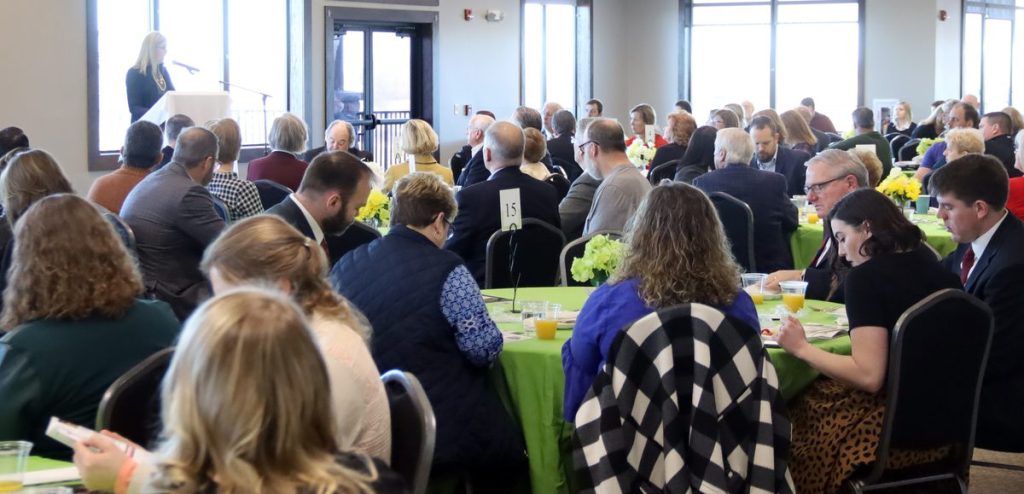
MARYVILLE, Mo. — Honing its focus on increasing the regional vitality of northwest Missouri, the Community Foundation of Northwest Missouri’s board members and donors gathered last week for the organization’s ninth annual meeting at the Mozingo Event Center.
“We at the Community Foundation of Northwest Missouri believe in the circle of giving,” said Bob Dempster, foundation board chair. “We realize that charitable giving and planning drives the quality of life. Quality of life drives economic development and economic success drives charitable giving and philanthropy. This is why we work on dual fronts to increase the vitality of our 18-county district.”
Since 2009, the foundation has grown from $962,748 in assets and 12 funds to $24,126,673 and 213 funds managed in 2019, according to foundation documentation.
The organization provides a path that helps direct investors to local community funds and scholarships in the region.
Christel Gollnick spoke about a shift in the foundation’s vision. She explained that the way to “Maximize NWMO,” — the foundation’s new key phrase — is by taking the many voices of local and regional communities and through shared activities work toward shared needs, focusing on larger community goals to create one vision for the region.
“We’re doing a lot of things right in northwest Missouri,” she said. “And we’re honestly, doing a lot better than a lot of other regions around the country we’re finding out. That’s awesome. It’s one of the reasons we’re still here. We’ve got more work to do.”
She said it’s time to start aligning the regional focus while still respecting individual interests to be more effective. By listening to leaders and donors throughout the region Gollnick said the top priority in the region is entrepreneurship.
She said they have four specific things the foundation is working on this year. The first of which is next level entrepreneurship support, an integrated strategic action plan, leadership training and pilot management/project coordination.
“Are we willing to move forward?” Gollnick asked. “Are we willing to look beyond the field that we work in … to cross-sector ‘collaboraction’ with our neighbors and seek a regional competitive advantage so that our children and our grandchildren, who we all love and adore, have a wonderful future in this primarily rural region.”
For more information about the foundation’s new focus, visit www.maximizenwmo.org.
Keynote speaker
Dell Gines, senior community development advisor at the Federal Reserve Bank of Kansas City – Omaha branch, spoke about building urban and rural economies by bolstering local entrepreneurship.
He applauded the foundation for its forward-thinking action in the region.
“I’m really excited about what you’re doing in northwest Missouri,” he said.
Using his expertise and vision as a certified economic developer with an MBA and Master of Science in Finance, Gines is working toward his Ph.D., focusing on entrepreneurship as a way of creating local economic development.
He referenced the recent news about the search for Amazon’s headquarters. Gines explained that while Amazon was offered deals and funds in the way of tax credits during the process, it also would take those funds away from the community into which it moved.
He said attraction-based development, or smoke-stack chasing when it started in the 1930s, made sense because of the massive industrial growth of that time. Those factories would provide jobs long term and funds could be recouped.
But big shifts in the 1970s from industrialization to globalization, created swings in employment leading to the entrepreneurial strategies of the 1980s that supported individual small business owners through space, funding and market opportunity. This led to cluster-based strategy in the 1990s.
“(That) strategy, says OK, it’s not about attraction or retention, while that’s important, it’s about appropriate kinds of attraction and retention in things the local industry supports,” said Gines.
Around 2010, economic developers saw the rise of the entrepreneurship ecosystem theory, he said.
“It’s like the entrepreneurship of the ’80s only it’s saying it has to be done in the context of a broader network of relationships,” Gines said. “But as you can see, that people were willing to give Amazon $3 billion and which one still remains dominant. What I’ve been arguing, now for almost nine years, is that this system of current economic development harms most of our communities.”
He said this is visible by seeing the decline in rural populations. Using 2016 U.S. Census County Business Patterns information about 18 northwest Missouri counties, Gines discussed specifics of the region’s economic state.
He said the Small Business Administration’s definition of a small business is one with fewer than 500 employees. Only seven of the 18 counties have businesses with more than 250 employees. The average number of employees per business in Missouri is 16, the average per business in northwest Missouri is 10. Only Buchanan County averages more employees per business than the state average at 19.
Eighty percent of counties in northwest Missouri have businesses with nine or fewer employees, and 61 percent of those have four or fewer, according to Gines’ data.
He explained that even this information is not exactly perfect, because only businesses with employees are surveyed by the County Business Patterns.
“We know that the majority of companies that are in our communities in any city are solo entrepreneurs,” he said. “So that number increases dramatically.”
He showed a chart with information that site selectors look for when searching for a location to build or move a business. From demographic profile, transportation access, workforce, education and training resources and overall costs, to the availability of water, sewer, gas, telecom and electric power, the presence of certain suppliers and the ability to recruit staff to an area, Gines explained this doesn’t usually match rural areas.
“When you look at your counties and you look at what companies are looking for and your economic development strategy is to recruit companies that are looking for this, you start to see some of the economic development challenges so many of our rural communities are facing,” he said.
His suggestion for rural areas is to put the entrepreneur in the center of a community that supports them.
“For us to really develop our economies, urban, rural, whatever, we have to have a return to community,” he said. “We have to have a return to valuing what we have versus trying to get somebody to come in and save us, because in so many of our communities it is just not worth it.”
Gines said that while Amazon got all those cities’ proprietary and financial data, Washington D.C. and New York City who actually won the deal gave up an arm and a leg.
Quoting a character from the old Popeye cartoon, “‘I’d gladly pay you Tuesday for a hamburger today,’ that’s what attraction-based economic developers are telling our communities,” Gines said. “In small communities, in talking to them they recognize intuitively that the way of development is not working. That’s why I’m so optimistic about what you all are doing in northwest Missouri. You’re on the cutting edge of a return to community, maintaining relationships and mobilizing each other to make it better for everyone not just the few. That’s where rural communities are actually ahead of the curve.”
Numerous Maryville and Nodaway County leaders were in the audience including Lily White, executive director of the Greater Maryville Chamber of Commerce, who said Gines is right.
“We are working hard and Josh (McKim, director of Nodaway County Economic Development) is working incredibly hard,” she said.
The chamber has developed the new business program called B.O.S.S. that offers a place for local entrepreneurs to learn and teach each other. The organization also has brought in a Google representative to show how the company can help local business owners.
“People want us to attract a new industry to go into the Energizer building or to fill the J.C. Penney’s,” she said. “We’re not going to attract a large business like that, and if we did they would come here and just take employees from a different employer in town which would cause an employee gap there. We don’t have the workforce to back bringing in a large organization like that.”
SKYE POURNAZARI/THE FORUM
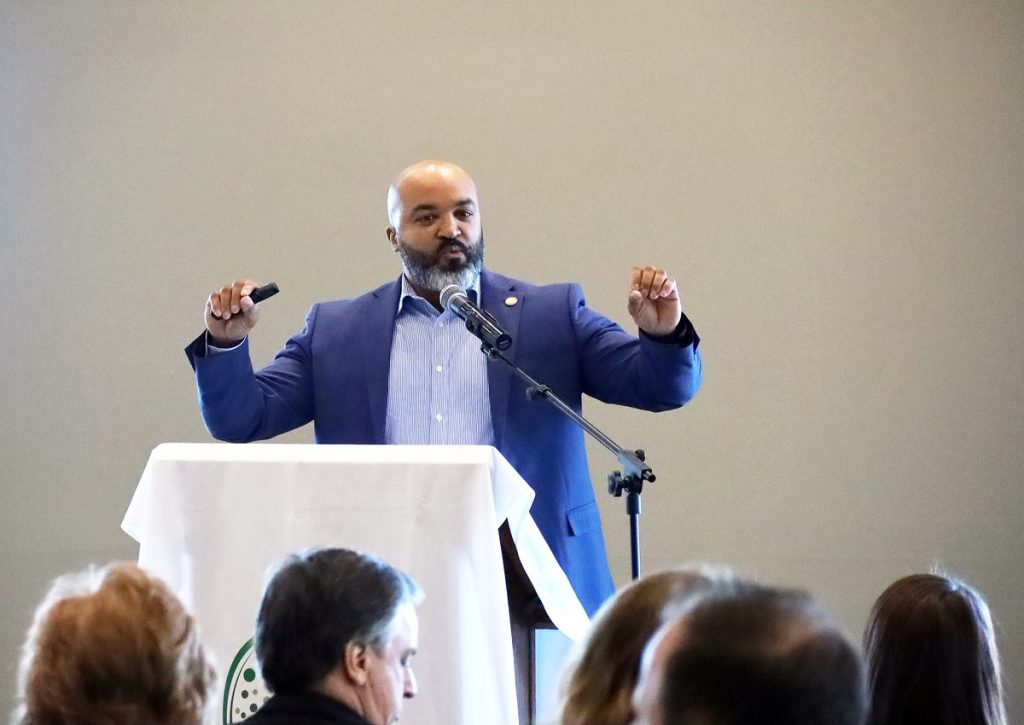
Dell Gines speaks at the Community Foundation of Northwest Missouri annual meeting on Feb. 21 at the Mozingo Event Center.
SKYE POURNAZARI/THE FORUM
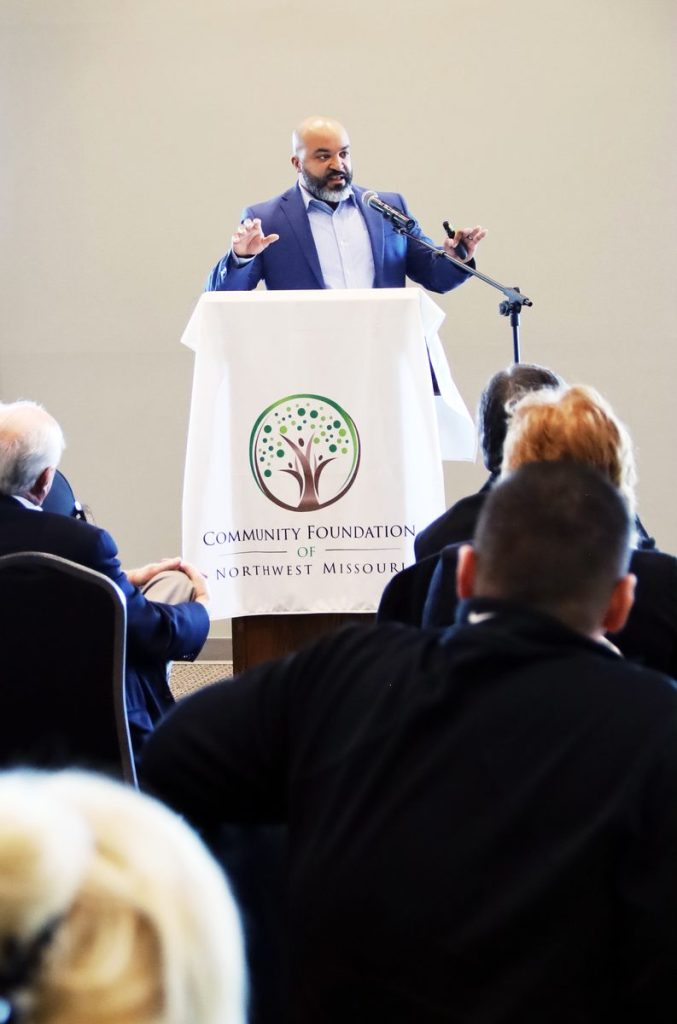
Dell Gines speaks at the Community Foundation of Northwest Missouri annual meeting on Feb. 21 at the Mozingo Event Center.
SKYE POURNAZARI/THE FORUM
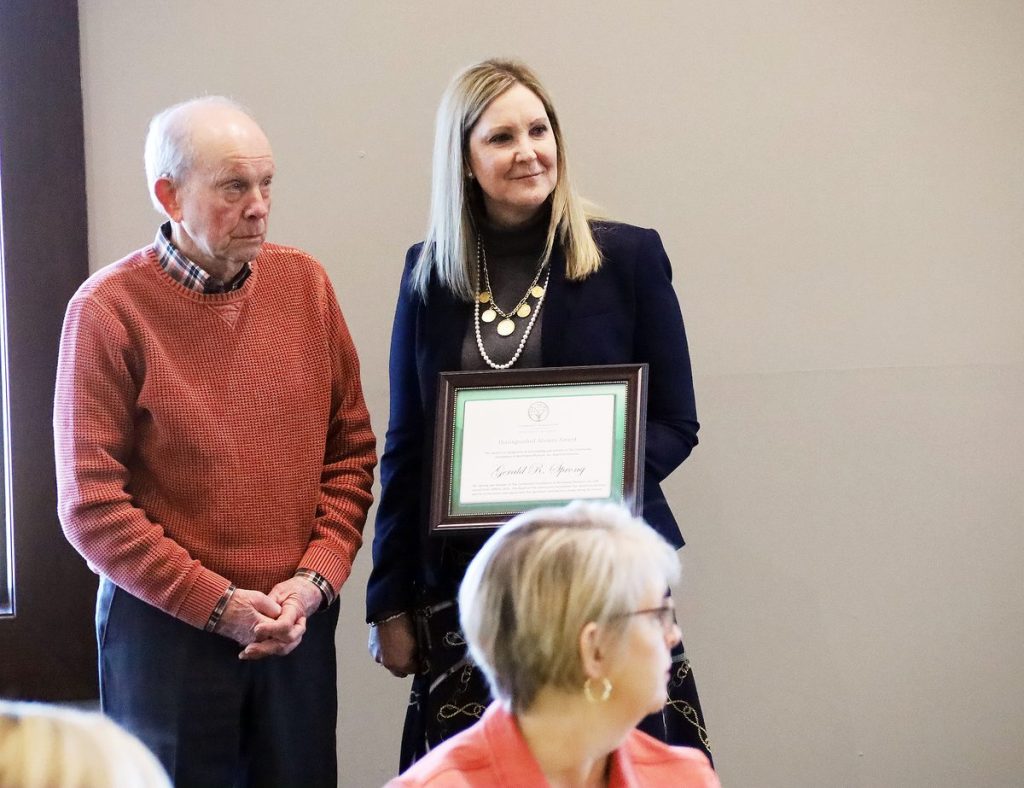
Mary Hinde, CEO and president of the Community Foundation of Northwest Missouri, presents Gerald R. Sprong with the Distinguished Alumni Award for his outstanding service on the Board of Directors during the group’s annual meeting held Feb. 21 at the Mozingo Event Center.
SKYE POURNAZARI/THE FORUM
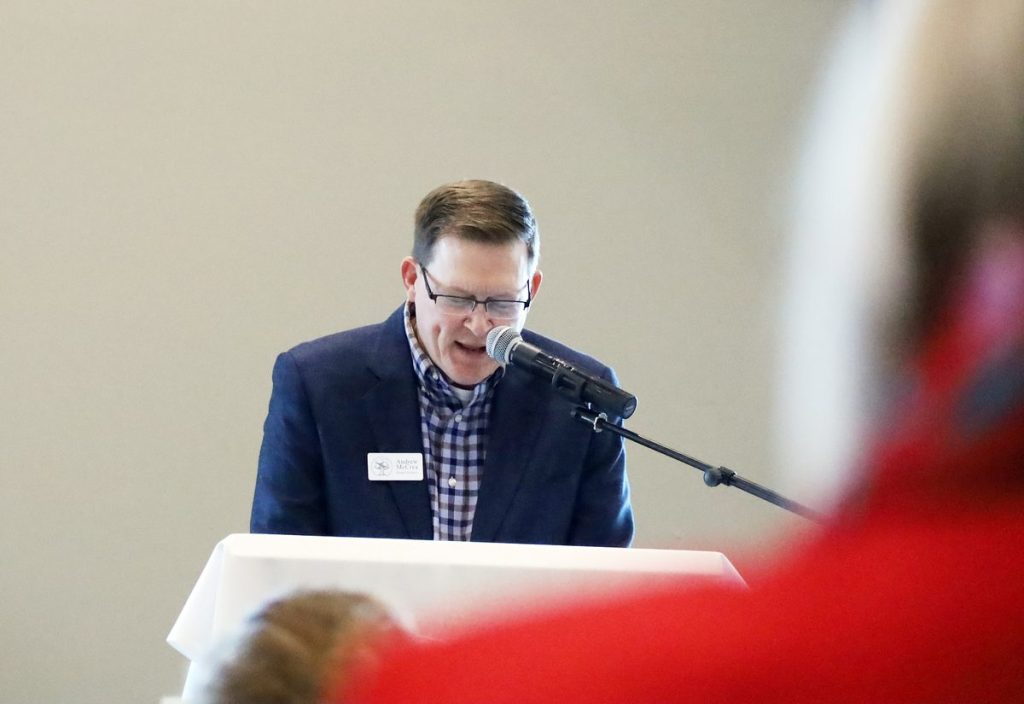
Andrew McCrea, public speaker and board member, speaks during the Community Foundation of Northwest Missouri annual even held Feb. 21 at the Mozingo Event Center.
SKYE POURNAZARI/THE FORUM
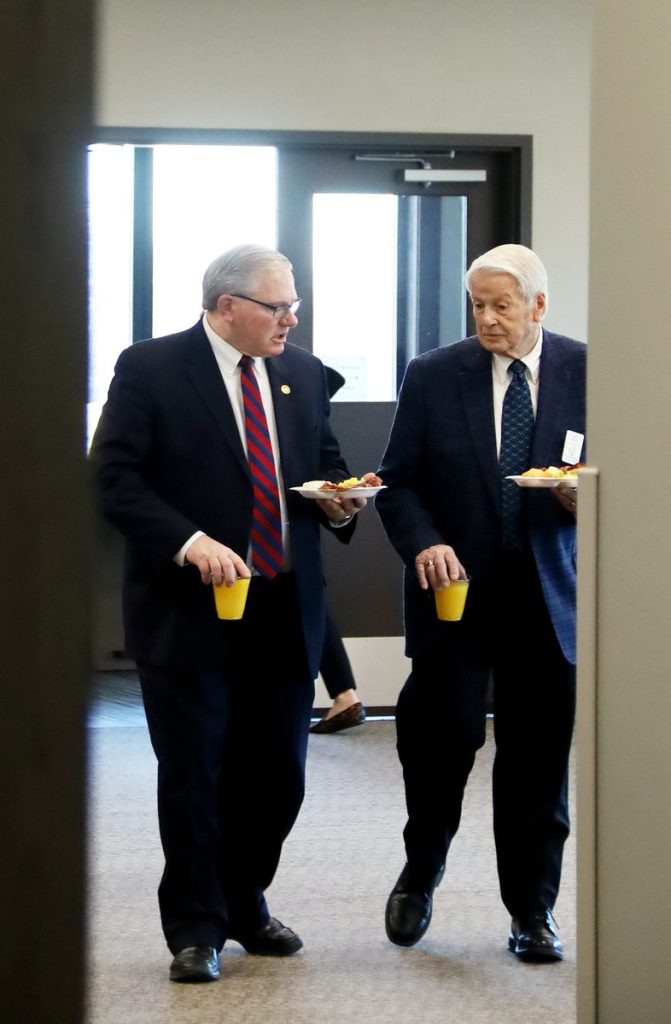
State Sen. Dan Hegeman speaks to Dick DeShon, Community Foundation of Northwest Missouri board member, during the group’s annual meeting held Feb. 21 at the Mozingo Event Center.
SKYE POURNAZARI/THE FORUM
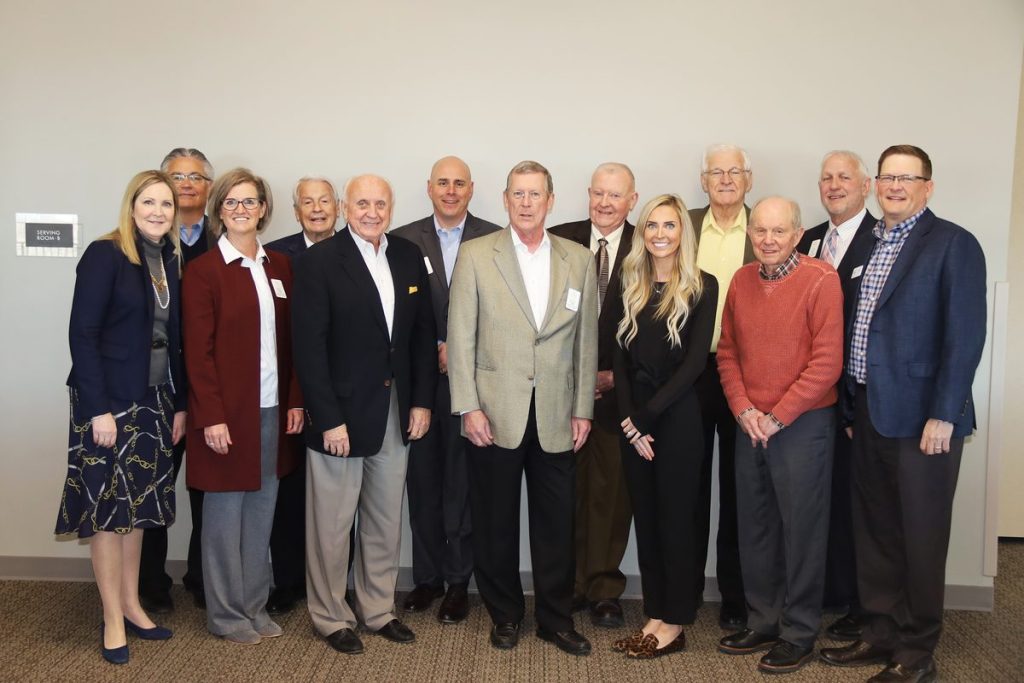
Community Foundation of Northwest Missouri board members are shown Feb. 21. at the organization’s annual meeting held at the Mozingo Event Center.
SKYE POURNAZARI/THE FORUM
Members of the Community Foundation of Northwest Missouri listen to Christel Gollnick discuss the shift in focus to “Maximize NWMO,” on Feb. 21 at the Mozingo Event Center.