Ag summit focuses on advocacy, education
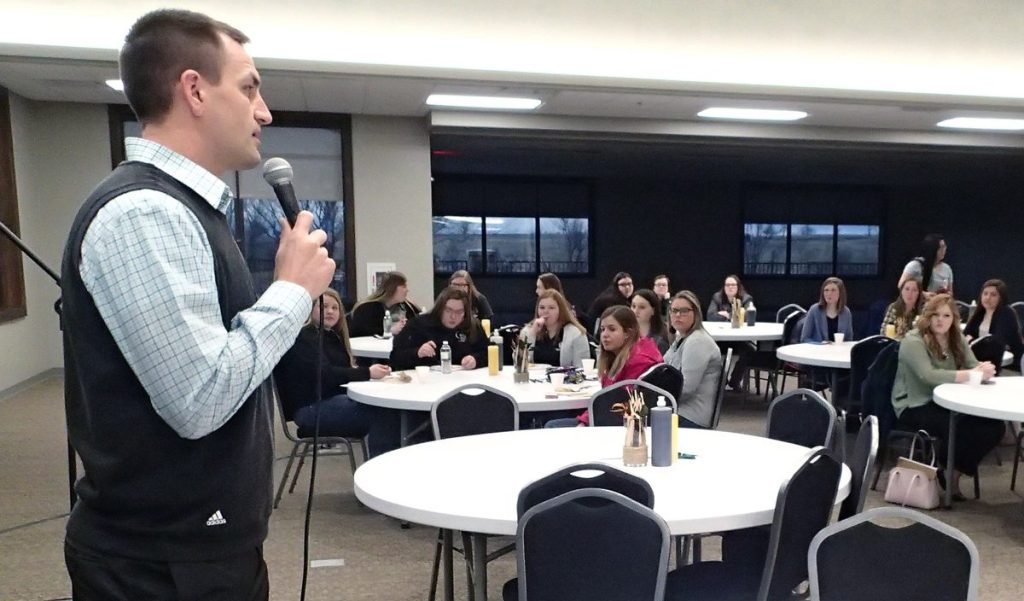
ANTHONY BROWN/THE FORUM
Northwest Missouri State University Athletics Director Andy Peterson addresses an audience made up of students, faculty members and production agriculture professionals and advocates during Thursday’s second annual Agriculture and Food Literacy Summit at the Mozingo Lake conference center. Peterson, who grew up on his family’s dairy farm near Trenton, holds three agriculture-related degrees from Northwest, where he also played for the Bearcats basketball team.
MARYVILLE, Mo. — Northwest Missouri State University’s head Bearcat put on his family farmer hat Thursday as the keynote speaker for the second annual Agriculture and Food Literacy Summit sponsored by the university’s School of Agricultural Sciences.
Best known to Northwest sports fans as director of Bearcat athletics, Andy Peterson has an extensive background in production agriculture, having grown up on his family’s dairy farm near Trenton in eastern Grundy County.
While he picked up a master’s degree in physical education during the early part of his Bearcats career, Peterson also holds a second master’s in agriculture and a pair of undergraduate degrees in agriculture economics and horticulture.
Peterson told his audience, composed of university students, ag faculty, production farming advocates and producers, that he fully intended to pursue a career in agriculture before shifting professional gears and entering higher education as a coach and administrator.
Still, Peterson spoke with affection and respect about the lessons he learned while helping his uncle, father and two brothers work the family’s dairy operation — Peterson Dairy Inc. — which has expanded over the years to include a 450-cow herd, 130 of which are milked. In addition the farm has moved into beef production after acquiring several bull calves and steers.
During his presentation, Peterson urged college students attending the workshop to value their agricultural roots and take pride “in the job of feeding people and feeding the world.”
He also broke the word farmer down into a six-letter acronym representing the values of faithfulness, accountability, responsibility, motivation, energy and resourcefulness.
Having learned to drive a tractor before his feet could reach the pedals, Peterson said farm life taught him the value of repaying trust with a commitment to “getting the job done” despite whatever obstacles and challenges stand in the way.
“You have to be responsible and aware and still get things done,” he said, adding that farmers must acquire skills that allow them to “fix just about everything with anything” because “anything and everything may happen on a farm.”
Following his formal remarks, Peterson said the biggest challenge facing young farmers today is adapting to the economies of scale required for a modern production agriculture operation to stay in business.
“You have to be so big to be able to survive,” he said, noting that the number of dairies in his home county has shrunk from around 20 to only four large operators.
On other fronts, Peterson said young farmers must learn to adapt to an industry that is constantly changing.
“Innovation and technology are the keys to progress,” he said.
Funded by a three-year, $150,000 grant through the U.S. Department of Agriculture, the Northwest ag summit functions as a forum promoting production agriculture as well as efforts to educate people — especially young people — lacking ties to farming and rural life.
Following Peterson’s opening address, Davin Althoff, division director of agriculture business development for the Missouri Department of Agriculture, spoke on challenges caused by what he characterized as “misconceptions” regarding production agriculture.
In a society where a growing number of consumers have little or no connection to the people and processes that bring food to their tables, Althoff said it is important for ag professionals to work toward bridging the “gap between urban and rural.”
Althoff, who grew up on a cattle farm near the central Missouri town of California, and later worked for the Missouri Beef Industry Council, said a large segment of the population, especially in urban areas, is increasingly sympathetic to environmental groups and food activists who claim many segments of production ag, such as the beef industry, are “unsustainable.”
Opponents of large-scale commercial agriculture, he said, also frequently cite health and environmental concerns related to the use of livestock antibiotics, growth hormones and genetically modified seeds.
Althoff said it is essential for farmers and other food industry professional to actively support efforts to educate people about the importance of traditional, tech-based commercial agriculture to feeding an increasingly overpopulated and hungry planet.
Producers and ag advocates, he said, should ask the question, “What will it take to reach one more consumer?”
Althoff compared the debate over production ag to a “civil war,” adding that education and outreach are the keys to resolving conflicts and “giving everyone a seat at the table.”
“All agriculture is important,” he said, adding that he sees value in such trends as the “eat local” movement, which emphasizes organically grown crops produced and marketed by small specialty farmers.
Althoff said he wants to create more awareness with regard to the importance of all kinds of agriculture by “building connections between agriculture and society.”
He admitted, however, that several environmental and animal welfare groups have proved intransigent in their opposition to the mainstream agriculture and food-processing industries.
“In some cases, the door is closed, and there is not opportunity for engagement,” Althoff said. “But a lot of society is somewhere in the middle.”
On other fronts, Althoff spoke of the growing need for food industry professionals with college degrees and technical certificates to fill tens of thousands of jobs that go unfilled each year.
Traditionally, he said, the ranks of professional agriculture have been filled by people who grew up on family farms, and who learned early to embrace rural traditions passed on over several generations.
But, Althoff said, that world is changing rapidly.
“We need more people to think about agriculture as a career, and not just folks who grew up on farms,” he said, adding that “the future agriculture workforce must be a source of advocacy.”
Other summit presenters included Kate Lambert, director of marketplace education and engagements for FCS Financial, a major agriculture lender, and a group of “agripreneurs” running businesses that market ag products ranging from popcorn to specialty jams and meats.