Consultants offer plans for downtown renewal
TONY BROWN/THE FORUM
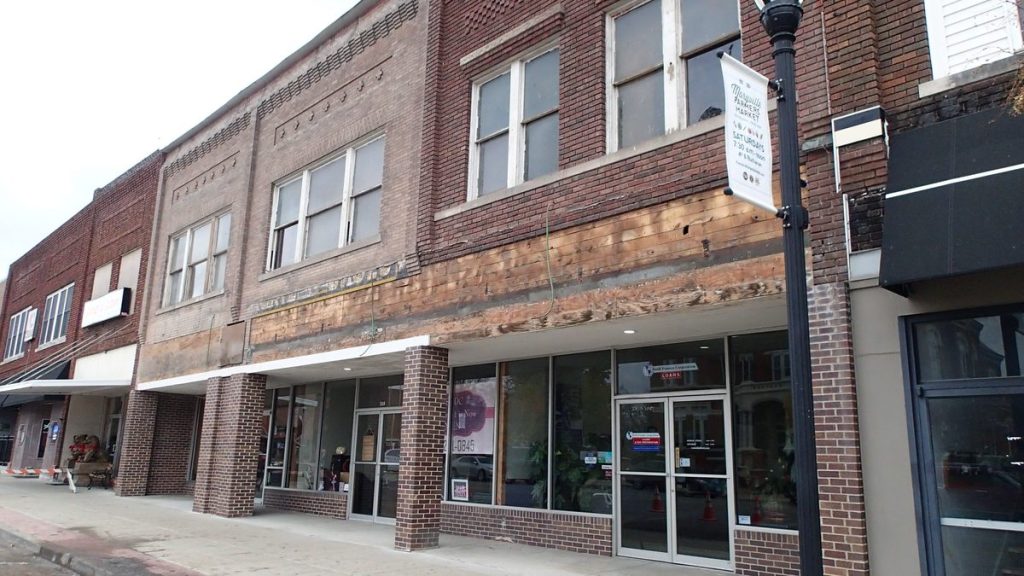
The removal of plastic and metal “slipcovers” from downtown buildings in order to restore their original brick facades is one of a number of improvements Missouri Main Street Connection consultants believe will help emphasize the historic character of Maryville’s central business district. Shown is one such project currently underway in the 300 block of North Main Street across the street from the Nodaway County Courthouse.
MARYVILLE, Mo. — Consultants from the Branson-based nonprofit, Missouri Main Street Connection, were in Maryville last week in support of an ongoing effort by Downtown Maryville — an organization comprising business and property owners on and around the courthouse square — to revitalize the city’s central business district.
During two days of meetings at the Bank Midwest branch on North Main Street, the consultants met with small business and building owners; representatives from the city’s major employers; public education officials and administrators from Northwest Missouri State University; and a collection of civic and municipal leaders and economic development professionals.
The latest spate of planning for a hoped-for downtown renaissance came about after Missouri Main Street received a $200,000 U.S. Department of Agriculture Rural Development Program grant and chose to spend a portion of that money providing Maryville with what amounted to an in-depth downtown redevelopment workshop.
Keith Winge, Missouri Main Street’s community development director, said Maryville was one of 20 communities chosen to benefit from the grant because of the progress it has made in rejuvenating downtown over the past several years.
“We chose communities that are trying to move forward,” said Winge, who added that his organization is prepared to provide Downtown Maryville with $20,000 over two years if the group can come up with $20,000 in matching funds in order to hire its first paid executive director.
Downtown Maryville is currently led by volunteer director Denise Jasinski, wife of Northwest Missouri State University President John Jasinski.
Winge was joined during last week’s sessions by Jim Thompson, an economic development specialist with Main Street Iowa, architect Randy Wilson and urban planner Tripp Muldrow, both of South Carolina.
In remarks during a Friday meeting that offered a summary of findings the team plans to incorporate in a forthcoming written report, Winge emphasized the importance of Downtown Maryville continuing to follow Missouri Main Street’s four-step formula, a recipe that calls for organization, economic restructuring, design and promotion.
He added that Maryville’s downtown serves as the city’s historic and cultural center, and said the community will find it difficult to grow “unless we have a strong heart.”
Winge further described downtown as essential to the city’s “quality of life and a reflection of the community as a whole.”
One focus of Friday’s meeting was the importance of a continuing partnership between Downtown Maryville and city government, which has set aside about $100,000 during the current budget year for central business district improvements.
Winge said that level of funding from a small-town City Council was unusual and praised the five-member governing board for its vision and commitment.
City Manager Greg McDanel said the projects that money will be used for are still to be determined, but that a number of possibilities are being considered.
One option floated on Friday is the creation of temporary easements that would allow municipal dollars to be spent helping to restore aging storefronts and other privately owned structures, a practice normally prohibited by law.
Winge said possible public/private partnership projects could include new paint, windows and doors; the creation of gathering spaces and pocket parks; security lighting; downtown festivals and special events; real estate development; and the formulation of development guidelines, building and signage codes and property improvement incentives.
Other recommendations included creation of a historical preservation committee that would focus on such things as saving old buildings and placing structures on the National Register of Historic Places.
Winge also urged cooperation with Northwest Missouri State University in order to come up with a coordinated look for signage, branding materials, color schemes and type faces.
In addition, Winge recommended incorporating high school and college students into the downtown renewal effort, a practice, he said, that takes advantage of the energy and creativity of youth while giving teens and young adults a sense of place and encouragement to remain in Maryville or return to the city as permanent residents after completing their education.
“It’s an opportunity to snag those folks and keep them here,” Winge said.
On other fronts, Winge said local government and business leaders should re-examine plans and drawings for a revitalized downtown created in the mid-2000s by the Downtown Revitalization and Economic Assistance for Missouri program (DREAM), a state initiative implemented by former Gov. Matt Blunt, who designated Maryville as a DREAM community in 2007.
During his portion of the program, economic development expert Jim Thompson presented a flurry of charts and statistics that he said demonstrate Maryville’s need for housing, especially affordable residences for young people who constitute the city’s fastest-growing demographic.
“You don’t have the quality or options that people are looking for,” Thompson said. “Your inventory is lacking.”
He continued that Maryville should work harder to exploit its position as an employment center and retail hub that provides jobs for nearly 3,400 out-of-town workers who drive here each business day.
That increased daytime population, Thompson said, means a city with a local retail “potential” of $103 million posts actual sales of $175 million, resulting in a positive “gap” of $71 million, much of it spent on the South Main strip.
“The question is, how do we drive those dollars downtown?” he said.
Thompson continued that an empty commercial building downtown costs the city $220,000 in economic activity and tax revenue, excluding lost sales, while individual consumer spending by residents of “upper story” downtown apartments ranges from $20,000 to $40,000 a year.
However, encouraging people to live and do business downtown will require both public and private investment, he said.
“You get what you incent,” Thompson said. “If you support more big-box land (large retailers located outside the downtown area) then that’s what you’ll get. … You always fund your priorities, and if it’s not funded, it’s not a priority.”
Architect Randy Wilson wrapped up Friday’s session with suggestions for affordably upgrading the appearance of occupied and vacant downtown structures and by encouraging the city to raise its signage and marketing standards to levels comparable to those employed by Northwest Missouri State University.
He also proposed a new community slogan, “cultivating opportunity,” that he said both looked to the future while hinting at Nodaway County’s agricultural heritage.
Wilson further suggested the creation of a #BeMary hashtag that could be coupled to such promotions as “Eat, Drink and be Mary, “Mary Christmas,” annual “Proud Mary” awards and community pride posters.
On other fronts, he urged the city to take advantage of its aging brick storefronts, which he said constituted “the primary distinguishing element of your place compared to any other place.”
While historic downtown buildings are unique, Wilson said, the South Main strip looks much the same as those found in thousands of other communities.
He added that preserving and capitalizing on that uniqueness is more a matter of individual initiative than signage rules and mandated color schemes.
“What I like to do most is write guidelines that help you protect and preserve your place,” Wilson said. “What I don’t like to do is write guidelines that tell you what to do with your building.”
Among other suggestions, Wilson recommended replacing downtown’s often washed-out crosswalks with stamped pavement, which is both more durable and more colorful, and the creation of small storefront retail businesses in buildings that also house low-traffic professional services, such as legal, financial and insurance firms.
Wilson emphasized that both public and private investment should be directed, at least at first, to relatively inexpensive quick fixes embracing facades; signs; partitions that improve rear-of-building appearance; decorative painting, awnings and overhangs; and the removal of metal and plastic “slipcover” materials hiding original exterior surfaces and ornamentation.
“I’d rather see 20 building owners do something small each year than to have two buildings completely renovated,” he said.
TONY BROWN/THE FORUM
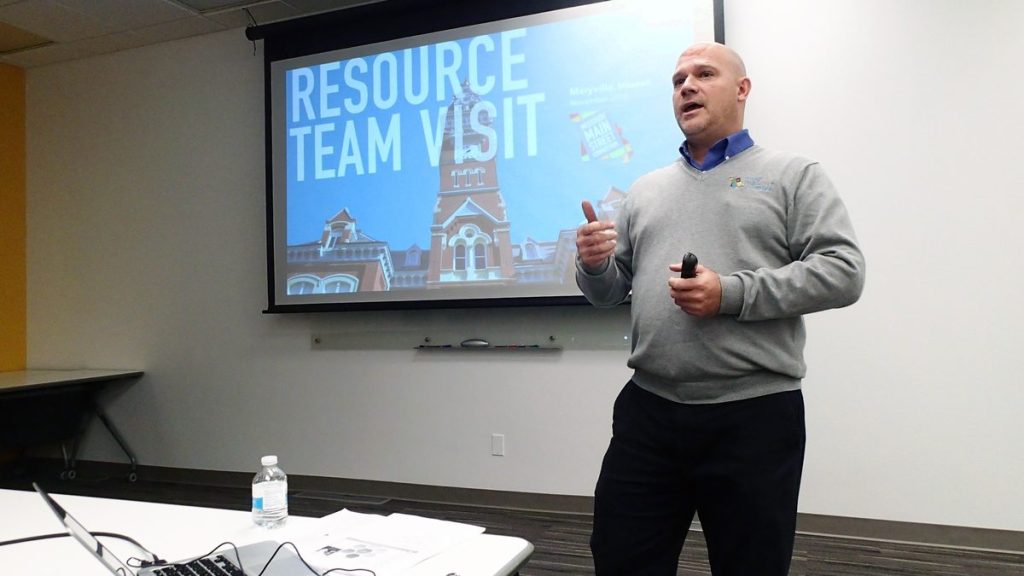
11-8-18 Downtown Maryville Keith Winge, Missouri Main Street Connection’s state community development director, addresses a group of civic and business leaders during a wrap-up session Friday that followed a series of meetings focused on rejuvenating Maryville’s courthouse square and surrounding portions of the city’s traditional central business district.