Pastor melds politics, faith to fight hunger
TONY BROWN/THE FORUM
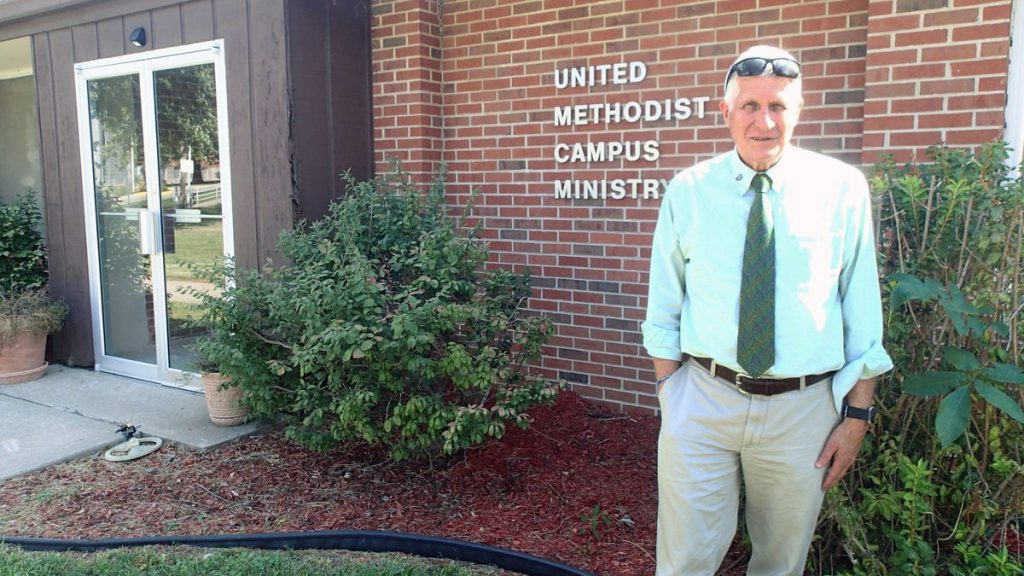
The Rev. Scott Moon, senior pastor of the First United Methodist Church of Maryville, is shown standing in front of the Methodist student center adjoining the campus of Northwest Missouri State University. Moon, a self-described proponent of social justice, recently returned from Washington D.C., where he lobbied congressional staffers on behalf of retaining current levels of Farm Bill funding for hunger relief.
MARYVILLE, Mo. — The Rev. Scott Moon, senior pastor of the First United Methodist Church of Maryville, believes deeply in social justice, the notion that society has an obligation to adequately care for those in want.
Though perhaps beyond the spiritual realm, Moon’s primary area of expertise, working for social justice, inevitably involves politics and government, arenas in which Moon has been active since he was a teenager serving as the legislative affairs coordinator for church youth within UMC’s Southern Illinois Conference.
That early experience of mixing citizenship and faith has continued throughout Moon’s pastoral career, and most recently during a trip earlier this month to Washington D.C., where he attended a conference titled Scarcity in Abundance: Hunger in the United States.
During his four-day stay in the nation’s capital, Moon also lobbied staff members attached to the offices of Missouri’s two senators, Claire McCaskill and Roy Blunt, as well as a representative from the office of Congressman Sam Graves, with regard to proposed cuts to the Supplemental Nutrition Assistance Program — SNAP — formerly known as Food Stamps.
Administered by the U.S. Department of Agriculture, SNAP provides food-purchasing assistance for low-income people via benefits distributed by social service agencies in all 50 states.
SNAP benefits totaled nearly $71 billion in 2016 and supplied roughly 44.2 million Americans — 14 percent of the U.S. population — with an average of $125.51 a month in nutrition assistance.
Moon said SNAP funding, part of the omnibus Farm Bill renewed by Congress every five years, is in danger of being cut under legislation proposed in the House of Representatives. Another bill, introduced in the Senate, would keep nutrition assistance at approximately its current level.
Both bills have passed their respective chambers and are currently before a congressional committee charged with reconciling them into a single piece of legislation.
Moon passionately believes that SNAP appropriations should remain, at the least, unchanged.
“Hunger continues to be a significant issue for many people in the United States,” he said, adding that private charities, churches and nonprofit organizations simply don’t have the resources to feed the millions of families and individuals facing hunger — a plight bureaucrats and social workers commonly call “food insecurity.”
“Every church congregation in the country, large and small and including all denominations, would have to come up with $20,000 a year each in order to meet the need,” said Moon, who pressed congressional staffers to advocate for the Senate version of the SNAP bill.
Looked at another way, he said, if 20 baskets of food were needed to feed all hungry Americans, only one of those baskets would be filled using donations from churches and private charities.
“It’s a bigger problem than any congregation can solve by itself,” Moon said.
And while hunger is a national issue, Moon argues that it’s also a local problem in a county where poverty, especially rural poverty, is commonplace.
Moon said about 20 percent of Nodaway County’s 20,000 residents — 4,000 people — have incomes that fall below the federal poverty line.
Representatives for Blunt and McCaskill told Moon that both their bosses were on board with maintaining SNAP’s status quo. The staff member for Graves, however, was noncommittal.
Should the House version ultimately be signed into law, Moon said, more than two million people could face benefit reductions or lose nutrition assistance entirely.
The pastor added that most of those affected would be workers with low-wage jobs, people with various disabilities and children.
To Moon, perceptions that people facing hunger are unwilling to work or somehow gaming the so-called social services “safety net” are simply unfounded. Instead, he sees poverty as a problem the nation is unwilling to solve rather than a choice made by people too lazy to earn a paycheck.
“A safety net isn’t a safety net if it’s laying on a concrete floor 40 feet below where you are,” he said. “We have a safety net, but it’s not in the right place.”
Moon admits he is one of a minority of pastors nationwide who choose to engage directly with lawmakers or their staff members. But he believes that doing so is part and parcel of a faith that urges believers to “be more just and compassionate.”
However, he makes a serious effort to ensure his activism doesn’t interfere with the traditional pastoral duties required to effectively shepherd one of Maryville’s largest faith communities — which, not coincidentally, serves a free meal to anyone who wants one every Wednesday evening.
And while Moon’s profession may be more about nourishing souls than bodies, he said that working for social justice — standing as an advocate for the poor, the hungry, the oppressed and the powerless — is as much a calling as delivering his Sunday sermon or leading a weekly Bible study session.
“It’s a defining characteristic of who I am,” he said.