Civil War submarine to stop at Nebraska Applejack festival
SUBMITTED PHOTO
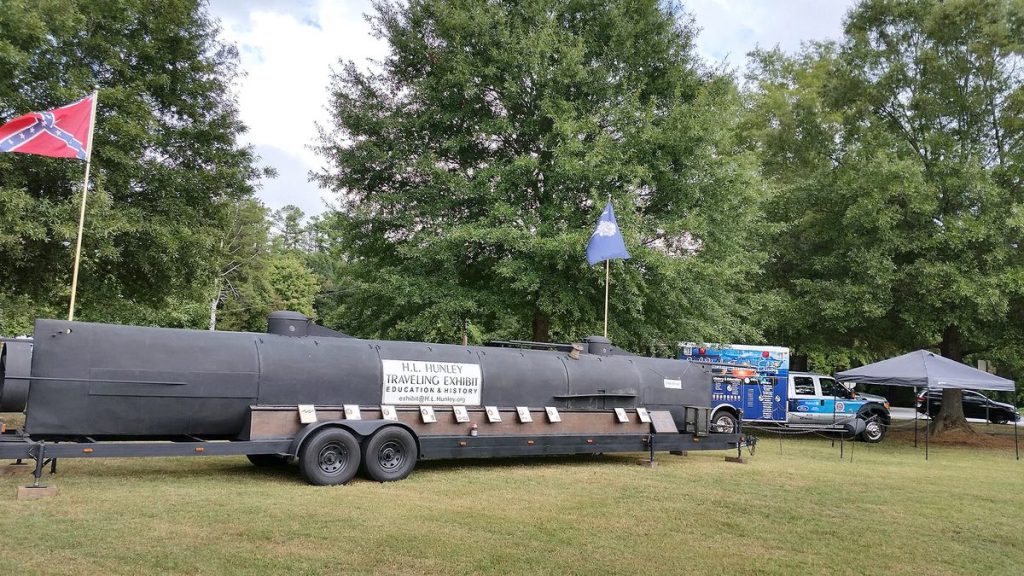
The H.L. Hunley Traveling Exhibit will bring a Civil War submarine to the 50th Annual Applejack Festival this weekend in Nebraska City.
NEBRASKA CITY, Neb. — The 50th annual Applejack Festival in Nebraska City is to host an unusual visitor this year: A Confederate submarine.
Instead of traveling up the river, the H.L. Hunley Travling Exhibit will be brought in by trailer, which is a good thing since the original drowned three crews one of which included its namesake, Horace Lawson Hunley, according to Joshua Whitney, information officer with the exhibit.
The Hunley will be displayed from noon to 6 p.m. on Friday, Sept. 21 and from 10 a.m. to 6 p.m. Saturday Sept. 22 and Sunday, Sept. 23, in front of the Civil War Veteran’s Museum on First Corso for Applejack weekend.
Five Confederate-clad hosts will explain the Hunley’s operatioin and answer questions.
Shaped like a very large cigar, the Hunley is about 40-feet long and a little more than 4 feet in circumference.
Museum Board president Sean Chance began exploring the Hunley’s visit about five years ago before securing funds and scheduling the visit.
“It is unusual, and there aren’t a lot of traveling exhibits like this,” he said. “I thought it would be spectacular for the public to see.”
The H. L. Hunley, while not an officially-commissioned Confederate boat, was a privateer used by the Confederacy.
The original H. L. Hunley was only the third submarine in American history and the first to sink an enemy vessel.
As such, Clark also explained that the exhibit offers a valuable experience not just for history buffs but also for anyone interested in the development of technology in the 19th century.
The Hunley was operated by a crew of eight: seven operated the hand cranks that turned the propeller and one directed the boat.
As for the replica that will be on display, the right side is removed to reveal its inner workings.
Only the third submarine in history, a great deal of trial and error – and risk – was involved in its development.
Electric and steam propulsion were tested, but did not prove as effective as a hand crank mechanism.
Following a successful trial in Mobile Bay, the H. L. Hunley was shipped to Charleston, S.C., in the summer of 1863 and commandeered by the Confederate military.
There, during a trial run in August, it sank before one of the hatch doors closed, killing all but three of its volunteer crew.
A little over two weeks later, the Hunley failed to surface on another trial run, killing the entire crew of eight, which included Mr. Hunley.
Then in February of 1864, armed with a spar torpedo, an explosive device attached to a 20-foot pole on the nose of the vessel, the Hunley attacked the USS Housatonic in the Charleston Bay in attempt to break the blockade there.
This attack was successful, sinking the USS Housatonic and killing five of its crew, but the Hunley killed its third crew in the process.
Several researchers believe the Hunley was simply too close when the charge was detonated: that 20-foot pole just wasn’t long enough.
The remains of the Hunley remained at the bottom of Charleston Harbor until being raised in the summer of 2000.
The original Hunley is currently on display at the Warren Lasch Conservation Center in Charleston.