Bass master angles for pro fishing career
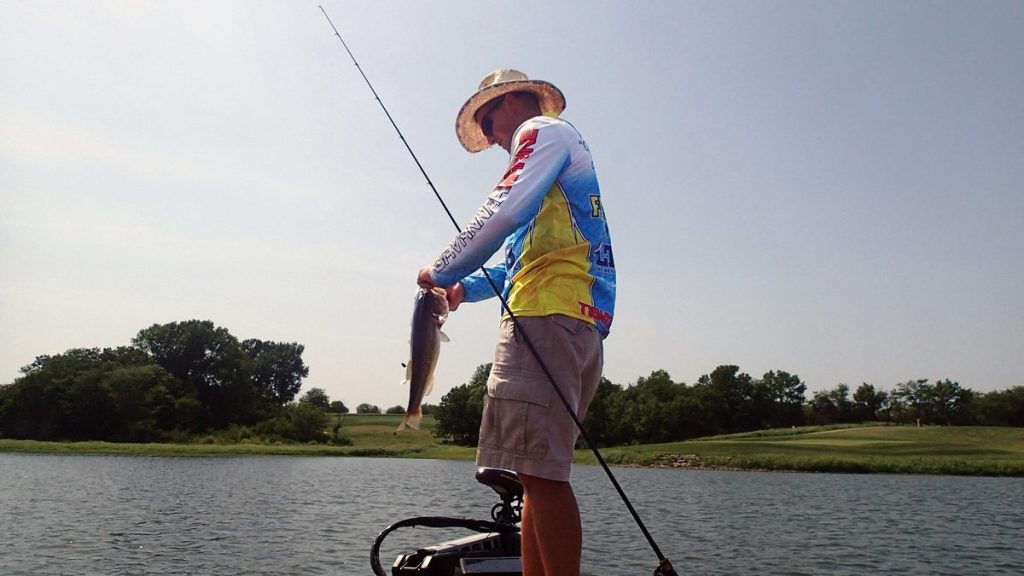
TONY BROWN/THE FORUM
Aspiring pro bass fisherman Andrew Nordbye of Maryville removes the hook from the lip of a largemouth bass last week at Mozingo Lake. Nordbye, former president of the Northwest Fishing Club, an organization made up of students at Northwest Missouri State University, participates in 10 to 15 bass tournaments each year. Among other fishing-related pursuits, he is building a growing roster of sponsors while developing “Fishing is a Habit,” a self-owned company that produces promotional videos designed to market lures, tackle and rods and reels.
MARYVILLE, Mo. — Most fishermen dream of catching the “big one,” but Andrew Nordbye, a 25-year-old Northwest Missouri State University graduate, is working hard to make that lifelong angler’s fantasy come true, not just once, but again and again.
A former president of the university’s Northwest Fishing Club, Nordbye has set his sights on becoming a professional bass fisherman, a goal he said he set for himself when he was only 5 years old.
While a lot of folks in northwest Missouri like to fish, Nordbye has taken what for most is a weekend hobby and ramped it up several levels.
He doesn’t just enjoy fishing, he lives for it, and is several rungs up the ladder toward joining the elite group of 500 or so anglers who earn their living reeling in lunker largemouth bass at tournaments nationwide.
A St. Joseph native who now lives in Maryville, Nordbye still has a “regular” job working for the local Midwest Assistance Program office, a nonprofit company funded by government grants that provides rural communities with technical solutions for upgrading water and wastewater facilities.
But while the Bearcat alum is putting his business management and marketing degrees to work helping small towns across the region deliver clean drinking water and efficient sewage treatment to their citizens, he’s also using those same skills to develop a budding fishing career.
Just a couple of years out of college, Nordbye has already established himself as a rising star in the bass-fishing world’s semi-professional ranks. His accomplishments to date include a number of solid professional tournament performances and a 10-company sponsor list that comprises Maryville-based Tightlines UV Lures plus a number of other tackle and fishing equipment enterprises.
Nordbye said sponsors cover about half his bass-fishing expenses, which come to around $10,000 a year. His goal is to increase his tournament winnings, sponsorship revenues and other fishing-related income to between $50,000 and $70,000 annually — the minimum overhead required to take a serious shot at becoming a full-time pro.
Nordbye’s other fishing-related endeavors include “Fishing is a Habit,” a self-owned company that produces promotional videos designed to market lures, tackle and rods and reels. He also maintains the Fishing with Nordbye YouTube site, which boasts more than 2,200 subscribers.
While investing a lot of time and effort into the business activities that constitute a vital part of any professional fishing career, Nordbye, like all high-level athletes and sportsmen, works constantly to improve his skills, hitting Mozingo Lake in his 19.5-foot Stratos bass boat at least three times a week.
His carefully honed expertise was on full display during a recent Mozingo outing during which he effortlessly pulled in a half-dozen bass weighing between 3 and 5 pounds while participating in a 90-minute interview that served as the basis for this story.
Sporting cargo shorts, sandals, a fishing jersey blazoned with sponsor logos and a battered straw cowboy hat, the quick-smiling, affable Nordbye made it look easy, chatting away while casting with practiced precision into Mozingo’s hidden trees and brush piles.
His set-up was deceptively simple — a medium-heavy rod equipped with baitcasting reel loaded with 15-pound test fluorocarbon line, the end of which sported a Tightlines UV Lures 10-inch plastic worm pierced by a single barbed hook.
While similar rigs are a staple for northwest Missouri bass fisherman, rubber worms are just one small weapon in Nordbye’s vast arsenal of artificial bait.
“I have thousands of lures,” he said, “Basically I have my own tackle shop in my garage.”
Nordbye said one of his favorite techniques is casting a plastic floating frog cast onto the top of moss beds. Using a surface lure, he said, is especially exciting because the angler gets to watch fish attack the bait, which often results in dramatic leaps and flips.
However, there is no perfect lure, and Nordbye in his quest for the wily bass under tournament conditions is largely governed by a single rule — “Find out where the bass are and what they are biting.”
It sounds simple enough in theory, but in practice requires a lakeful of experience, expertise and gear.
In addition to his seemingly infinite store of lures, Nordbye uses a wide selection of rods and reels plus several pieces of fish-seeking electronic gear designed to track down the biggest bass as they lurk in dense cover or hide within underwater structures both natural and manmade.
“Without the proper line and rod I would not have caught the fish I caught today because I had to pull them through brush piles,” he said in a tone of easy, practiced confidence.
In addition to electronic depth finders, Nordbye’s boat is also equipped with GPS devices and a “side scanner” that provides him with views of lake-bottom contours and real-time images of the fish lurking there.
During the waterborne interview at Mozingo, however, Nordbye left most of his tech toys stored inside a deck hatch, explaining simply that they were unnecessary because, “I know the lake.”
Though he participates in 15 to 20 tournaments a year — he won a recent Mozingo tourney hosted by the Northwest Fishing Club — the highlight of Nordbye’s angling season consists of three professional “opens” that in 2018 have taken him, or will take him, to Wisconsin, Alabama and South Carolina.
In addition to the hours on the road required to participate in these events, Nordbye also spends a week before major tournaments “pre-fishing” on the reservoir where the competition will take place.
Such preparation is key, he said, in order to become as familiar with the lake as possible while learning what kind of lures are attracting the biggest fish.
“It’s all about presentation,” Nordbye said, “putting your lure where the fish are. The right equipment helps, but number one is presentation.”
So what advice does a young pro like Nordbye have for the casual angler — the guy or gal who fishes off the bank or a dock without the benefit of a $600 reel, a bottomless tackle box and underwater imaging technology?
Study, learn, practice and dream the dream, says the young man who began his professional fishing journey as a toddler casting off the bank with his father.
“Take one step toward your dream every day,” he said. “Watch fishing videos and go to fishing websites. There are all sorts of ways to learn.”
And keep your eyes on the prize and your bait in the water.
“There is nothing like the thrill of hooking into a big bass,” Nordbye said.
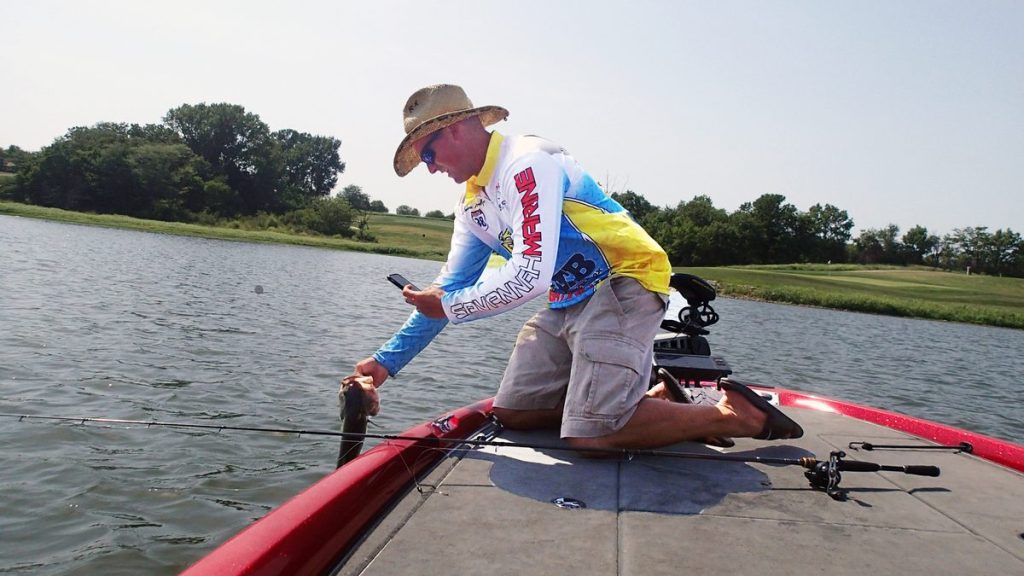
TONY BROWN/THE FORUM
Andrew Nordbye uses his cell phone to photograph a bass caught during a recent afternoon fishing outing at Mozingo Lake. A semi-professional angler, Nordbye manages the Fishing with Nordbye YouTube site, which currently has more than 2,200 subscribers.
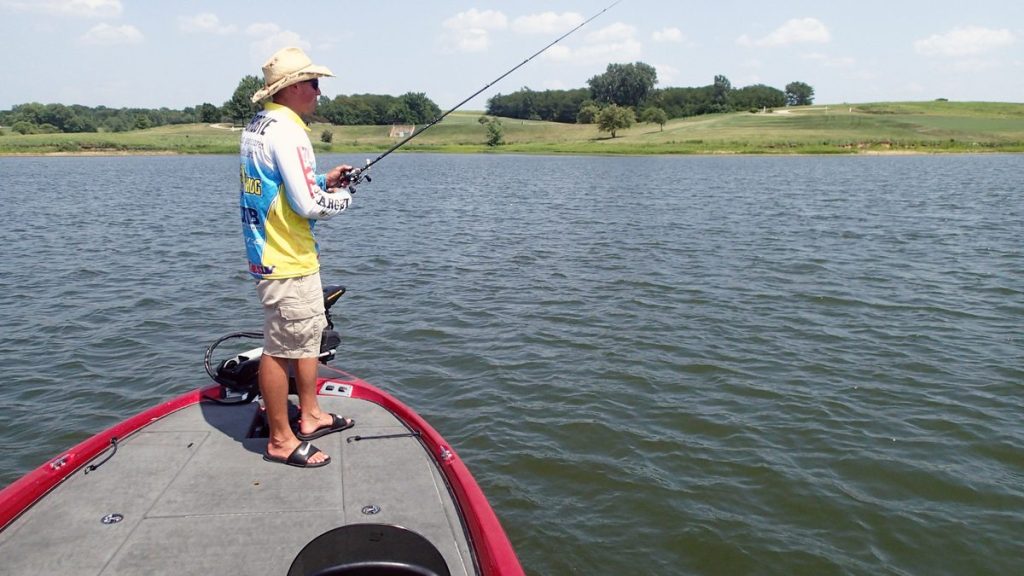
TONY BROWN/THE FORUM
Andrew Nordbye waits for a largemouth bass to strike a 10-inch Tightlines UV Lures plastic worm while fishing last week at Mozingo Lake Recreation Park. An aspiring professional angler, Nordbye caught a half-dozen 3- to 5-pound bass during the 90-minute afternoon outing.
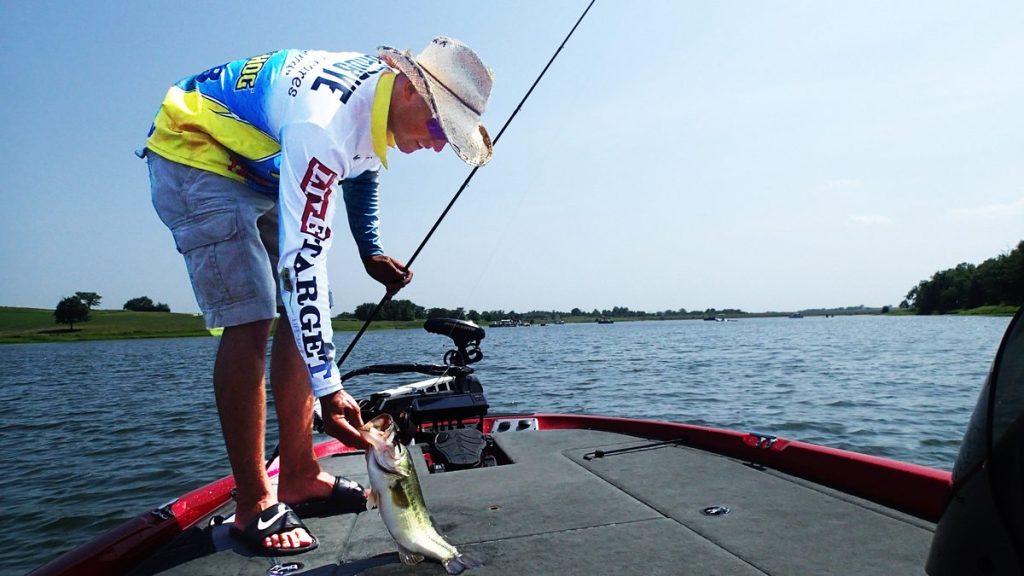
TONY BROWN/THE FORUM
Andrew Nordbye displays a freshly caught largemouth bass before releasing the fish back into Mozingo Lake. An aspiring professional angler, Nordbye, who lives in Maryville, said his biggest catch at Mozingo was a 7.5-pound bass, and that his personal-best largemouth, hooked at Chickamauga Lake in Tennessee, weighed in at 9.63 pounds.