Secular Bearcats offers home for non-believers
TONY BROWN/THE FORUM
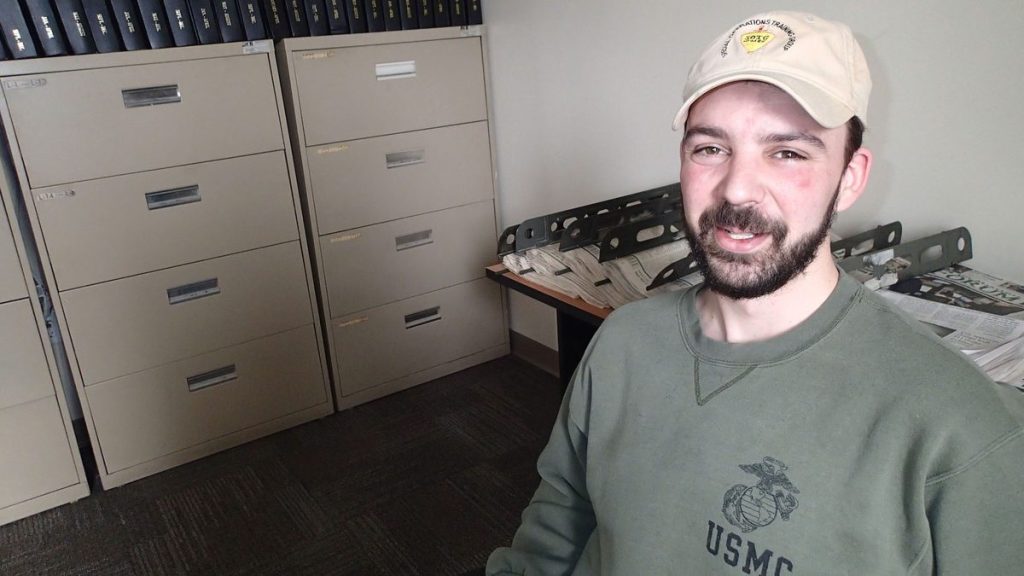
Ryan Lanman, a U.S. Marine veteran now working toward a biomedical sciences degree at Northwest Missouri State University, is the founder and leader of Secular Bearcats, an organization focused on, but not limited to, students who have rejected Christianity and other faith traditions based on belief in a revealed, supernatural deity.
MARYVILLE, Mo. — As a state-assisted public institution, Northwest Missouri State University is a secular campus, required under the U.S. Constitution’s First Amendment to show neither fear nor favor with regard to the religious beliefs — or lack thereof — held by any student, faculty member or employee.
That said, Maryville is very much a part of the Bible Belt, and the influence of various faith, and predominantly Christian, traditions plays a key role in the lives of many — perhaps most — members of the university community.
Indicative of what might be called a culture of belief at Northwest is the number of student-focused ministries that maintain facilities along Fourth Street, the western portion of which is also known as College Avenue.
It is also worth noting that, for years, one of the most active student organizations on campus has been Cru — an evangelical-leaning national organization formerly known as Campus Crusade for Christ.
The name change came about because the word “crusade,” for reasons obvious to anyone with a rudimentary knowledge of medieval history, is offensive to many Muslims.
Faith-based organizations serving students at Northwest span the gamut of faith traditions, again almost exclusively Christian, ranging from the Roman Catholic Newman Center to Protestant outreach efforts such as the Baptist Student Union.
Other campus-centered Maryville ministries include the Northwest Wesley Foundation, Christian Campus House, the Lutheran Campus Center, the Muslim Students’ Association, the Northwest Spirit & Truth Gospel Choir, Spirituality Involved Sisters Together Achieving Harmony (SISTAH), The Bridge Collegiate Ministry and The Navigators.
But times are changing. And in recent years, especially with the advent of a movement sometimes called the “New Atheism,” more and more Americans are identifying themselves as atheists, agnostics and freethinkers — that is people who reject the notion of humanity being watched over, inspired or guided by a supernatural, all-powerful deity capable of intervening in human affairs.
While polls and academic research show the vast majority of Americans — more than 90 percent — still believe in God, there are indications that many citizens, especially among the millennial generation, those born between about 1980 and the early 2000s, are choosing to live without faith.
While 22 percent of these religious “nones” — those who call themselves atheists, agnostics or “nothing in particular” — said they did not believe in God in 2007, that figure rose to 33 percent in 2014, according to the Pew Research Center. The same study showed that 27 percent of the religiously unaffiliated are certain that God exists, down from 36 percent in 2007.
Lack of certainty in God’s existence also appears to be more common among some Christian groups and members of non-Christian faiths. For example, 66 percent of those identifying with mainline Protestant traditions now say they are absolutely certain God exists, down from 73 percent in 2007.
A similar trend is seen among Catholics, where 64 percent expressed an absolute belief in God in 2014, compared with 72 percent in 2007.
In an effort to provide a social and cultural home for what he sees as a growing number of non-believing members of the Northwest Missouri State community, a former U.S. Marine and 30-year-old undergraduate student named Ryan Lanman has founded a campus organization called Secular Bearcats.
A junior biomedical sciences major from Columbia, Lanman founded Secular Bearcats after arriving in Maryville as a freshman in 2015.
An active campus citizen, the outgoing, articulate Lanman, who served stateside as a USMC mechanic and marksmanship coach, is also president of Northwest’s Association of Non-traditional Students.
“When I got here, I discovered there wasn’t anything on campus for students who were disenfranchised by religion,” Lanman said. “I thought there was a need for an organization that offered the sense of community that a religious organization provides without the doctrine and the heavy-handed expectations that come along with a specific dogma.”
He added that people who come to college as believers often have a church affiliation that can provide a ready-made social network during their years on campus.
“We absolutely want to provide that,” Lanman said. “I want to see something like that for the non-religious. One thing that religion offers is that sense of community.”
He went on to say, however, that Secular Bearcats has no interest in proselytizing or convincing the faithful to adopt a non-believing worldview. If faith in God, whether or not he, she or it exists, makes someone a more fulfilled, kindly, ethical and realized person, Lanman is all for it.
For this reason he has rejected affiliating Secular Bearcats with national organizations like the Secular Student Alliance, because, he said, “they tend to be exclusive or create an environment where believers don’t feel welcome to come and find out who we are and why we are not believers.”
Christians and members of other faith traditions, Lanman said, are more than welcome at Secular Bearcats meetings and activities and will be treated with acceptance and courtesy.
“We want to encourage dialogue with believers,” he said. “We want people to learn and grow. I’m an agnostic-leaning atheist, but I am also a humanist. I believe in humanity, and I believe that the interactions we have with each other are more important than any interactions we have with the supernatural. Believers are welcome all day every day, especially those who believe but don’t have a church affiliation.”
Lanman said as a teenager he committed to Christianity while in junior high school and remained a believer through his years in the military. His grandfather was a Southern Baptist minister, he said, describing his parents as “culturally Protestant” but not regular churchgoers.
Then about four years ago, Lanman began tuning into arguments questioning the truth of Christianity on television and the Internet, especially a public-access TV show called “The Atheist Experience.” That exposure led him to begin exploring online presentations and books written by such noted “New Atheists” as Richard Dawkins, the late Christopher Hitchens, Daniel Dennett and Sam Harris.
It was Dawkins who uttered the widely quoted phrase, “We are all atheists about most of the gods that societies have ever believed in. Some of us just go one god further.”
As for his own journey away from faith, Lanman said he simply grew doubtful about the logic used to justify deity-inspired moral systems.
“Using the words good and bad is a terrible way to describe morality,” said Lanman, who draws a sharp distinction between the “subjective morality” of belief and the “objective morality” of the ethical non-believer.
“A moral system does not have to be rooted in faith. It can be rooted in our interactions with each other,” he said.
“Look at the commandment ‘You shall not covet your neighbor’s wife.’ I can understand (without belief in God) that destroying someone else’s relationship can do harm and cause lots of suffering. So why would I want to interact with someone like that and cause them pain and suffering? Why would I want a society like that?”
Secular Bearcats currently has about 20 members on its roster. Another 70 or so students have joined the organization’s email list. The group maintains a Facebook site at www.facebook.com/secularbearcats.
The organization will host an informational booth April 5 (today if you are reading this in the Forum’s print edition) on the second level of the J.W. Jones Student Union. A second event, set for 6:30-8:30 p.m. Monday April 9, also on the union’s second level in the “fireplace” area, will take the form of an open forum titled “Quest for Knowledge.”