Mo. ag chief addresses Northwest food summit
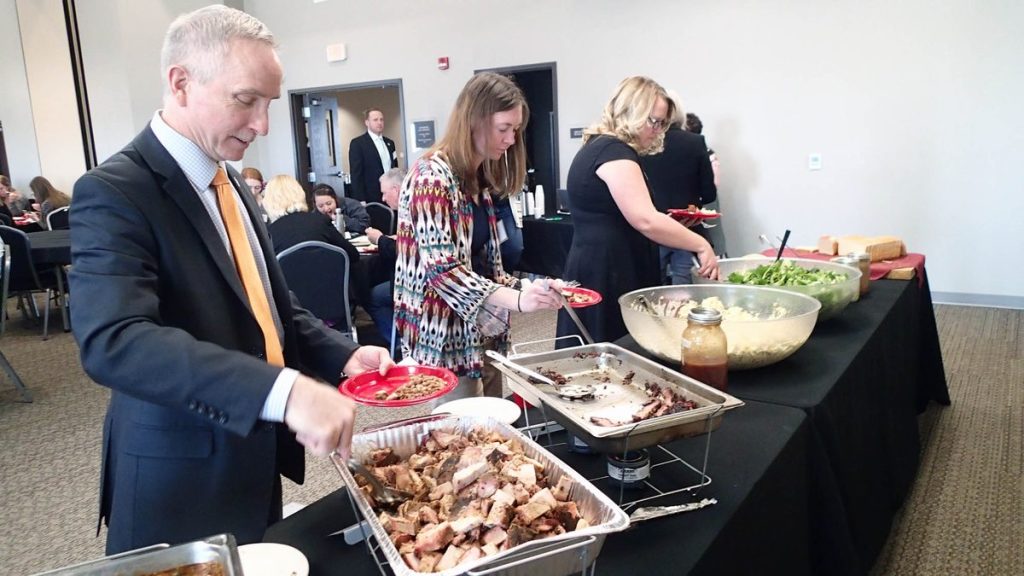
TONY BROWN/THE FORUM
Northwest Missouri State University President John Jasinski, left, helps himself to a portion of northwest Missouri-raised beef during a local-foods luncheon served during Wednesday’s Agriculture and Food Literacy Summit. The meal was prepared by Michael Foust, owner of Farmhouse, a company that plans to open a restaurant and catering business this spring at the Mozingo Lake Recreation Park conference center.
MARYVILLE, Mo. — Missouri Department of Agriculture Director Chris Chinn was at Mozingo Lake Recreation Park Wednesday to speak at the Agriculture and Food Literacy Summit hosted by Northwest Missouri State University’s School of Agricultural Sciences.
Chinn is a fifth-generation farmer who, along with father-in-law Gary, husband Kevin and other family members, owns and operates a northeast Missouri hog, feed mill, row crop, hay and cattle operation.
She was appointed to head Missouri’s ag agency in 2017 by newly elected Gov. Eric Greitens after rising to statewide prominence a decade ago as a family farm advocate working primarily through social media, including Twitter and a popular blog site.
The Agriculture and Food Literacy Summit was the first major event related to a two-year, $150,000 grant awarded to Northwest by the U.S. Department of Agriculture and the National Institute of Food and Agriculture.
The money is earmarked for development of faculty and student partnerships with middle schools aimed at increasing knowledge about food production systems.
Among other goals, the grant is to provide classroom toolkits for children that showcase the importance of production agriculture and emphasize ag-related careers. Grant funds will also be used to support professional development for K-12 educators as well as school visits to Northwest’s R.T. Wright Farm north of Maryville.
During her remarks, Chinn urged farmers and other industry professionals to get the word out about the importance of production agriculture in ways that counteract “misconceptions” related to genetically modified crops, confined animal feeding operations and the use of livestock antibiotics and hormones.
Such practices have stirred opposition among environmentalists, animal-rights lobbies and consumer groups.
“All farmers care,” said Chinn, refuting the notion that so-called “factory farms” employ methods that are inhumane, environmentally unsound or both.
She added that the industry needs to fight what she sees as burdensome regulation, such as the classification of animal effluent as “toxic waste.”
“Too many farmers are struggling with this conversation,” said Chinn, who added that dialogue with individuals and groups opposed to aspects of production agriculture is preferable to confrontation.
As an example, she cited the negative response of livestock producers to Australian winemaker Yellow Tail’s support of the Humane Society of the United States.
Calls for boycotting Yellow Tail products, Chinn said, served only to divide the agriculture community against itself.
“We’re never going to make that mistake again,” she said. “Instead, we should seek to draw attention to the people who support us.”
Chinn went on to say it was important for farmers and other agriculture industry professionals to “share those stories” in an effort to place farming and food production systems in a light that “addresses misconceptions rooted in fear” and “bridges the rural-urban divide.”
Promoting and protecting production agriculture, including small producers and specialty farms as well as large livestock and crop operations, Chinn said, is an essential step toward feeding a world in which too many people go without. She added that one in five Missourians face “food insecurity,” a bureaucratic term for intermittent hunger.
On other fronts, Chinn cited additional priorities she has set as director, including access to high-speed Internet for “every rural community” and the creation of more opportunities for young farmers.
Ensuring the success of a new generation of producers is essential, Chinn said, in an industry where the average age for farmers is 58.
Finally, Chinn underscored the importance of Missouri agriculture — an $88 billion industry — to the state’s economy. One in 10 workers statewide, she said, has an agriculture- or forestry-related job.
Chinn further noted that there are about 100,000 farms in Missouri, 90 percent of which are family owned. Ag and forestry enterprises, she claimed, generate nearly 15 percent of the state’s total sales volume.
During a brief question-and-answer session following her talk, Chinn also said she is concerned about the international response to import tariffs proposed by President Donald Trump.
Such tariffs, she fears, could spark retaliation by countries who buy U.S. foodstuffs and other agricultural products.
“How important it is to keep every single market that we have,” said Chinn, who went on to describe the negative impact excess supply has had on the once-thriving Missouri dairy industry.
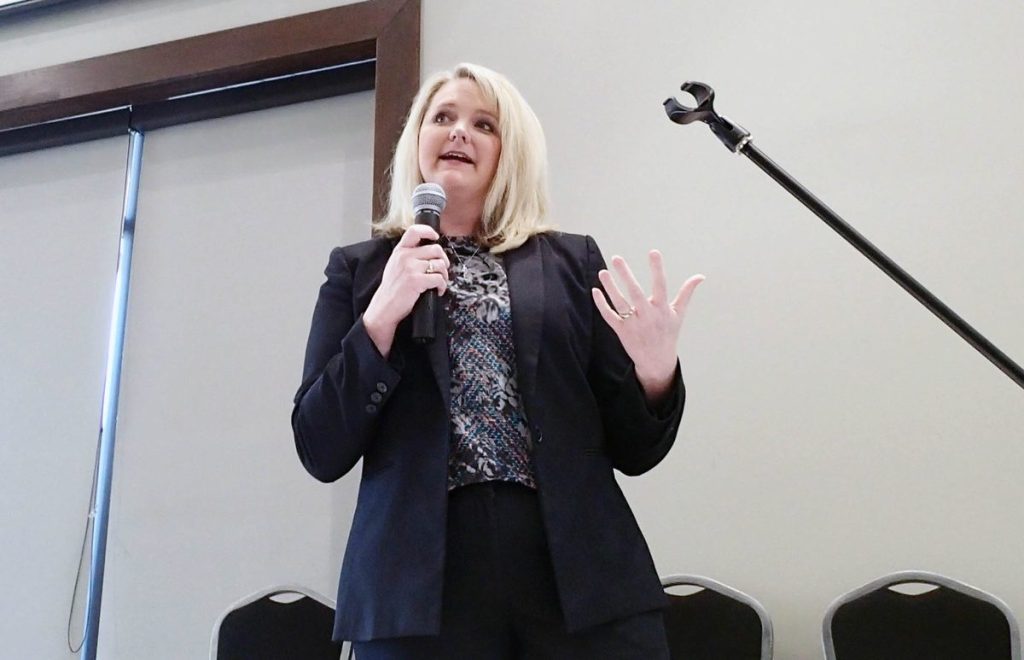
TONY BROWN/THE FORUM
Missouri Department of Agriculture Director Chris Chinn speaks Wednesday at the Mozingo Lake Recreation Park conference center during the Agriculture and Food Literacy Summit hosted by Northwest Missouri State University. , Chinn urged farmers to get the word out about the importance of agriculture in ways that counteract “misconceptions” about genetically modified crops, confined animal feeding operations and other practices that have stirred controversy among environmentalists, animal-rights lobbies and consumer groups.