Autism advocate Grandin speaks at Northwest
TONY BROWN/THE FORUM
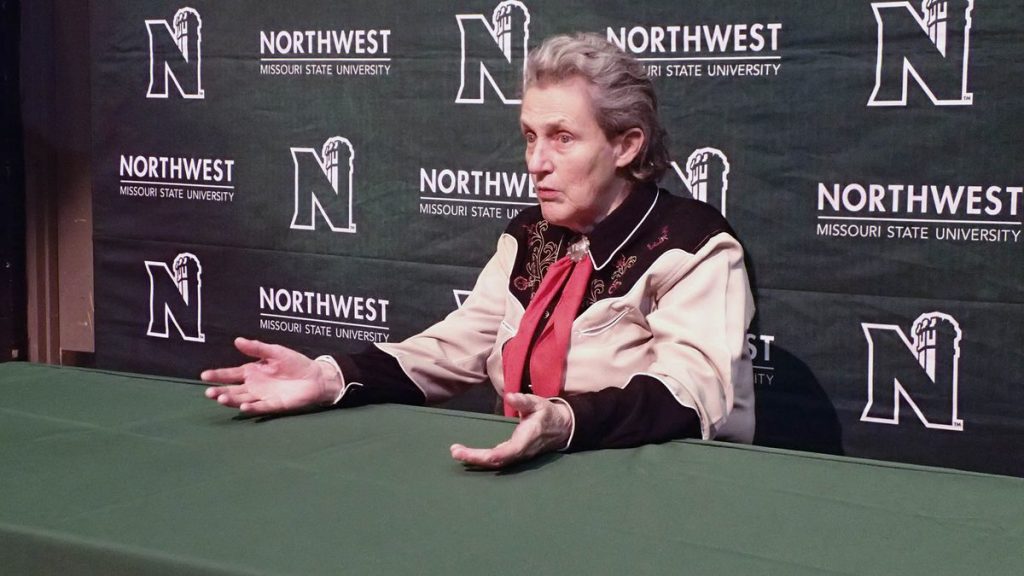
Animal science professor, author and autism advocate Temple Grandin speaks during a press conference Feb. 15 prior to delivering this year’s James H. Lemon Lecture at Northwest Missouri State University.
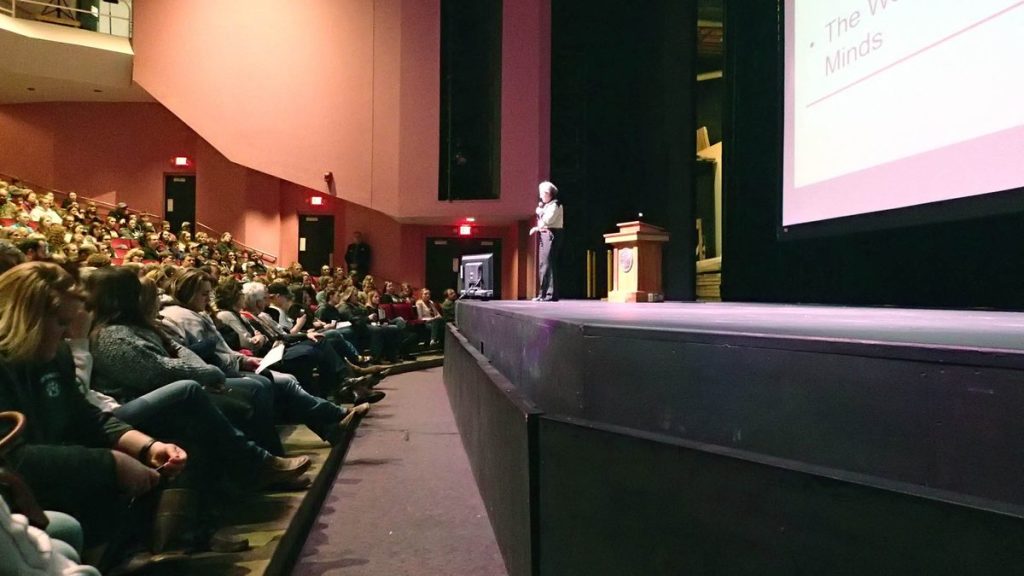
Nationally renowned scientist, author, educator and autism awareness advocate Temple Grandin, a professor of animal science at Colorado State University, addressed a near-capacity audience Thursday, Feb 15, at the Houston Center for the Performing Arts on the campus of Northwest Missouri State University.
Grandin’s presentation, titled “Developing Individuals Who Have Different Kinds of Minds,” focused on the importance of providing effective educational opportunities to all students of all ages, especially those challenged by such conditions as autism, dyslexia, attention deficit hyperactivity disorder and Asperger’s syndrome.
Too many teachers and school administrators, Grandin said, focus on “top-down” educational strategies that lead to broad generalizations about how children and teenagers learn.
The result, she said, is that students whose brains are wired for different kinds of learning are “screened out” rather than receiving the kinds of lessons and experiences necessary to prepare them for academic and career success.
“We need these different kinds of minds,” said Grandin, dressed in her trademark western clothing and neckerchief. “Over-specialization is killing creativity.”
In addition to her speech at the Houston Center, Grandin’s visit to Maryville included tours of Northwest’s R.T. Wright Farm and the university’s Leet Center for Children and Families, a campus pre-school that provides experience-based training for early childhood education majors.
Grandin said she was especially impressed by the Leet Center, where she watched children “making cool stuff out of old computer parts” and participating in other activities designed to develop practical, hands-on skills.
Such experiences are important for children, she said, and figure into a new book she is writing that she hopes will “get kids interested in the whole idea of inventing things.”
Grandin rose to national prominence as an animal behavior consultant to the livestock industry and a designer of humane livestock handling systems.
Today, it is estimated that her center-track restraint system is used to handle nearly half the cattle in North America.
Grandin is also one of the first people on the autism spectrum to publicly share insights about living with that condition.
The inventor of the “hug box,” a device used to calm people with autism, Grandin, in 2010, was named one of Time magazine’s 100 most influential people in the world in the “Heroes” category. She is also the subject of the biopic, “Temple Grandin,” a major motion picture starring Claire Danes in the title role.
During her speech, Grandin reeled off a list of thinkers, inventors, scientists and business people who achieved success despite failing to follow, or choosing to ignore, the traditional college/graduate school path.
Jane Goodall, for example, long considered the world’s foremost expert on chimpanzees, started her career after earning a two-year secretarial certification before going on to acquire a doctorate without first receiving a bachelor’s degree.
The great American inventor Thomas Edison, Grandin said, was probably autistic and was once described as “addled” by one of his teachers.
Poor at math, she said, Edison once quipped that “I can always hire some mathematicians, but they can’t hire me.”
Others on Grandin’s list of those who succeeded despite, or because of, their “different brains” included filmmaker Steven Spielberg, who overcame dyslexia; “nerdy” Elon Musk; and Gary Cohn, also dyslexic, the chief operating officer of investment giant Goldman Sachs.
These life stories, and others, Grandin said, underscore the need for broad-based educational offerings that, in addition to traditional academic subjects, provide exposure to hands-on activities such as art, music, homemaking, woodworking and theater.
Nobel Prize winners, she said, are 50 percent more likely to have an arts-and-crafts hobby than other scientists and thinkers.
As a girl and young woman, Grandin said her favorite subjects were animal behavior, biology, psychology and literature, even though she was at first a poor reader. However, she also acquired practical skills in carpentry and drawing.
“I wasn’t overspecialized,” she said, adding that young people should view school as an opportunity to achieve their goals while figuring out “what they hate and what they love.”
Born into a wealthy New England family, Grandin was expelled from a private school at age 14 for throwing a book at a schoolmate who taunted her.
Shortly after this incident, Grandin spent a summer on an aunt’s Arizona ranch, an experience she described as transformative with regard to her later career.
As a teen, she also attended Mountain Country School in New Hampshire. It was there that Grandin met William Carlock, a science teacher who became her mentor, and whom Grandin said encouraged her to pursue her dream of becoming a scientist.
She speculated that a child at the same place on the autism spectrum today and entering public schools would likely be shunted aside, “defined by a label,” become a prime candidate for video-game addiction and given fewer opportunities for visual and hands-on learning.
American public education currently overemphasizes skills needed to become a white-collar professional, Grandin said, whereas a lack of hands-on, technical and visual learning has led to a shortage of workers in skilled trades capable of the “complex work” needed to design and create advanced mechanical systems.
“Educators must not screen out students with unique minds,” Grandin said. “The world needs all kinds of minds.”
In describing the narrow, professions-based learning that defines much of the American educational establishment, Grandin quoted from the late science fiction author and biochemist Isaac Asimov’s short story “The Dead Past.”
“A degree is the first step down a ruinous highway,” Asimov wrote. “You don’t want to waste it, so you go on to graduate work and doctoral research. You end up a thoroughgoing ignoramus on everything in the world except for one subdivisional sliver of nothing.”
Grandin was invited to Northwest as this year’s James H. Lemon Lecturer, which was created through a gift by Beatrice E. Hanson, who graduated from Northwest in 1936.
The talk, formerly part of the Distinguished Lecture Series, is named in honor of Hanson’s grandfather, who helped found the university, then known as Missouri’s Fifth District Normal School.
Additional support for Grandin’s appearance was provided by Northwest’s School of Education and the Northwest Missouri Local Administrators of Special Education.
TONY BROWN/THE FORUM
A near-capacity audience was on hand Feb. 15 at Northwest Missouri State University for a talk by Temple Grandin, a prominent designer of livestock handling systems and an advocate for making better educational opportunities available to students coping with autism, dyslexia, attention deficit hyperactivity disorder and Asperger’s syndrome.