
Law, court issues dominate county meeting
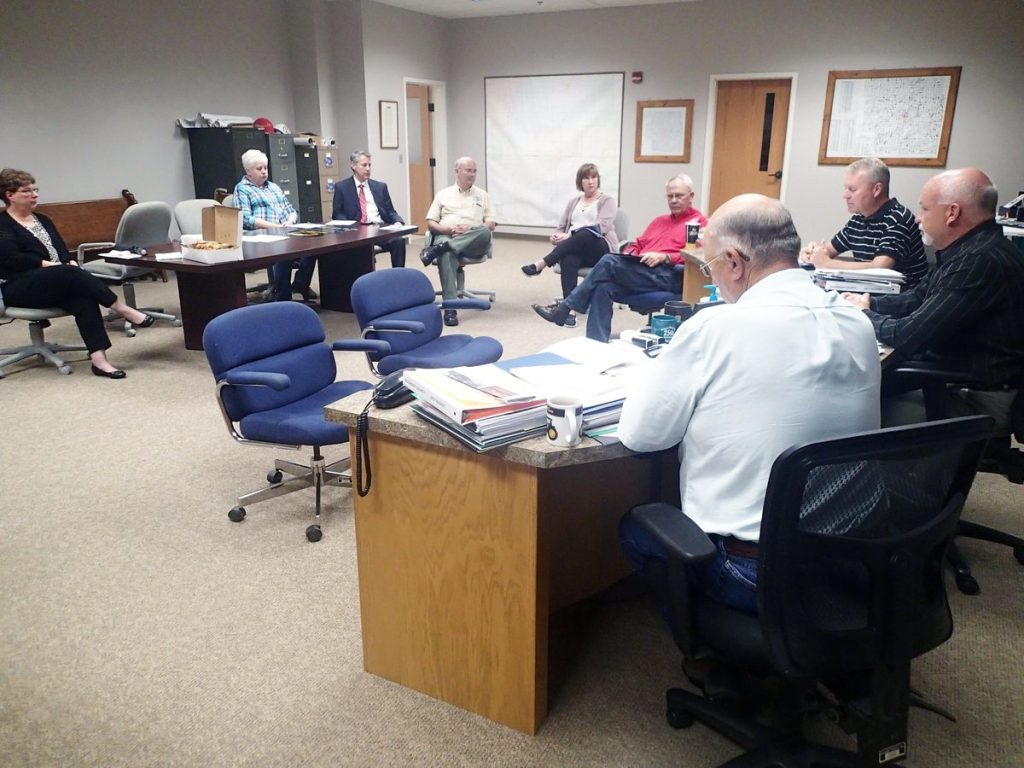
TONY BROWN/DAILY FORUM
Nodaway County officeholders gather Friday in the Administration Center for their final quarterly meeting of 2017. Pictured clockwise are Public Administrator Diane Thomsen, Recorder of Deeds Sandy Smail, Associate Circuit Judge Doug Thomson, Sheriff Randy Strong, Collector-Treasurer Marilyn Jenkins, Assessor Rex Wallace and commissioners Chris Burns, Bill Walker and Robert Stiens. Also in attendance were Clerk Melinda Patton and Prosecuting Attorney Robert Rice.
Nodaway officeholders had a lot on their minds Friday when they gathered in the County Commission chambers for their final quarterly meeting of 2017.
Criminal justice and law enforcement issues dominated the 90-minute session, which in the past has generally lasted about 30 minutes.
Associate Circuit Judge Doug Thomson set the tone when he warned the commission that the county is likely to see increased costs in 2018 due to fees charged for court-appointed attorneys representing people whose ability to govern their own affairs is being questioned due to apparent mental illness.
Thomson said an increasing number of mental illness cases are ending up in Nodaway County as patients are transferred to St. Francis Hospital from urban jurisdictions — mostly Kansas City and St. Joseph — due to lack of bed space.
Public Administrator Diane Thomsen, who is tasked with looking after the finances of people deemed incapable of handling their own affairs, seconded the judge’s comments.
“This could be a real crisis down the road,” said Thomsen, who added that the number of transient citizens and mental-health patients transferred to Nodaway County from hospitals in other parts of the state is increasing.
For his part, Thomson said he didn’t know how much the cost of securing representation for mental illness patients in court would increase, but that the commission should be prepared for at least some fiscal impact.
Also addressing the commission Friday was Prosecuting Attorney Robert Rice, who offered a lengthy presentation on recidivism rates, a measure of the number of convicted criminals who commit repeated illegal acts.
Rice has made an issue of recidivism since being elected prosecutor in 2010, and is a particular champion of “drug court,” a program that replaces prison time for habitual drug offenders with closely monitored therapy and counseling.
Drug court funds in the 4th Judicial Circuit, which includes Nodaway County, have been eliminated by the state Legislature, a development that Rice fears will negatively affect the number of repeat offenses among drug users he described as “the worst of the worst.”
Offenders who complete the drug court program, Rice said, have re-offense rates with respect to drug abuse at or near zero percent. Offenders who fail to complete the course, in contrast, have drug-related re-offense rates approaching 18 percent.
Including 12 offenders still enrolled in the program, drug court has been offered to 145 offenders since its inception. Of those, 62 have graduated.
Rice said sufficient funds exist to continue the program for the 12 offenders currently enrolled, but that the initiative will then cease unless new revenues become available.
The fiscal outlook for DWI court, a similar program for motorists who persistently drive while under the influence of alcohol, is somewhat rosier, Judge Thomson told the council, thanks to $75,000 in grant funds provided by the National Highway Traffic Safety Administration and the Missouri Department of Transportation.
On other fronts, both Thomson and Rice voiced support for a “diversion” program designed to encourage citizens driving without a valid operator’s permit to become properly licensed.
Rice said the initiative gives motorists cited for driving without a license the option of getting relicensed and having the charge dismissed without prejudice.
Thomson added that there are currently 27 infractions that can cause drivers to lose their license ranging from “points” for moving violations to non-payment of child support, a legal quagmire, he said, that can result in “a web that these folks just get stuck in.”
What’s more, not having a license means drivers can’t get insurance.
In some cases, Thomson said, college-age adults who lose their licenses and don’t tell their parents end up driving illegally and uninsured while their families continue to pay premiums.
“How are you going to keep someone from driving?” if it means not going to work or failing to meet family obligations, Rice asked. “You’re better off just rehabbing them and moving on.”
Also addressing the commission Friday was Sheriff Randy Strong, who described an inter-agency agreement regarding his office’s Cellebrite technology, which makes it possible to download data from cellphones confiscated in the course of criminal cases or subject to investigation in the event of a death or disappearance.
In the past, the Sheriff’s Office has paid the annual $3,400 Cellebrite fee on its own. That expense is now being shared equally by the office, Maryville Public Safety, the prosecuting attorney and the Northwest Missouri State University Police Department, all of which have access to the Cellebrite system.




