
Pronouns lead topic of discussion at town hall
TOM PINNEY/DAILY FORUM
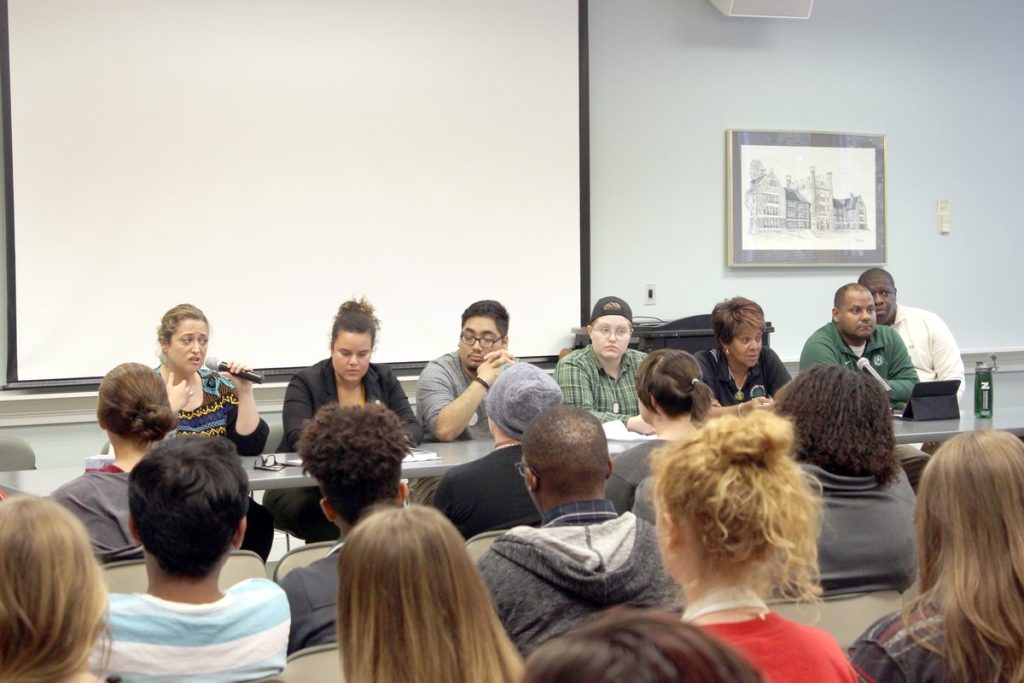
Members of a panel discuss the importance of using preferred gender pronouns during a town hall gathering at Northwest on Wednesday night. Pictured are, from left: Northwest professor Cris Jacobsen, Student Success Center adviser Lauren Shackleford, students David Anzures and Ju McKinley, Juanita Simmons, vice president of Diversity, Equity, and Inclusion and residence hall director Andre Brown.
Following a risqué editorial in last week’s edition of the Northwest Missourian campus newspaper, Northwest Missouri State University’s Office of Diversity, Equity, and Inclusion hosted a town hall Wednesday night on the topic of gender pronouns.
The event took place in the J.W. Jones Student Union Boardroom and featured a panel of people from many parts of the Northwest community. Justin Mallett, director of Diversity, Equity and Inclusion, said the panel was put together to bring several unique perspectives to the discussion.
Psychology professor Cris Jacobsen, Student Success Center advisor Lauren Shackleford, students David Anzures and Ju McKinley, Juanita Simmons, vice president of Diversity, Equity, and Inclusion and residence hall director Andre Brown made up the panel. More than 100 people attended the event, which Mallett said he hoped was only the beginning of the campuswide conversation on the issue.
To open the discussion, Shackleford, Anzures and McKinley informed the audience of several terms to set up the overarching conversation. Among those was the term “non-binary,” to which McKinley ascribes.
“Being non-binary means you exist or identify outside of the binary genders,” McKinley said. “It’s an umbrella term that encompasses just about everyone between male and female identification.”
McKinley prefers the gender-neutral plural pronouns “they/them/theirs,” a preference which sparked the editorial piece in the campus newspaper. The author of The Stroller, which reportedly changes weekly, wrote about when they ran across a person who identified as gender non-binary and expressed confusion at a singular person using plural pronouns.
The editorial had incorrectly described the person as a woman and initially used feminine pronouns to describe them in print, thereby creating a need for the town hall. Shackleford said that using a person’s preferred pronouns is an important way to show basic respect for that person.
“When you use the pronouns someone prefers, it honors their wishes and validates them as people,” Shackleford said. “It’s okay to ask someone what pronouns a person prefers, and it can go a long way to make people feel welcome.”
“It feels great when people ask me what I prefer,” McKinley added. “I feel validated as a human when someone asks me and then uses the pronouns I prefer.”
Brown then followed up that discussion by talking about Northwest’s moves to provide gender-neutral housing on campus. He said the mission is to help students feel safe.
“It’s impossible to feel safe if you don’t feel accepted,” Brown said. “We must support a person’s identity in whatever way we can.
“When it comes to gender-neutral housing, if there are any issues, please come talk to us. We can make accommodations as needed.”
Jacobsen then discussed making accommodations in the classroom. She said the first thing she does each semester is send each of her students an e-mail asking for their preferred name and pronouns.
“I also let people introduce themselves to the class instead of calling out the roll on the first day so that they have a chance to tell the class who they are,” Jacobsen said. “If they’re not on my list, I ask to see them afterward so that we can clear it up.
“Instead of addressing the class as a whole as ‘ladies and gentlemen,’ ‘guys and girls’ or anything like that, I use ‘friends,’ ‘siblings’ or ‘neighbors.’ These are small changes that anyone and everyone can make to the way they run their classrooms that can go a long way to making all students feel welcomed.”
From there, Mallett discussed the many affiliates that the office of Diversity, Equity, and Inclusion has to make sure people feel safe and welcome at Northwest. Simmons followed up on this part of the discussion by talking about the administration’s efforts to be more accepting of people with different gender identities.
At this point, Mallett opened the mic to accept questions from the audience. One member asked how to reach to those who were not in attendance and change minds.
“What it comes down to is working these things into conversations that you have day to day,” Anzures answered. “Now that you’ve been to something like this, you know what it is we’re talking about. So, you can talk about it with others now.”
“We all have to adopt an attitude of civility,” Simmons added. “What that means is, though we don’t know everything, we’re willing to learn, listen and practice civility by respecting each other’s individuality.”
Overall, the panelists agreed, the conversation needed to keep going after the forum ended in order to create lasting and significant change.
As his first Town Hall event wrapped up, Mallett expressed excitement at a successful start to the conversation.
“We’ve opened the lines of communication here so that we can spread the knowledge throughout the campus community and the community at large,” Mallett said. “I’m happy for the amount of people who came, and it’s really an encouraging sight to see as we start to plan other discussions on other topics related to diversity, equity and inclusion.”