‘Bonnie & Clyde’ rifle still part of Sheriff’s Office arsenal
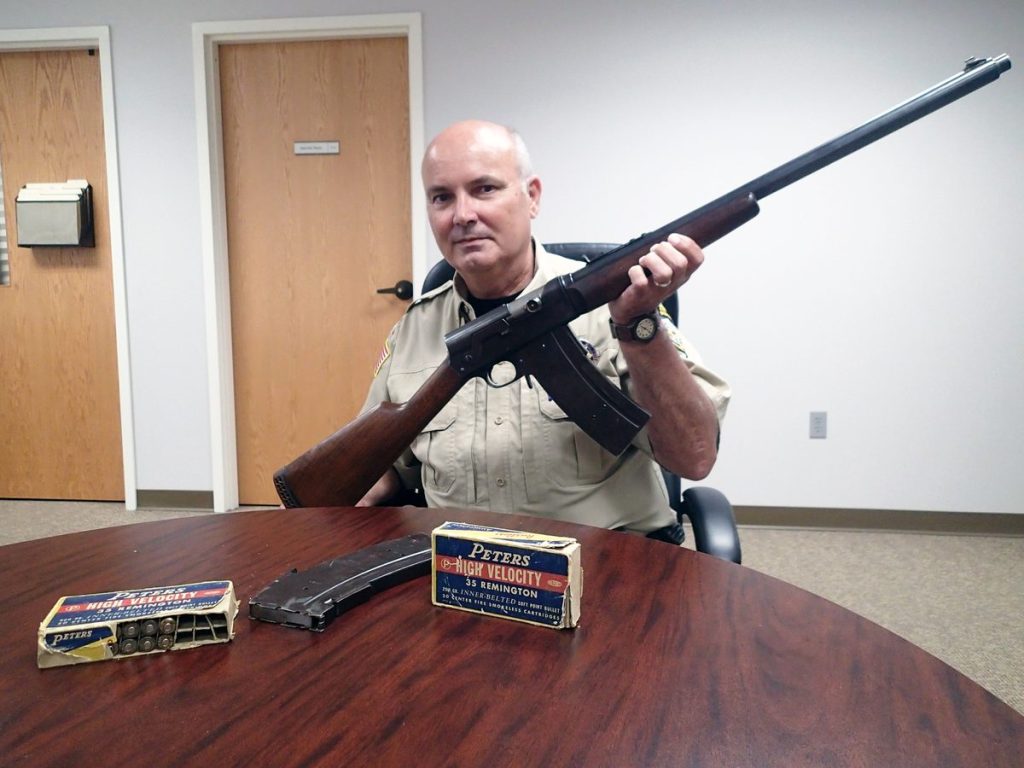
TONY BROWN/DAILY FORUM
Nodaway County Sheriff Randy Strong displays a Remington Model 8 rifle, a pair of 15-round magazines, one fixed in the rifle, and two boxes of vintage Remington .35-caliber ammunition. The rifle, virtually identical to two of the firearms used to cut down notorious 1930s outlaws Clyde Barrow and Bonnie Parker, was acquired by the Sheriff’s Office in April 1934, almost exactly a month before “Bonnie and Clyde” died in a hail of gunfire on May 23, 1934, on a back road in Bienville Parish, Louisiana.
On Thursday April 26, 1934, the front page of the evening edition of the Maryville Daily Forum carried the following item:
“DALLAS, Tex. (AP) — Raymond Hamilton, erstwhile pal of Clyde Barrow and, like the latter, one of the Southwest’s most widely sought desperadoes, occupied a cell in the Dallas County jail today while the wheels of justice moved swiftly for his trial for the capital offense of participation in the March 19 robbery of the Grand Prairie State Bank.”
On the same front page is this bit of copy: “Two guns ordered by the (Nodaway) County Court arrived today from the Remington Arms Co. One is a riot gun (shotgun), and the other a rifle that shoots a bullet that will pierce the engine of an automobile. … The cost of the two guns was around $100. A stock of ammunition for these guns has been received by Sheriff (Edwin) Wallace.”
Though the editor couldn’t have known it at the time, the two stories are linked.
The tie is that the rifle purchased by the Sheriff’s Office was the same basic model as two firearms owned by legendary Texas lawman Frank Hamer. Both guns — state of the art at the time — were used during the ambush in which Hamer and five other officers killed Barrow and his lover Bonnie Parker.
Barrow and Parker — known to the world as Bonnie and Clyde — died in a hail of gunfire on May 23, 1934, on a backroad in Bienville Parish, Louisiana.
During their brief, violent career at the height of the Great Depression the couple got close to Maryville, most famously in July 1933 during a northwest Missouri gunfight when lawmen tried to apprehend the gang at the Red Crown Tourist Court south of Platte City.
Bonnie and Clyde shot their way out of the trap, but it was the beginning of the end. Clyde’s brother Buck suffered a mortal head wound, and Buck’s wife, Blanche, was nearly blinded by bullet-shattered glass.
During such times, and in this part of the country, it must have seemed plain common sense for Nodaway peace officers to acquire a weapon like the Remington Model 8.
In the bandit era of the early and mid 1930s, when outlaws armed themselves with the Browning Automatic Rifle and Thompson submachine guns, peace officers generally carried .38-caliber revolvers or even Old West-style single-action pistols.
That allowed criminals like John Dillinger, “Baby Face” Nelson and “Pretty Boy” Floyd to rampage across the Midwest and South packing incredibly powerful weapons that law officers of the day simply couldn’t match.
It took a while, but slowly police departments and sheriff’s offices, hampered by Depression-era tax revenues and citizen resistance to heavily armed officers, began to catch up.
The Model 8 rifle, designed by John M. Browning, was produced from 1911 until 1936. And the one purchased 83 years ago by Sheriff Wallace now occupies pride-of-place in the office of Wallace’s modern-day successor, Sheriff Randy Strong.
Strong, who spent most of his 30-plus-year career as an officer and detective with Maryville Public Safety, said that he remembers the rifle as being part of the Sheriff’s Office arsenal in the early 1980s, still on the inventory but basically retired.
After taking office in January, Strong said he found the rifle stored in a gun cabinet in his new office, cleaned and in excellent condition. There were also a couple of 15-round magazines, manufactured and retrofitted by the Peace Officer Equipment Co. of St. Joseph, and two boxes of .35-caliber Remington centerfire cartridges.
Model 8s, later designated as Remington’s Model 81, are prized by collectors as one of the first genuinely practical semiautomatic rifles, and any number of these recoil-operated firearms, with their fixed five-round magazines and reciprocating barrels, are used by hunters and marksmen to this day.
But Strong, something of a romantic when it comes to vintage weapons, looks at Nodaway County’s Model 8 as a window into the past.
“I want to know the history of it,” he said. “I’m a firearms enthusiast, especially when it comes to the tools used by the military and law enforcement. These guns changed the people who used them to protect others and to protect themselves. They show battle scars like the people who carried them.”
Strong said he hasn’t fired the Model 8 and doesn’t plan to. He is considering breaking it down and cleaning it, or having the job done by an expert, and mounting the weapon for display in the Sheriff’s Office area of the Nodaway County Administration Building.