Friends find adventure on African odyssey
SUBMITTED PHOTO
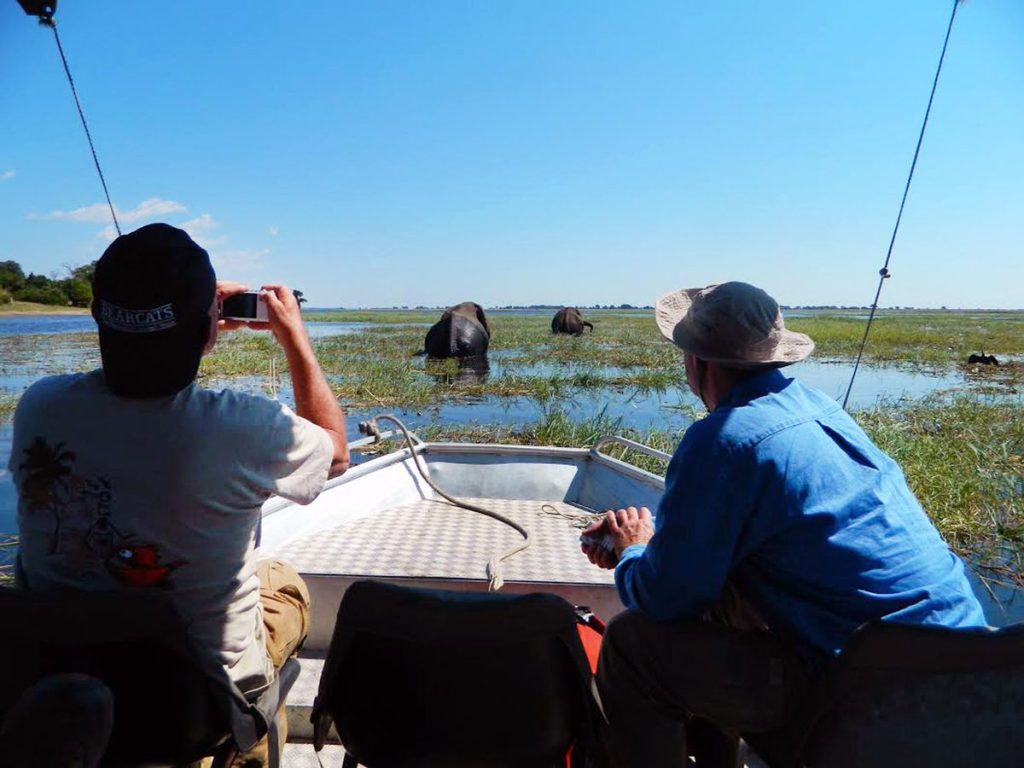
Gary Coenen, left, and Eric Nelson, both of Maryville, observe a pair of elephants moving through a swamp-like portion of the Okavango Delta during a recent trip to the south African nation of Botswana. The men were accompanied by Jeff Smith, a local builder who spent several years in Botswana working as a Peace Corps volunteer, contractor and wildlife sanctuary manager.
Two Maryville businessmen recently returned from the vacation of a lifetime — two weeks of walking, canoeing, hitchhiking and busing their way through the villages, rivers and open savannah of Botswana in southern Africa.
Gary Coenen, who owns and operates Coenen Enterprises, a lighting and electrical contracting firm, and Eric Nelson, who owns and operates Nelson Plumbing, were accompanied on their adventure by local builder Jeff Smith. Jim Moody, a structural engineer from St. Louis, also made the trip.
Smith lived and worked in Botswana for a number of years, first as a member of the Peace Corps in the late 1980s and early ’90s and later as a private contractor. His last extended visit to the continent, with his wife, Gina, was in 2006-2007.
Both Coenen and Nelson said Smith’s experience made traveling through the backcountry of one of the most sparsely populated countries in the world — Botswana is about the size of France and contains only 2 million people — a much more rewarding experience that it would have been otherwise.
Many of the people the men met were friends and acquaintances Smith acquired while working in the Peace Corps or during his time creating and managing a 90-square-mile wildlife sanctuary near the village of Nata.
“That’s one thing that sticks out in my mind,” Nelson said, “the respect these people had for Jeff. Wherever we went, whatever town we were in, Jeff had a contact.”
Traveling with someone who knows the region intimately meant the group was able to steer clear of Botswana’s many tourist draws and experience the country in a way few visitors can.
“We saw the culture and the people,” said Coenen, who described visiting free-range “cattle posts” and small farms where families raise corn, sorghum and beans along with goats and sheep.
But some famous sights are just too amazing not to see if you happen to be in the neighborhood. So while in Africa the group did manage a side trip to Victoria Falls — the world’s largest sheet of falling water — and also spent time in the neighboring countries of Zambia, Namibia and South Africa.
Nevertheless, the heart of the trip was spent in rough country, sleeping in tents and riding in guide-poled canoes through the Okavango Delta, a swampy region surrounding the Okavango River as it flows through a gigantic basin in the Kalahari Desert.
This place isn’t like the Mississippi Delta where water runs on to the sea. Instead, water flows into the Okavango region, but doesn’t flow out. It simply evaporates or is absorbed by plants and transpired.
As a result, the Okavango is one of the most exotic natural wonders on the planet.
So it was fitting that a canoe excursion through the delta produced one of the trip’s more memorable episodes — a too-close-for-comfort encounter with a hippopotamus.
After tenting for the night on a small island, the Maryville travelers boarded fiberglass canoes and headed for their next destination. But the hippopotamus in question was apparently not all that pleased to have company.
“Out he came,” Coenen said, “and he was not happy.”
The group’s guide took the traditional steps in such an emergency, which amount to banging on the side of a canoe with your pole and yelling.
“We sailed right on by it, but it couldn’t have been more than 15 or 20 feet away,” Coenen said.
“Yes, four or five yards,” Nelson agreed. “That was an adrenalin rush.”
Returning later that day from another island, the group encountered what was apparently the same hippo at about the same spot — and decided to take a different route back to camp.
At other times during their stay, the Missourians encountered a host of other kinds of wildlife, including elephants, wildebeests, giraffes, buffalos, hyenas, zebras and wild boars.
After returning to the United States, however, both Coenen and Nelson agreed it was the people who made the trip, not the animals.
Throughout their time in Africa, the men said, the Botswanans treated them with unfailing courtesy and kindness.
“Once you got a rapport built up with them, they take care of you,” Coenen said.
While many Americans may envision Africa as a place filled with hunger and poverty, Botswana is not like that. The people may not have much, Nelson said, but they have enough, and they are proud to share it with guests.
Formerly one of the poorest countries anywhere, over the last several decades Botswana has created one of the fastest-growing economies in the world with a heavy emphasis on mining, cattle and tourism. Since becoming independent from Great Britain on the mid-1960s, the nation has also maintained a strong tradition of stable government, with a consistent record of democratic elections.
“You never want to eat everything on your plate,” said Smith, who sat in on the interview for this article with Coenen and Nelson. “They’ll think you didn’t get enough and prepare more food the next day.”
Another cultural habit Botswanans have, Smith said, has to do with handling their currency, the pula.
When giving a bill to someone, he said, one does it with both hands or by placing the empty hand on the arm offering the money.
This is because, in Botswana, money represents not only what it can buy also the value of the labor done by the person who earned it.
Smith said Coenen and Nelson both worked to absorb such insights and showed respect for their hosts and their hosts’ culture.
“Those are the kind of people I want to go on a trip with,” he said.
Quite a vacation — and Nelson remarked that he returned to Missouri with one especially valuable mental souvenir.
“I was so impressed that there seemed to be zero race issues in Botswana,” he said, noting that four white men, very much in the racial minority, could go anywhere and talk to anyone without a remark or second glance.
“It’s too bad the U.S. couldn’t be the same way.”
SUBMITTED PHOTO
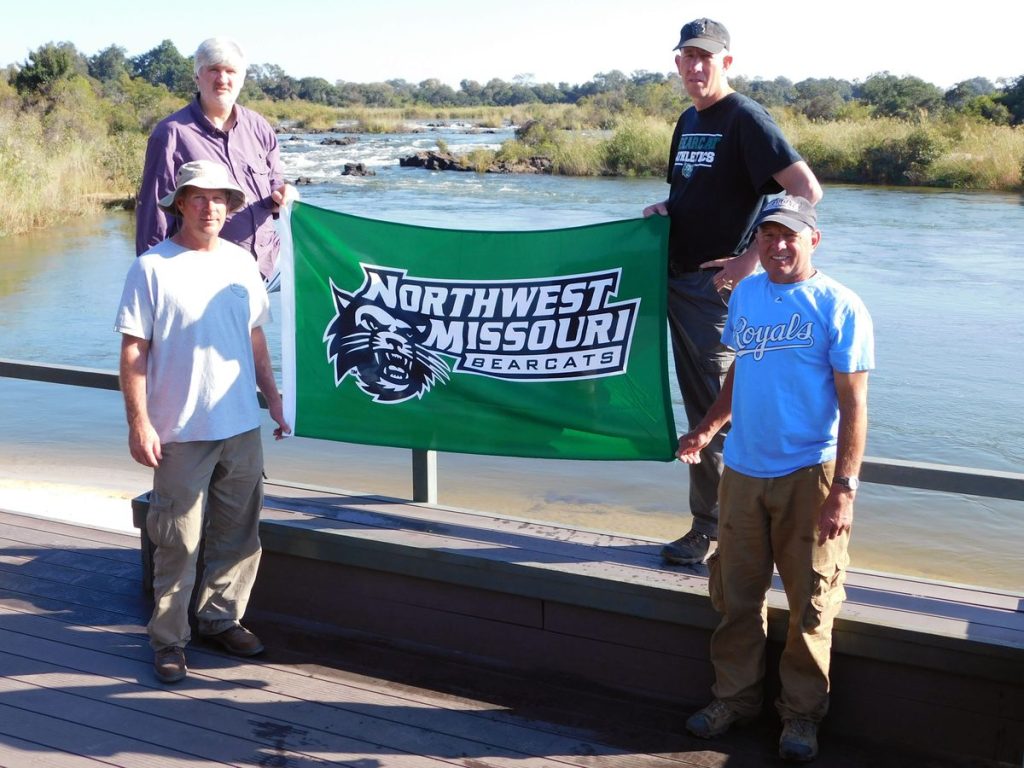
Four Missourians, three of them Maryville residents, are shown during a recent trip to the south African nation of Botswana. Pictured clockwise from top left are Jim Moody, a structural engineer from St. Louis; local builder Jeff Smith; and Maryville business owners Gary Coenen and Eric Nelson.